LONDON (AP) — Meta was punished Friday with a fine worth more than $100 million from the social media giant's European Union privacy regulator over a security lapse involving passwords for Facebook users.
The Irish Data Protection Commission said it slapped the U.S. tech company with the 91 million euro ($101.6 million) penalty following an investigation.
The watchdog started investigating in 2019 after it was notified by Meta that some passwords had been inadvertently stored internally in plain text, which means they weren't encrypted and it was possible for employees to search for them.
Deputy Commissioner Graham Doyle said it's “widely accepted” that user passwords should not be stored in plain text, "considering the risks of abuse.”
Meta said a security review found that a “subset” of Facebook users' passwords were “temporarily logged in a readable format.”
“We took immediate action to fix this error, and there is no evidence that these passwords were abused or accessed improperly,” the company said in a statement. "We proactively flagged this issue to our lead regulator, the Irish Data Protection Commission, and have engaged constructively with them throughout this inquiry.”
It's the latest in a series of hefty fines for Meta and its social media platforms from the Dublin-based watchdog, which is the company's lead regulator under the 27-nation EU's stringent data privacy rulebook. They include a 405 million euro fine for Instagram over mishandling teen data, a 5.5 million euro penalty involving WhatsApp and a 1.2 billion euro fine for Meta over transatlantic data transfers.

Meta hit with $102 million privacy fine from European Union over 2019 password security lapse

FILE - In this May 16, 2012, file photo, the Facebook logo is displayed on a mobile device in Philadelphia. (AP Photo/Matt Rourke, File)

Meta hit with $102 million privacy fine from European Union over 2019 password security lapse
Doc Rivers needed some time to write the speech that he'll give when formally inducted into the Naismith Memorial Basketball Hall of Fame.
The storytelling, that part was easy. He's a natural at that.
But what Rivers wound up learning during the trial-and-error process of speechwriting was that the words he'll say from a stage in Springfield, Massachusetts aren't going to be about him. They're going to be about everyone else who played a role in him getting to that moment.
“You go through this journey of writing it and you realize it has nothing to do with you in a very good way,” Rivers said. “People are happy for you, and I am happy for them because they got me there. You hear all your life, ‘You don’t do anything alone.' When you get in the Hall of Fame, you really understand that you don’t do anything alone. It's all the coaches in your life, your parents, the players. It's a thankful journey and that’s what the Hall of Fame should be about."
A winner of 1,194 regular season games as an NBA coach — and that'll be all, he insists, saying his retirement is a real one — Rivers ranks sixth in league history. The only others ahead of him: Gregg Popovich, Don Nelson, Lenny Wilkens, Jerry Sloan and Pat Riley, all of whom are Hall of Famers, so it was obviously a lock that Rivers would be joining them.
He won a championship with Boston in 2008, won 114 playoff games as a coach, played 13 seasons, was an All-Star once, has been a broadcaster and — if he goes back to work, and his family currently has a pool that he will — he'll be a broadcaster again.
But there's more to life now. The Illinois native and Marquette legend has seven grandchildren, a house on the water and can't play enough golf. He'll still be involved in the game, somehow. It just won't be as a coach. It'll be as a Hall of Famer.
“Doc is a proven, extraordinary leader and communicator during his renowned NBA coaching career,” Milwaukee general manager Jon Horst said when the Bucks hired Rivers in 2024. “As a championship coach, he’s widely respected as an established innovator, and the right coach to lead our experienced and talented team."
He was, until he wasn't.
Injuries derailed every chance the Bucks had at being a winner this past season, and when the season came to its dismal close Rivers was fairly certain it was the end for him as well — after 27 seasons on the sideline, and whole lot of missed moments along the way.
“The one thing that people have no idea about is the toll it takes on you and the family component," Rivers said. "It is rough. You’re never home. You make sacrifices and your family has to make them as well.”
That won't be an issue now.
Rivers won coach of the year in his very first season, taking a team he called “the 301s” in Orlando and leading it to a 41-41 record. On the surface, there's nothing special about going .500. But the Magic were supposed to be bottom dwellers that season and Rivers used a preseason ranking of the league's top 300 players as inspiration — since none of those top 300 were playing for the Magic.
“That season gave me great confidence,” Rivers said.
He has some regrets, of course. Critics have long pointed to the 10 losses that Rivers-coached teams had in Game 7s, by far the most of any coach in NBA history. And his fans will retort by pointing to his 114 playoff wins, fourth-most in NBA history. But the biggest do-over, if Rivers had such an option, would be changing his mind about leaving the Celtics for the Los Angeles Clippers in 2013.
Rivers got to the Clippers not long before the end of Donald Sterling's ownership of the team; Sterling made racist comments and wound up getting banned by NBA Commissioner Adam Silver.
“I underestimated what a great situation I was in, and I took that for granted, like you can just go anywhere and create that," Rivers said. “I messed that one up. But then when I go to the Clippers, the team is pretty damn good. The organization, it was the worst organization in sports with the ownership problem. Within a week there, I remember telling my assistant, ‘We’ve got a lot to do here.'”
The championship with the Celtics in 2008 — Ray Allen, Paul Pierce and Kevin Garnett, the stars of that team, will be together again to present their former coach for his Hall enshrinement — was an obvious high point for Rivers' career. There were other moments he's particularly proud of as well, such as delivering on a promise that he made to someone who barely played for him.
Tyronn Lue succeeded Rivers as coach of the Clippers. Lue played 11 games for Rivers in Orlando during the 2003-04 season; that was all the time it took for Rivers to be convinced that Lue would one day be a coach. He told Lue to call him if he ever wanted a job and Lue took him up on it. Rivers wound up going to the Hall of Fame, and few within the game would be surprised if Lue joins him there one day.
“It's the stories like that that you think about,” Rivers said. "Rajon Rondo played for me in Boston. We had a very tumultuous relationship when I coached him and now, I probably talk to Rondo more than probably than any player that I coached.”
It's what the game does, Rivers said. The lucky ones get guided along the way. He played that role with players like Rondo — who coached with Rivers — and Lue, and in Rivers' own case, it was Riley who gave him the push he needed.
Riley and Rivers clashed at times in their player-coach relationship, and their biggest fights came when Riley was telling Rivers that he belonged in coaching.
Riley was right.
“When I was doing TV, he kept writing and sending me these freaking messages about getting into the fray," Rivers said. “He knew it. And here I am, going into the Hall of Fame.”
AP NBA: https://apnews.com/nba
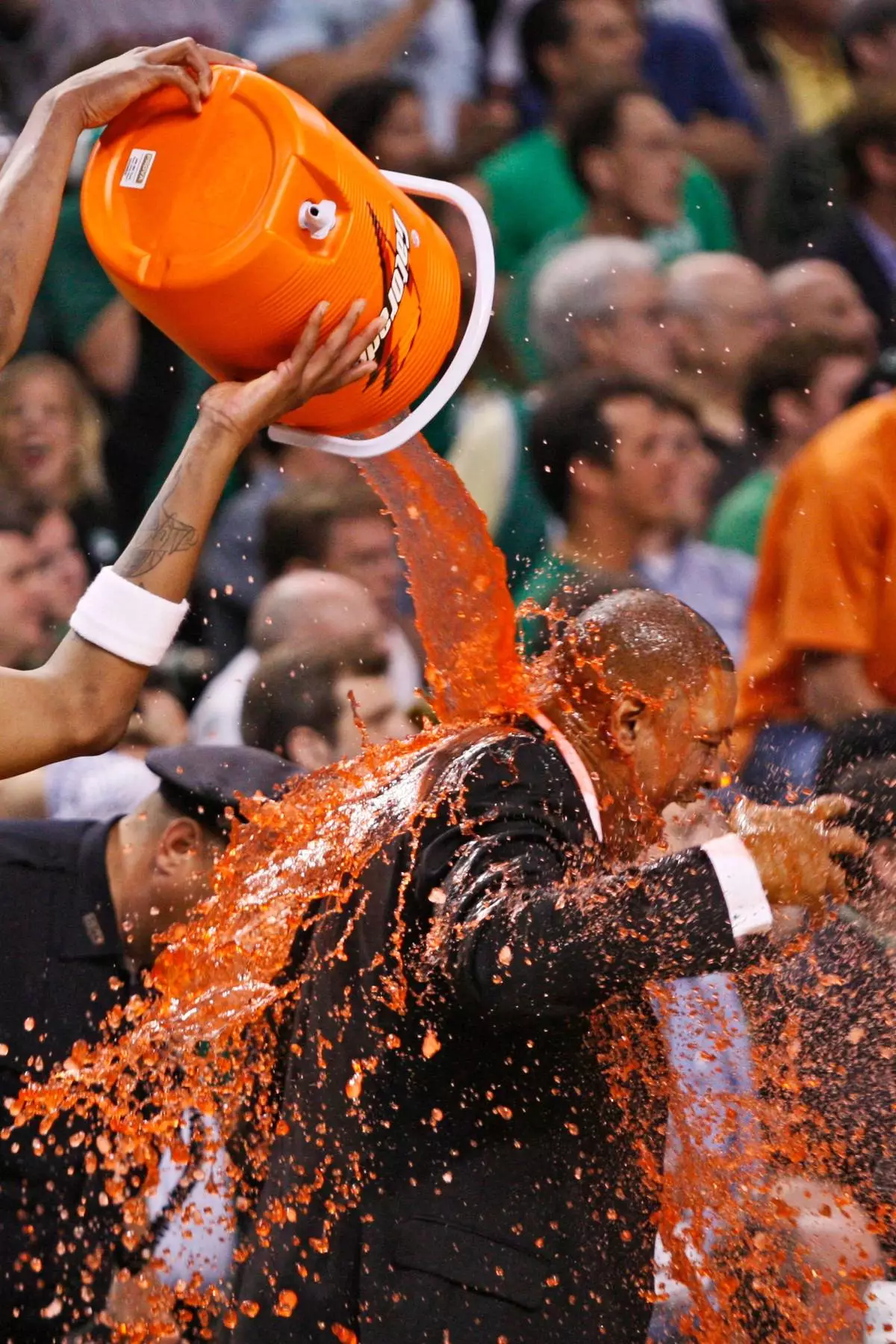
FILE - Boston Celtics coach Doc Rivers gets a Gatorade shower from Paul Pierce as the Celtics win the NBA Championship over the Los Angeles Lakers in Game 6 of the NBA basketball finals, June 17, 2008, in Boston. (AP Photo/Elise Amendola, File)
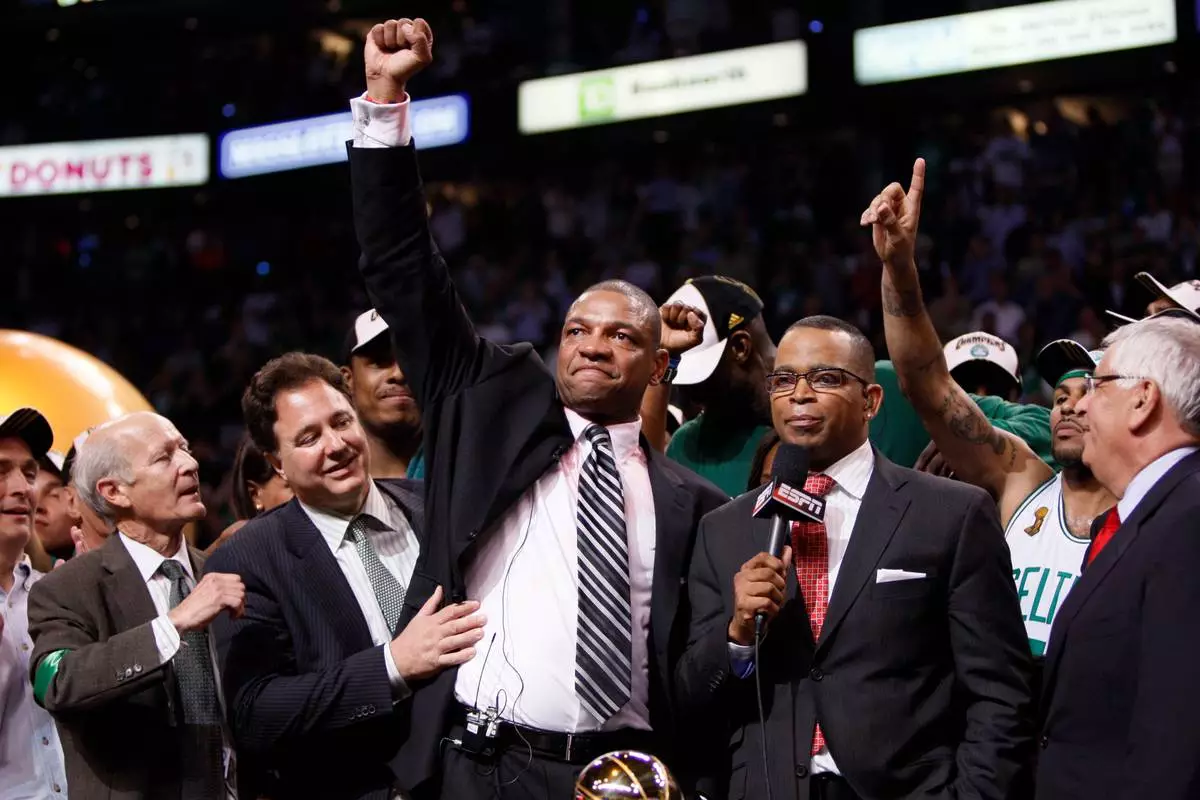
FILE - Head coach Doc Rivers and Boston Celtics team owner Steve Pagliuca, second from left, celebrate after defeating the Los Angeles Lakers in Game 6 of the NBA basketball finals, June 17, 2008, in Boston. (AP Photo/Elise Amendola, File)
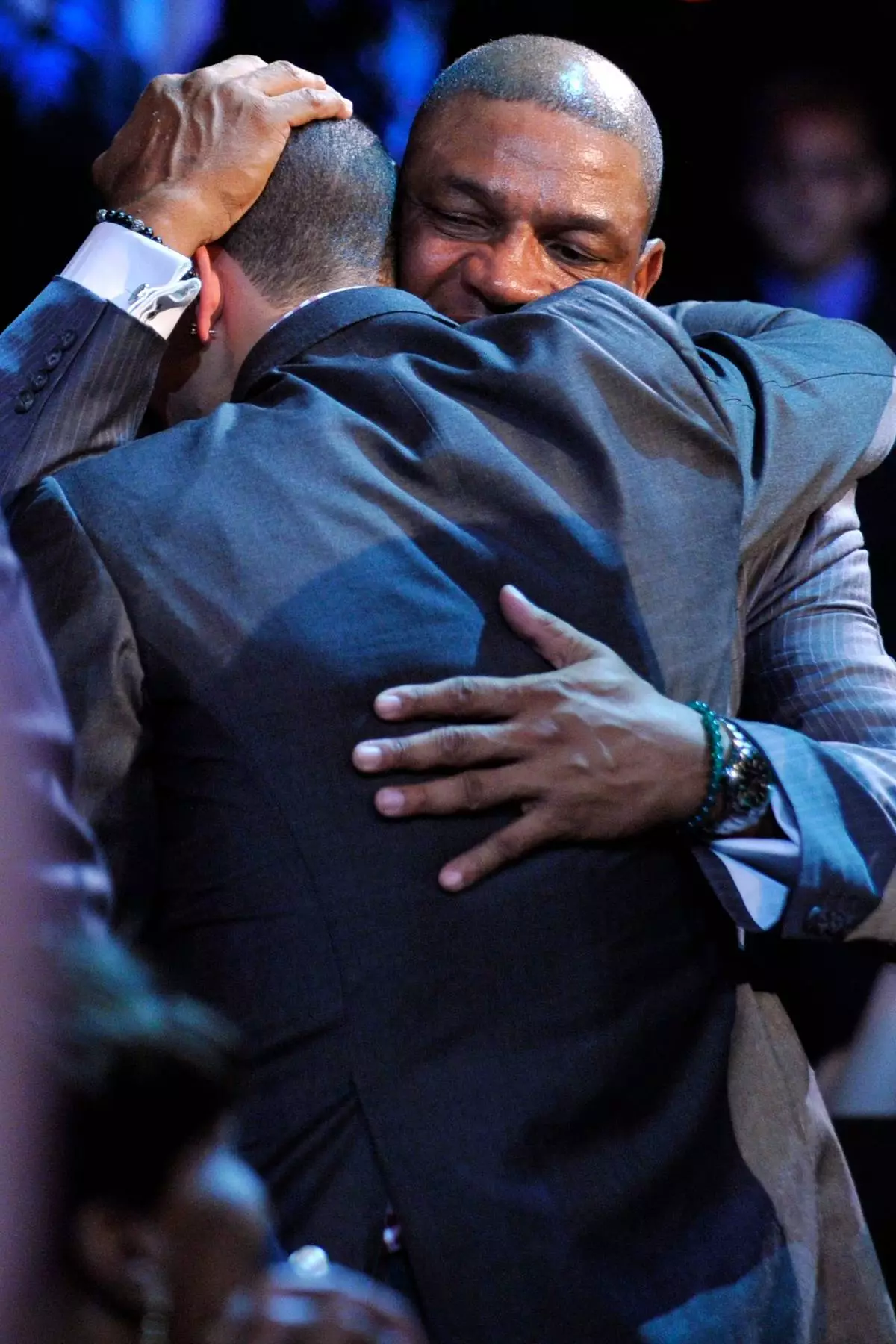
FILE - Boston Celtics head coach Doc Rivers, rear, hugs his son, Duke's Austin Rivers, after Austin was selected as the No. 10 overall draft pick by the New Orleans Hornets in the NBA basketball draft, June, 28, 2012, in Newark, N.J. (AP Photo/Bill Kostroun, File)
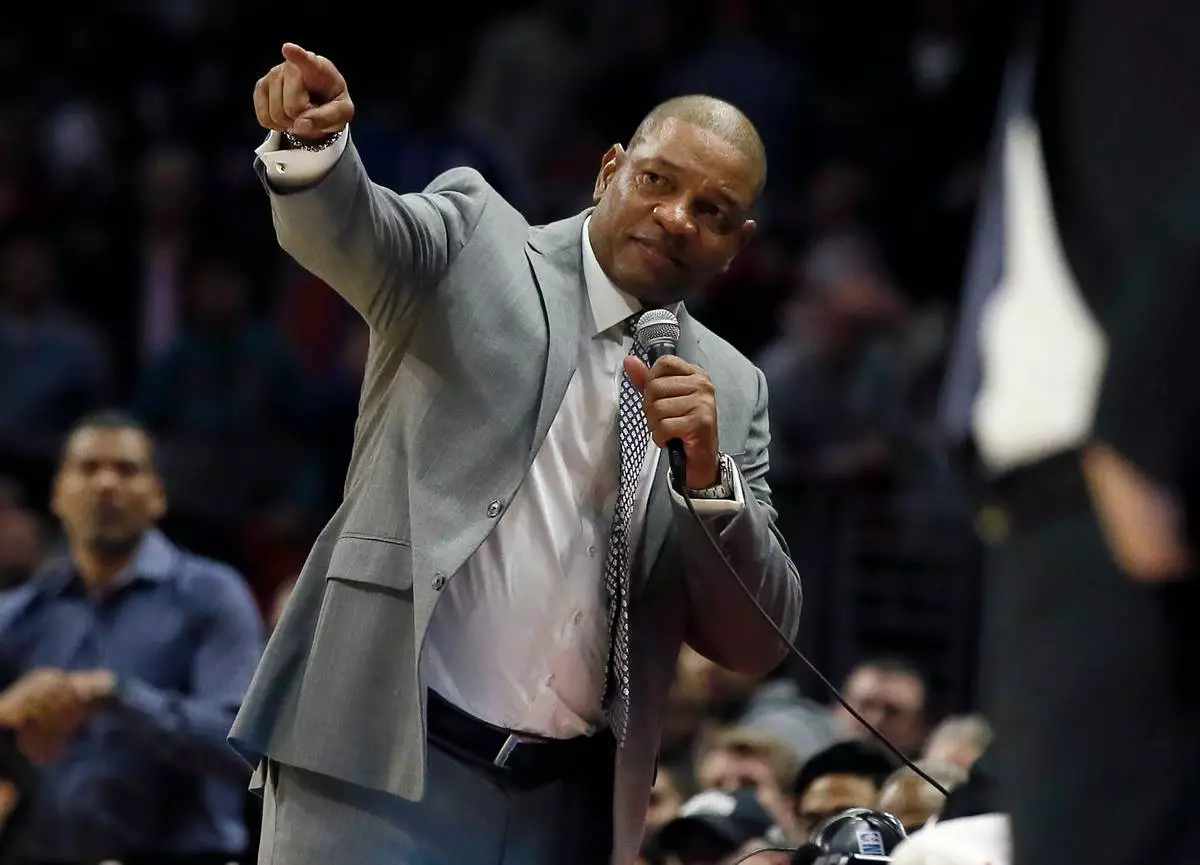
FILE - Los Angeles Clippers head coach Doc Rivers stops the game with 9.4 seconds left during the second half of an NBA basketball game to honor Dallas Mavericks forward Dirk Nowitzki in Los Angeles, Feb. 25, 2019. (AP Photo/Alex Gallardo, File)
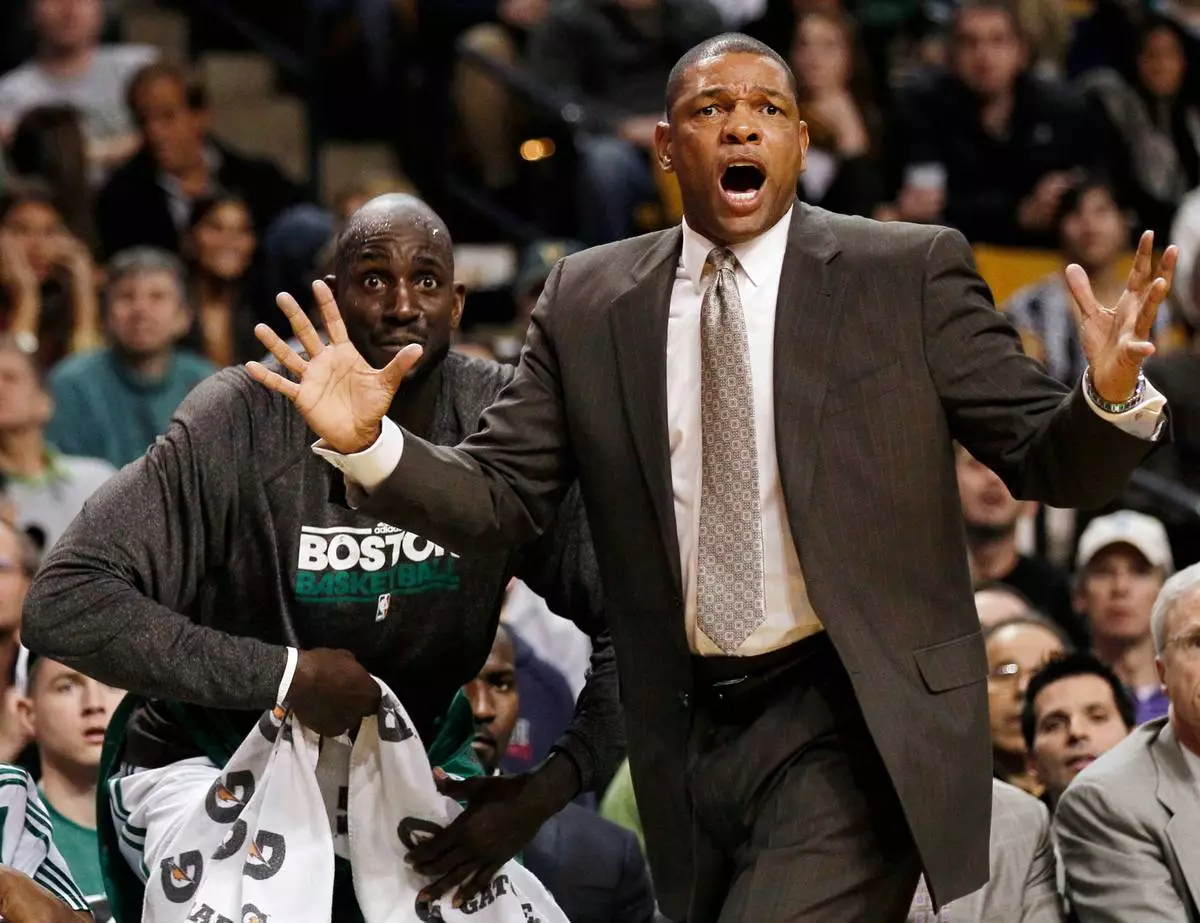
FILE - Boston Celtics coach Doc Rivers shouts at a referee as Kevin Garnett looks on during the first quarter of a NBA basketball game against the New Jersey Nets in Boston, Nov. 24, 2010. (AP Photo/Winslow Townson, File)