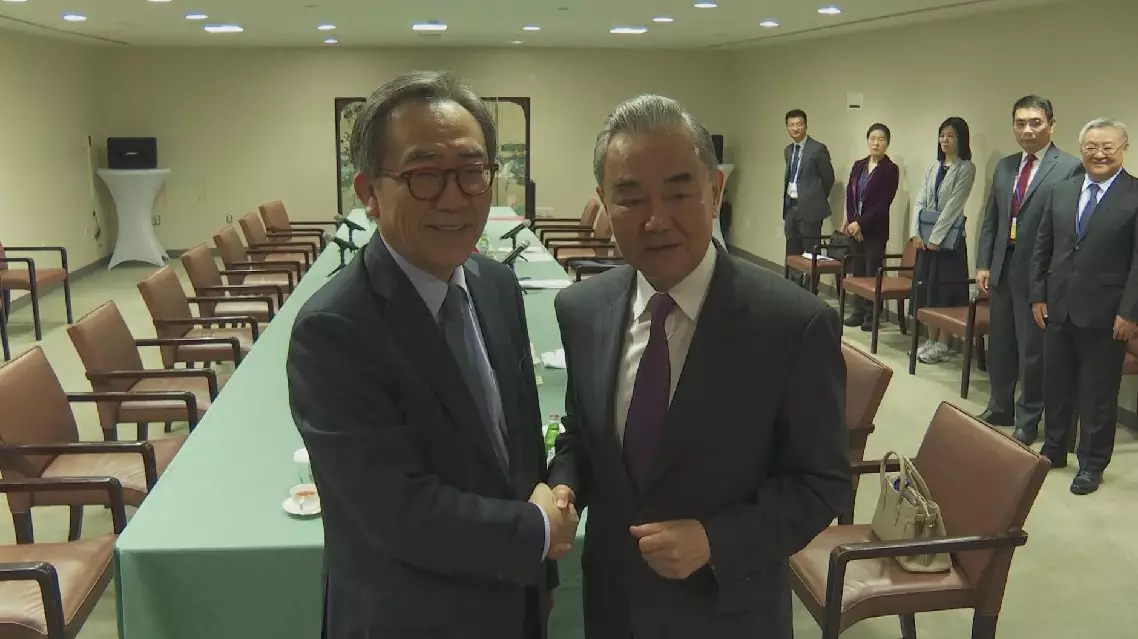
Amid rising global turbulence, unilateralism and protectionism, China and South Korea, as close neighbors and key partners, should collaborate to manage risks and strengthen bilateral ties, said Chinese Foreign Minister Wang Yi in New York City on Saturday.
Wang, also a member of the Political Bureau of the Communist Party of China Central Committee, made the remarks during a meeting with South Korean Foreign Minister Cho Tae-yul.
Wang noted that this year, exchanges and cooperation between China and South Korea have become more active in various fields, and the bilateral relationship has shown a positive trend of improvement, demonstrating that the efforts of both sides are in the right direction with promising results.
He stressed that as long as both countries remain committed to the principles of their diplomatic ties, continue their focus on friendship, and pursue mutual benefit and win-win cooperation, China-South Korea relations will continue to develop healthily and sustainably.
Noting that the close economic ties and intertwined interests between China and South Korea are market-driven and align with their common interests, Wang said China is willing to support South Korea in successfully hosting next year's APEC Economic Leaders' Meeting and advancing regional economic integration.
Emphasizing that the deployment of U.S. intermediate-range missiles in the region undermines regional peace and stability and is not in the interest of regional countries, Wang said that preventing war or chaos on the Korean Peninsula is in the common interest of all parties and China will continue to contribute constructively to long-term peace and stability in the region.
For his part, Cho expressed congratulations on the 75th anniversary of the founding of the People's Republic of China, adding that South Korea-China relations show a good trend of resuming exchanges.
Cho expressed hope that both sides will maintain this positive momentum, strengthen high-level exchanges, and promote the stable development of bilateral relations.
South Korea is willing to enhance economic and trade cooperation with China and jointly promote regional economic integration, said Cho.
Regarding the situation on the Korean Peninsula, South Korea expects to maintain strategic communication with China, Cho said.
China, South Korea should collaborate to manage risks, strengthen bilateral ties: Chinese FM
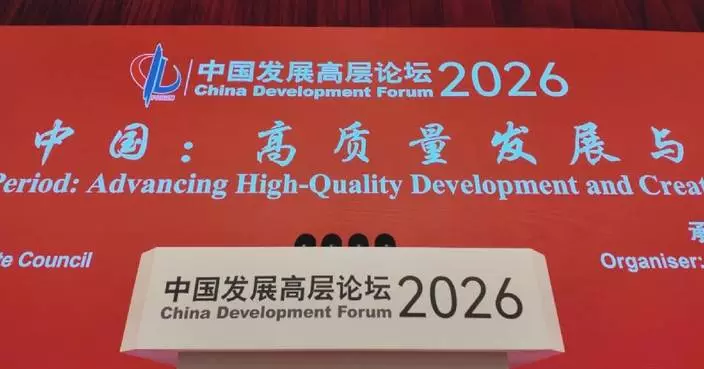
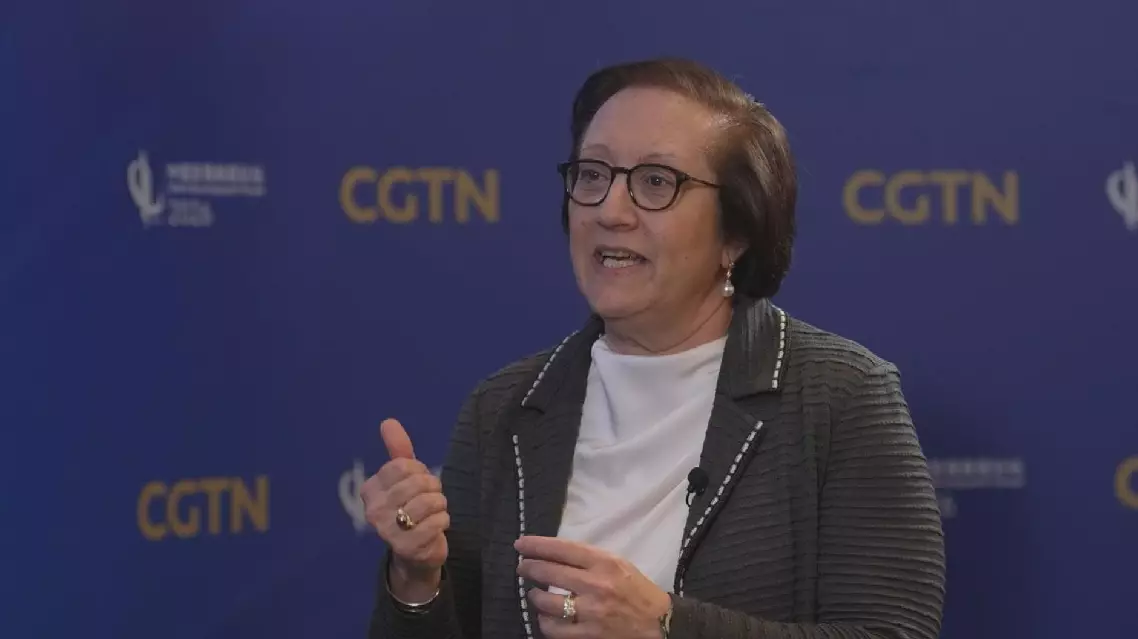
China's development blueprint for the 2026-2030 period will create strong market opportunities for industries worldwide, said Judy Marks, president and CEO of American elevator maker Otis, in Beijing on Sunday. The China Development Forum 2026 began on Sunday in Beijing. With the theme of "China in Its 15th Five-Year Plan Period: Advancing High-Quality Development and Creating New Opportunities Together," the two-day event is bringing together global officials, industry leaders, and experts for 13 thematic sessions and a series of closed-door discussions, covering topics including new trends in consumption growth, green and low-carbon transition, the development of future industries, and the industrial application of artificial intelligence (AI).
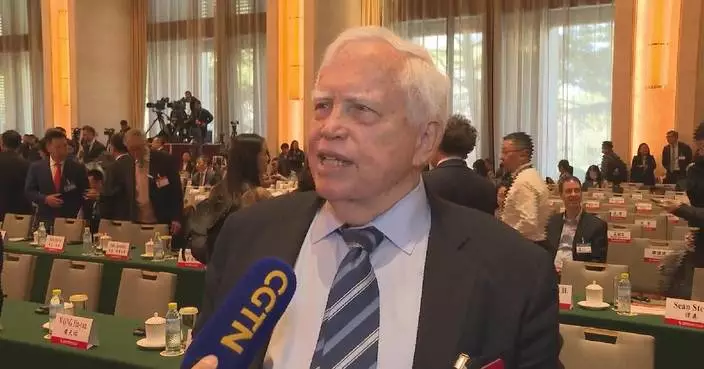
In an interview with China Global Television Network (CGTN) on the sidelines of the event, Marks shared her insights on the significant role of China's research capabilities and market environment for the global economy.
She said that Otis's research and development center in China, leveraging local resources, is well-positioned to advance its innovation strategy.
"So I would tell you to us in China, it's an innovation hub and an agility engine. And, that really describes China for us. We do work in China for China, but we also do both manufacturing and development and research for the rest of the world. And China, in Shanghai, has our largest development team of anywhere in the world. It makes us go faster. It's AI and digital driven -- and it really allows us to set the benchmark," said Marks.
She said that China is advancing rapidly in areas including smart cities and digital infrastructure, developments that will bring new opportunities and shape the future of the global elevator industry.
"Now to us, the world is digital and connected. They're the two highest priorities we have. If an elevator is part of an ecosystem in the building, we can share information with transportation systems, with energy systems. As China pursues even more of a low carbon world, our elevators actually push power back into the building and capture power when they break with our regenerative drives," she said.
Speaking of China's recently-approved 15th Five-Year Plan (2026-2030), aimed at expanding high-level opening up and driving high-quality development, Marks described it as highly encouraging for multinational companies.
"I would tell you everything we see in the 15th Five-Year Plan is encouraging: high-quality development, which is a commitment from the government and the whole ecosystem to serve its citizens, digitalization, urban renewal -- all of this combines. It's created a large market for a company like Otis. It's where we're going to invest, and it's in sync with our strategy and our mission," she said.
China's development blueprint brings opportunities to global industries: Otis CEO