Generations of Chinese researchers have made great strides in pursuing autonomy in the country's semiconductor capabilities, lifting up China from an importer of foreign technologies to a world-leading innovator.
A special report by China Global Television Network (CGTN) outlined the growth of China's computer and semiconductor industries over the past 75 years.
The first part of the special report chronicled China's efficiency in making its first homegrown CPU.
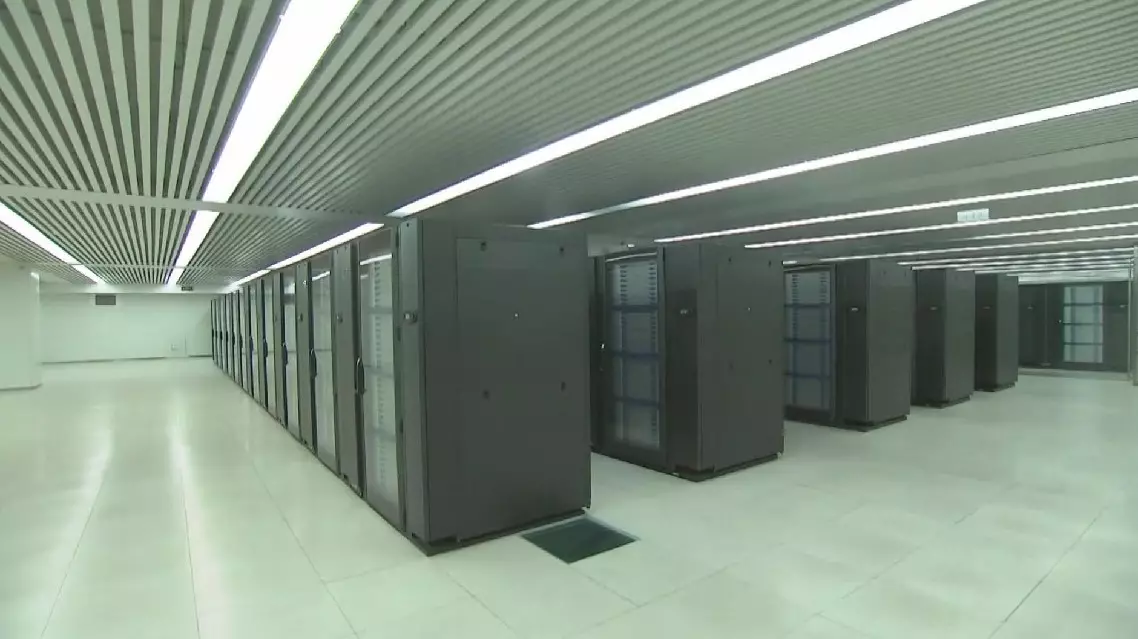
China's homegrown supercomputer Tianhe-3 is now capable of a performance of 2 exaflops.
One exaflop is one quintillion calculations per second. A quintillion has 18 zeros, which is a billion billion. Two exaflops would take an Apple MacBook Pro 16 more than four days.
Yet, it was back in 1958 when the country saw its first computer born. The vacuum-tube computer could only run short programs of 4 instructions.
The hardware was several large cabinets, taking up 40 square meters. It had nearly 4,000 semiconductor germanium diodes and 800 electronic tubes.
"We were very happy, because we had a computer of our own. Before that, we only knew (how to build one) from books. Although we had our first computer, we couldn't be complacent. We had to continue to advance without stopping," said Chen Changlin, a researcher from the Institute of Computing Technology under the Chinese Academy of Sciences (CAS).
This great breakthrough came in when China formulated the 1956-1967 Long-Term National Program for Scientific and Technological Development, designating computers, radio, semiconductors and automation as key areas for urgent development.
This was what famed Chinese Mathematician Hua Luogeng and nuclear physicist Qiang Sanqiang had pushed for.
Semiconductors got priority because they were the core components in computers.
Chinese researchers nationwide collaborated on several types of silicon transistors in the late 1950s. They are basic building blocks of modern electronics. They can be used to amplify or switch electrical signals and power.
Hu Weiwu, the father of China's first CPU, credits the efforts of the country's early researchers.
"My mentors' generation really built the computer from the ore, all by themselves. It was not for the market, but for the 'Two Bombs and One Satellite' project. Their computer met the demand of that research. It also supported tasks such as weather forecasting and oil exploration. It was for national strategic needs. Their generation fulfilled its historical mission well, said Hu, president of Chinese chip designer Loongson Technology.
"Two Bombs" refers to the atomic bomb and the intercontinental ballistic missile, while "One Satellite" refers to the launch of an artificial satellite.
Starting in the 1980s, China's reform and opening-up saw a huge influx of foreign-made electronic components. They became widely popular among Chinese users.
"At that time, foreign CPUs were cheap and user-friendly. In short, it was better to buy than to make them," said Hu.
This mindset once stalled China's electronic research and development, and it took a while before the researchers realized the danger.
"If we are completely dependent on others, we cannot control our information system autonomously, and there will be no security of information," said Wang Endong, academician of the Chinese Academy of Engineering (CAE) and chief scientist of Inspur Group, a leading Chinese cloud computing and big data service provider.
In 1998, computing scientists Jin Yilian, Xia Peisu and Zhou Yulin proposed developing a CPU at the Xiangshan Science Conference held by the Ministry of Science and Technology.
Four years later in 2002, the Loongson-1 was born, China's first homegrown high-end general-purpose CPU. Hu, in charge of its development, recounted the challenges.
"We looked through textbooks and materials for inspiration. The most difficult part was there was no one we could consult. We basically lived in the labs. I remember I barely slept for 7 days except naps from time to time. I got very little sleep," he said,
The developer explained the philosophy behind his commitment.
"Every time we are faced with a major choice, whether it is about an individual, our team or the development of Loongson, the only basis for our choice is to choose a way that is good or that is better for the country and the people. We always choose that way," said Hu.
Chinese scientists' pursuit of CPU autonomy rooted in deep history