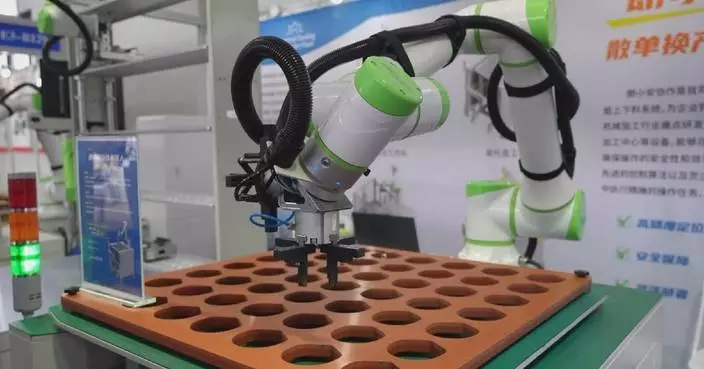
The technological innovation in agricultural equipment and planting methods has significantly strengthened China's agricultural sector by boosting yields and optimizing farming efficiency.
A special report by China Global Television Network (CGTN) sheds light on how technological innovation has propelled China's agricultural industry, benefiting not only its own people but also many in other nations.
After China adopted the reform and opening-up policy, the government carried out campaigns such as "Spark Program", the country' s first agricultural project focusing on technology.
Then came the "Harvest Program", which elevated the pursuit of agro-tech to a national level. It mobilized people from various backgrounds to participate in agricultural innovation.
Wang Leyi, a village Party secretary in Shouguang City, east China's Shandong Province, was one of them.
In 1989, Wang led a group of 17 Party members to experiment on 17 vegetable greenhouses. He adjusted the orientation and the angle of the roofs for maximum sunlight. The greenhouses were a huge success, producing cucumbers that had never been grown in Shandong's winter.
"The production of these 17 greenhouses fell short of demand. Every single cucumber was sold," said Wang.
In the next year, more villagers followed, and 180 greenhouses were built. Now Wang is still the Party secretary, and Shouguang has become a stronghold for vegetable production and a hub for the exchange of innovative farming technologies.
The latest type of greenhouses in Shouguang uses smart technology. The irrigation, ventilation, and temperature control systems can be remotely operated via smartphones, demonstrating how China continually uses modern technology to improve its agriculture industry.
More examples can be found across the country.
In the southwest, farmers grow seeds on robo-rice-transplanters. In the northeast, the smart farming system covers nearly 90 hectares of land in the Jiansanjiang rice production base.
"I set the route with my smartphone and click 'start.' The rice transplanter begins to work. This machine fertilizes uniformly. It sends the fertilizer into the mud, directly to the roots. That's what we call spoon-feeding the crops," said Zhang Liangbao, a farmer at Beidahuang Group Heilongjiang Hongwei Farm.
The development of China's agricultural science and technologies has not only fed its own population and eradicated extreme poverty, but also empowers rural industries and helps ensure food security for people around the world. Juncao technology stands out as a notable example of this.
Juncao, literally translated as "mushroom grass", is a hybrid grass developed by Lin Zhanxi, a professor at Fujian Agriculture and Forestry University.
After decades of research and cultivation, the versatile grass with strong environment adaptability was first used to replace timber for mushroom farming.
In mushroom farming, Juncao technology can substantially lower farming costs, reduce annual tree clearing, and provide an economical and environmentally friendly path for poverty alleviation. In addition, Juncao can be used as livestock forage and poultry feed.
"It grows to 8.78 meters in Fiji, and it's high in protein and can be used to feed live stock and grow mushrooms. It can also be used for thermal power generation, and substitute wood to make slabs and paper," said Lin Zhanxi, chief scientist at China's National Engineering Research Center of Juncao Technology.
In addition, Juncao's leaves, stems and roots are useful for different kinds of ecological management, such as soil erosion control, desertification prevention and saline-alkali soil management.
"Its roots hold the sand like a burlap sack," said Lin.
Professor Lin has been committed to promoting Juncao technology to aid foreign countries, especially the poverty-stricken regions. He simplified the planting process and utilized ordinary items to spread Juncao technology in villages.
"Lin's experiments were conducted under poor conditions, where the incubators were worn out and gasoline drums were used for sterilization. I asked him why. He said the more basic the method, the easier it is to popularize in the countryside. I admired him very much, for he is indeed a farmer's child," said Lin Shuqian, a researcher at China's National Engineering Research Center of Juncao Technology.
"We localize technology and simplify the methods, so that villagers can understand it easily, and they can succeed as long as they learn how to do it," said Lin Zhanxi.
Juncao is planted in many African countries such as Kenya, the Central African Republic and Rwanda, as well as Pacific island countries such as Fiji and Vanuatu.
After years of cultivation, many nations have benefited from Juncao and witnessed its potentials.
"It will really help the farmers. They will just grow the grass and feed the animals. There's no need to worry about buying and having to wait for the next load, [because it is all there]," said Alexander Micky, support officer at the Vanuatu Department of Horticulture.
Now Juncao is one of the key models under the Belt and Road Initiative. And China has pledged more agricultural technological aid to the Global South.
"China will provide Africa with one billion yuan, or about 140 million U.S. dollars for emergency food assistance, build about 6,670 hectares of standardized agricultural demonstration areas in Africa, send 500 agricultural experts and establish a China-Africa Agricultural Science and Technology Innovation Alliance," said Xi Jinping, Chinese president.
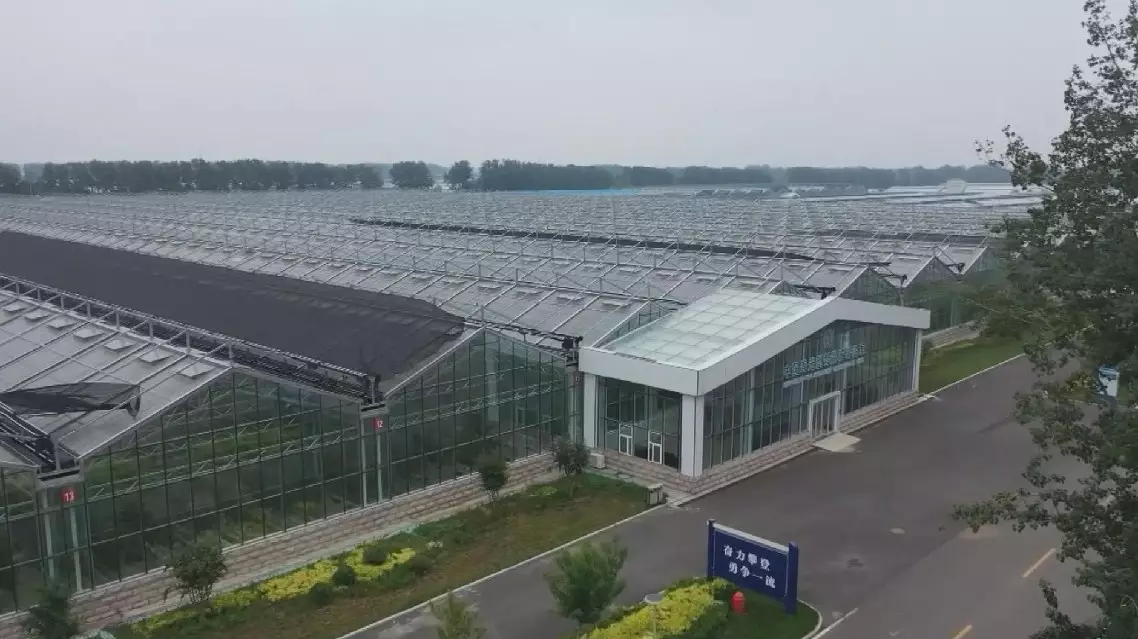
Tech innovation boosts China's agriculture by enhancing yields, farming efficiency
Chinese President Xi Jinping's just-concluded trip to Kyrgyzstan and Egypt demonstrated China's commitment to joining hands with all other countries for development and rejuvenation, and reforming and improving global governance, Chinese Foreign Minister Wang Yi said on Thursday.
Wang, also a member of the Political Bureau of the Communist Party of China Central Committee, made the remarks while briefing reporters on the conclusion of Chinese President Xi Jinping's attendance at the 26th Meeting of the Council of Heads of State of the Shanghai Cooperation Organization (SCO) in the Kyrgyz capital city of Bishkek and state visits to Kyrgyzstan and Egypt.
Wang said the trip, with solidarity and cooperation as its guiding theme, focused on a shared future and advocated fairness and justice.
It holds significant practical and far-reaching implications for building consensus on cooperation among all parties and reforming and improving global governance, he said, hailing the trip as a complete success.
Media outlets both at home and abroad paid close attention to the trip, noting that against a backdrop of deepening geopolitical rifts and challenges to the international order, it powerfully responded to the international community's aspirations for peace, stability, and development, and offered China's solutions and wisdom to a world fraught with turmoil and upheaval, according to the foreign minister, who said that China's image as a reliable partner and a responsible major power has become even more deeply rooted in people's hearts.
The SCO summit in Bishkek injected vitality into regional development through the collective efforts of all parties concerned, Wang said.
The summit also fostered synergy for global multipolarity, and provided fresh impetus for improving global governance, which once again demonstrated the vitality and capacity for action of the organization, he said.
At the Bishkek Summit, Xi said the SCO's most significant achievement has been its gradual transformation into a new type of regional cooperation organization that spans the largest geographical area, represents the largest population, and possesses enormous development potential in the world.
He said the SCO's most valuable spiritual asset is the pioneering initiative of and steadfast adherence to the "Shanghai Spirit" of mutual trust, mutual benefit, equality, consultation, respect for diversity of civilizations and pursuit of common development.
The SCO's most important experience for cooperation is that it has found the right way of coexistence featuring non-alliances, non-confrontation and not targeting any third party, while bringing countries in the region together to build a common home, he added.
Xi put forward a four-point proposal at the summit: stay committed to putting development first, and open up the prospects for shared prosperity; stay committed to taking security as a key goal, and foster an environment of common security; stay committed to a people-centered approach, and cement the foundation for everlasting friendship; and stay committed to dialogue and consultation, and strive for more equitable and orderly governance.
Wang recalled last year's SCO Tianjin Summit, where Xi and leaders of other SCO member states charted a blueprint for the organization's development over the next decade, ushering in a new stage of high-quality development for the SCO. The outcomes of the summit are being implemented at an accelerated pace, he noted.
At this year's SCO summit, Wang said, the strategic blueprint drawn up in Tianjin is gradually becoming a reality, with the organization's structure becoming more optimized, its operations more efficient, and its cooperation more effective.
Xi's state visit to Kyrgyzstan strengthened the bonds of permanent good-neighborliness and friendship between the two countries, Wang said.
It also opened up new prospects for shared prosperity, deepened commitment to a shared future, and demonstrated China's principle of amity, sincerity, mutual benefit and inclusiveness in its neighborhood diplomacy, he noted.
The visit to the Central Asian nation came as China-Kyrgyzstan cooperation has ushered in a "golden period" of rapid development, as noted by Xi in a written speech delivered upon his arrival, with the two countries working to translate their longstanding friendship and strong political mutual trust into broader cooperation and greater benefits for their people.
During the Kyrgyz leg of the trip, the most significant political outcome was the signing by the two heads of state of a treaty on permanent good-neighborliness, friendship and cooperation, which legally cemented their commitment to everlasting friendship, Wang said.
The treaty marks a new level of political mutual trust, mutual support and strategic cooperation, while opening broader avenues for future relations, he noted.
During the visit, the two sides signed more than 30 cooperation documents covering trade, transportation, science and technology, education, cultural and people-to-people exchanges, among other areas.
The two heads of state also agreed to elevate practical cooperation, with high-quality Belt and Road cooperation as the main focus, consolidating trade and investment, connectivity and green minerals cooperation while expanding into emerging fields such as the digital economy, clean energy and artificial intelligence, Wang recalled.
Xi, during his talks with Kyrgyz President Sadyr Japarov, said the two sides should ensure high-quality construction of the China-Kyrgyzstan-Uzbekistan Railway, calling it a major transportation artery that carries the development aspirations of the people across the region.
Japarov, for his part, said Kyrgyzstan stands ready to actively advance the construction of the railway project, so as to turn it into a "steel Silk Road" for the new era and a new bond of friendship between the two countries.
Xi's state visit to Egypt fully demonstrated the strategic, leading and exemplary nature of China-Egypt relations, marking a milestone in the development of bilateral ties, Wang said, adding that the historic visit is not only a journey to carry forward friendship but also one to expand cooperation.
During his talks with Egyptian President Abdel Fattah El-Sisi, Xi called for efforts from both China and Egypt to support each other, deepen cooperation, and continue advancing the building of a China-Egypt community with a shared future amid a turbulent international and regional landscape.
China has been, is now and will always be a trustworthy and reliable comprehensive strategic partner to Egypt, Xi said.
Wang said that the visit charted a new blueprint for mutually beneficial cooperation between China and Egypt.
The Belt and Road Initiative proposed by Xi is highly aligned with Egypt Vision 2030 put forward by Sisi, he said, adding that the two countries have achieved fruitful results in high-quality Belt and Road cooperation.
He also noted that the two heads of state's joint visit to the Grand Egyptian Museum is a vivid example of mutual learning between civilizations.
Last year, in his congratulatory message to Sisi on the opening of the Grand Egyptian Museum, Xi said that China and Egypt, both ancient civilizations, should continue to deepen exchanges and mutual learning among civilizations, inject fresh impetus into the development of their comprehensive strategic partnership, and contribute the strength of civilizations to the building of a community with a shared future for humanity.
During his visit to the Grand Egyptian Museum, Xi called for efforts from both sides to uphold the vision of equality, mutual learning, dialogue and inclusiveness among civilizations, and implement the Global Civilization Initiative, advancing the building of a community with a shared future for humanity.
Xi's four-point proposal on building a new security architecture in the Middle East once again offers a Chinese solution for achieving long-term peace and stability in the region, Wang said.
Xi put forward the proposal in his talks with Sisi, calling for unleashing internal drivers, advancing an integrated approach, cementing development foundation, and enhancing international coordination.
International observers expressed the belief that Xi's proposal has offered a viable path toward resolving the Middle East's security dilemma, Wang said.
During the visit, Xi had in-depth exchanges with leaders of various other countries on world affairs and hotspot issues, speaking up for peace and standing up for justice, according to Wang.
On the sidelines of the Bishkek summit, Xi held separate meetings with Russian President Vladimir Putin, Uzbek President Shavkat Mirziyoyev and Mongolian President Ukhnaa Khurelsukh.
Xi and Putin agreed to deepen China-Russia comprehensive strategic cooperation, advance reform of global governance, promote a multipolar world, and jointly safeguard world peace, stability and development, Wang noted.
Guided by the Xi Jinping Thought on Diplomacy, China has been exploring a distinctly Chinese approach to resolving hotspot issues, Wang said, adding that no matter how complex the disputes or how intense the conflicts is, China will always stand firmly on the side of peace and dialogue and on the right side of history.
Wang also mentioned cultural events attended by Xi's wife Peng Liyuan, along with Japarov's wife Aigul Japarova, and Sisi's wife Entissar El-Sisi, respectively, saying the activities fostered a bond between the people and strengthened people-to-people exchanges.
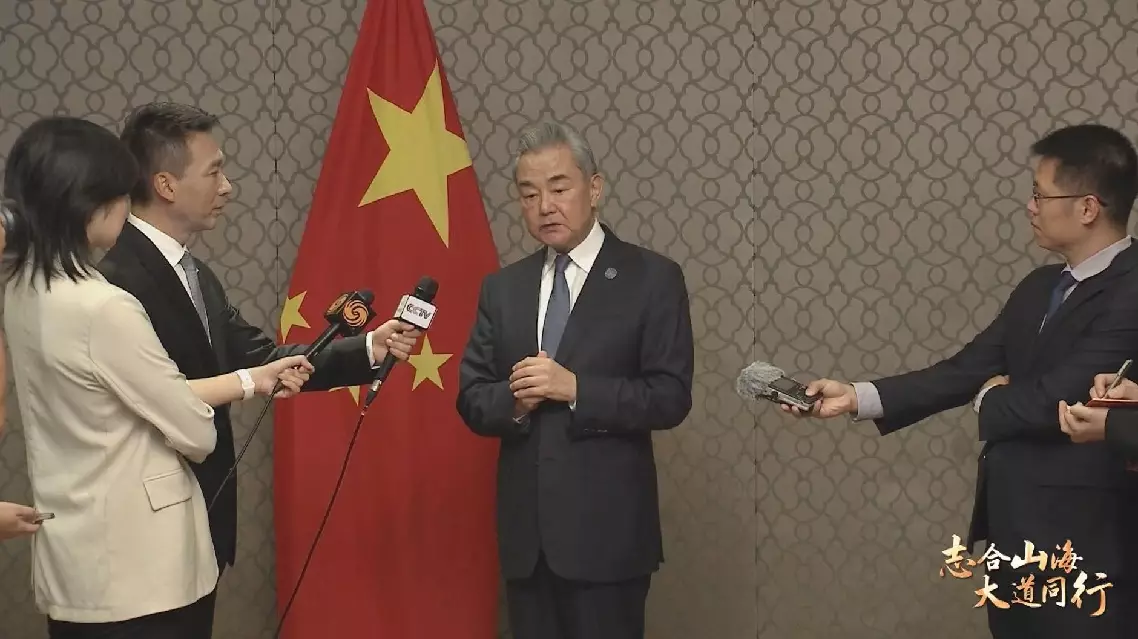
Xi's trip to Kyrgyzstan, Egypt demonstrates China's commitment to shared development, improving global governance: FM
Xi's trip to Kyrgyzstan, Egypt demonstrates China's commitment to shared development, improving global governance: FM