A village in northwest China's Xinjiang Uygur Autonomous Region has been developing fig fruit planting industry, significantly increasing income and job opportunities for local people and further boosting rural revitalization.
Atux City's Takut Village covers an area of 45.2 square kilometers, with half of its land consisting of Gobi desert. The village boasts a rich tradition of fig cultivation, with every household nurturing fig trees in their yards.
Last year, it attracted investment from fig cultivation company Xinjiang Haidekun Agricultural Technology Co., Ltd., which is introducing a unique variety called Brook Red figs. Unlike typical fig seedlings that take three years to bear fruit, Brook Red figs can produce fruit in the same year they are planted, promising quicker returns for local farmers.
"The local figs in Xinjiang are called 'Early Yellow'. Why do we plant 'Brook Red' figs? Their yield is higher than that of local Early Yellows, and they have a higher planting density. With higher yield and planting density, the benefits can be much better," said Liu Dongdong, manager of the company's planting department.
Memetjan Kurban, a 35-year-old local villager, was hired by the company a year and a half ago. Now earning a monthly salary of 4,000 yuan, a desirable amount in the area, he is now also gaining valuable knowledge in Brook Red fig cultivation techniques while working in the greenhouse.
"I have learned about seedling cultivation, pest control, temperature control, and watering," said Memetjan.
Upon settling in the village, the company rapidly constructed nine greenhouses on the Gobi desert and initiated the cultivation of Brook Red figs. This new variety has become quite popular locally, with a noticeable price difference compared to the traditional Early Yellow figs.
"These are Early Yellow figs. When the fruits ripen, each can be sold for one yuan. These are Brook Red figs. When they ripen, they can be sold for three yuan each. Right now, there are fewer Brook Reds, so I'm eating them myself instead of selling them. Next year, I'll plant more, and after I make more money, I'll build a larger greenhouse," said Memetjan.
Brook Red figs offer a significant economic opportunity for local farmers, with a harvest period lasting up to eight months, compared to just three months for the Early Yellow variety. When grown in greenhouses, Brook Red figs can even produce fruit in the winter, allowing for off-season sales. Last winter, these figs were priced as high as 15 yuan for each, creating a high demand that resulted in over a million yuan in profit for the company.
Recognizing the potential benefits for the community, the company has committed to supporting local farmers by providing fruit seedlings free of charge and promising to buy back their harvests. In addition to supplying seedlings, the company also offers free training on cultivation techniques, empowering farmers to maximize their yields. As a result, villagers from this and nearby communities have frequently gathered to learn cultivation techniques from the company, fostering a collaborative spirit and enhancing local agricultural practices.
Currently, Takut Village has 97 greenhouses, with 15 dedicated to fig cultivation. The village is planning to gradually increase the planting area for Brook Red figs and has initiated subsequent industrial development related to fig production.
"First, we will expand the planting area. Second, we will enhance our secondary industry through processing, and regarding the tertiary industry, we will increase agritourism and fruit-picking experiences to further boost rural revitalization," said Mu Dinglie, Party secretary of Takut Village.
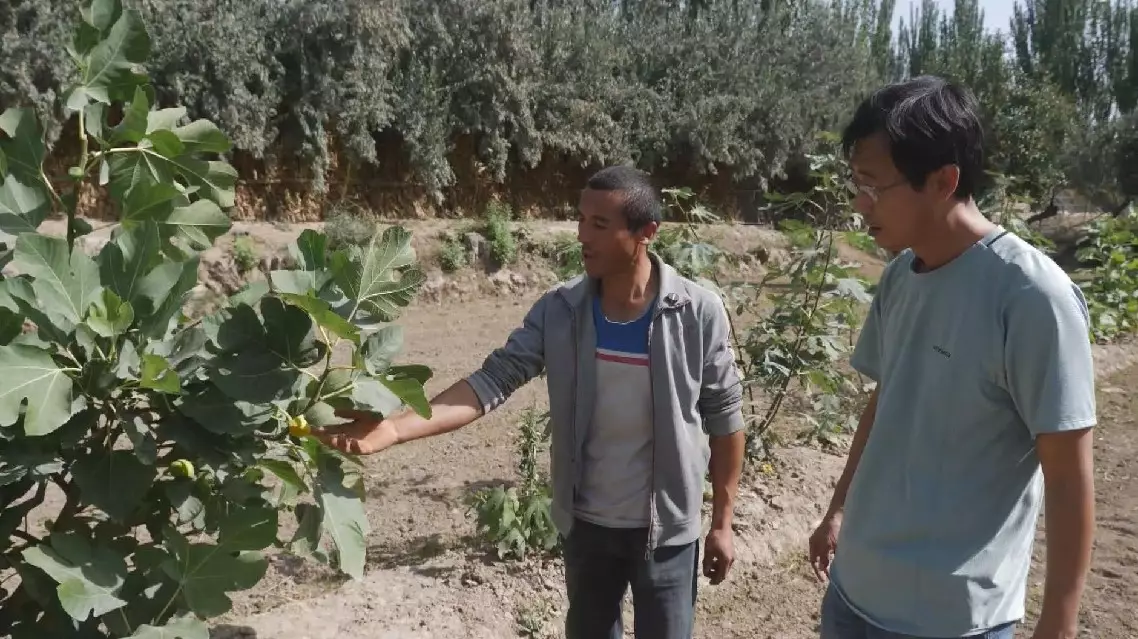
Village in Xinjiang eyes fig fruit planting industry to further boost rural revitalization