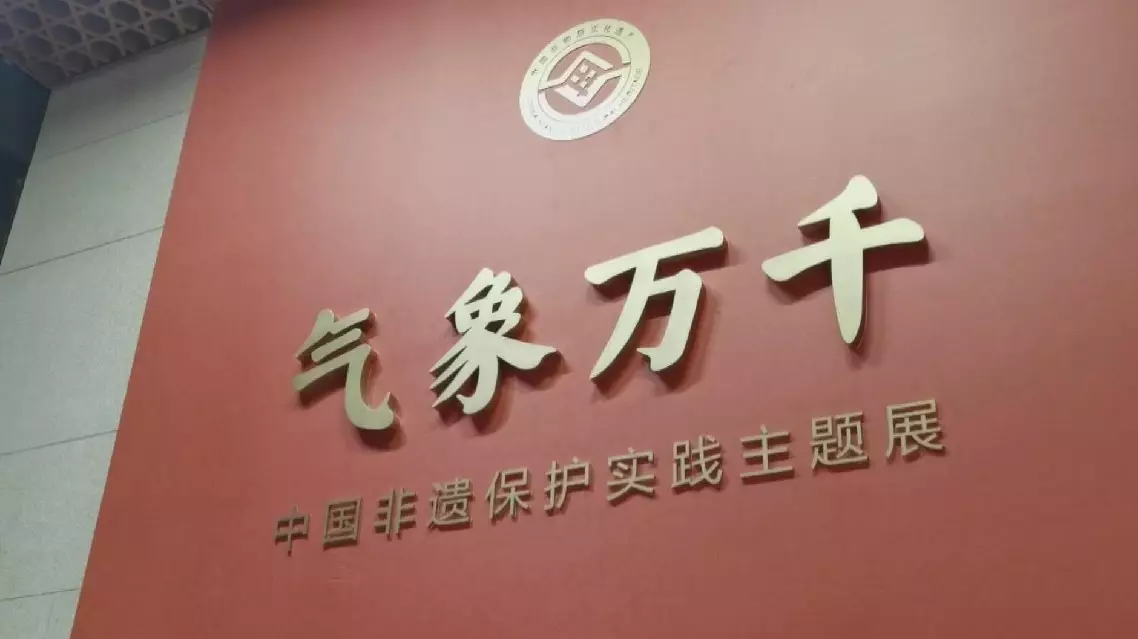
A year-long exhibition at the China Intangible Cultural Heritage Museum in Beijing showcasing the country's intangible cultural heritage maintains its popularity among visitors during the National Day holiday, with various exhibits illustrating the vitality of intangible cultural heritage in contemporary society.
As part of the celebrations for this year's Cultural and Natural Heritage Day, the exhibition, which opened on June 7, features over 100 national intangible cultural heritage projects and items listed on UNESCO's Intangible Heritage lists, including local opera materials and crafts such as embroidery and wood carving, with over 600 pieces on display at the museum.
In the exhibition hall, the dragon- and phoenix-shaped kites hanging from the ceiling stand out as captivating displays, symbolizing prosperity and good fortune in Chinese culture.
Surrounding the phoenix-shaped kite are 100 smaller kites, symbolizing "A Hundred Birds Paying Homage to the Phoenix." The dragon-shaped kite's main body is composed of fans featuring the patterns of "The Twenty-Four Solar Terms," with its four colors representing the four seasons.
The kite-making craftsmanship, originating from Weifang in east China's Shandong Province, is an ancient Chinese folk art listed as a national intangible cultural heritage item in 2006.
Meanwhile, on-site activities such as making oil-paper umbrellas and bamboo carving enable visitors to experience Chinese intangible cultural heritage skills firsthand.
The troupe of the Baizhifang Lion Dance, which originated in the Qing Dynasty (1644-1911) and was added to China's intangible cultural heritage list in June 2008, also performed at the exhibition.
"This is a national intangible cultural heritage. It not only exercises the body but also becomes a part of our daily life," said Ma Xiuling, a performer.
With the growing popularity of China-chic, a fashion trend blending modern designs with traditional cultural elements, cultural and creative products themed on intangible cultural heritage are becoming increasingly popular among young people.
At the exhibition, under the guidance of a dough sculpture inheritor, children can personally craft a rose from dough to take home.
At another booth displaying Fengning paper-cut works from north China's Hebei Province, an artisan can swiftly create lifelike paper-cut silhouettes for visitors with just a few skilled cuts. The traditional paper-cutting art has been enhanced in design and materials, evolving from simple window decorations into exquisite souvenirs.
"We have transformed paper-cutting from paper to gold foil and from two-dimensional to three-dimensional, making intangible cultural heritage visible in the forms of figurines, objects, and daily life," said Shi Junfeng, a Fengning paper-cut inheritor.
This year marks the 20th anniversary of China joining UNESCO's Convention for the Safeguarding of the Intangible Cultural Heritage.
As of now, China has a total of 43 projects, including Nanjing Yunjin weaving technique and Peking Opera, listed on UNESCO's Intangible Heritage lists, ranking first in the world. The seven-day National Day holiday started on Tuesday.
Intangible cultural heritage exhibition in Beijing stays popular during National Day holiday