Chinese scientists have successfully transmitted high-definition video signals over kilometers using terahertz wireless communication technology, marking the world's first case to apply superconducting terahertz receivers to long-distance wireless communication systems.
Terahertz waves refer to electromagnetic waves with wavelengths between 3,000 and 30 micrometers, sitting between microwaves and optical infrared frequencies. Research into the terahertz range deepens the understanding of fundamental scientific questions in physics, astronomy, and information science. Applications for terahertz technology span various fields, including astronomical observation, biomedical science, and data transmission, with significant implications for cutting-edge research, national economic development, and security.
The experiment was carried out from Sept 27 to Oct 1 at the submillimeter-wave astronomical observation base at an altitude of over 4,000 meters located on the Qinghai-Xizang Plateau. Researchers from the Purple Mountain Observatory under Chinese Academy of Sciences led the experiment with other teams.
"For example, if we see microwave communication as a two-lane road, then terahertz communication, due to its broader and richer spectrum resources, is like expanding that road to six or eight lanes. The significance of the superconducting detection technology we used this time lies in its high sensitivity. It's like having better-performing cars on this wider road, with almost no energy loss, allowing the signals to travel much farther," said Li Jing, researcher at the Purple Mountain Observatory.
This experiment has fully demonstrated the unique advantages of using superconducting receivers in terahertz communication, laying critical technical foundation for future space and air-to-ground high-capacity terahertz communication, as well as the construction of a multi-disciplinary platform at the submillimeter-wave observatory.
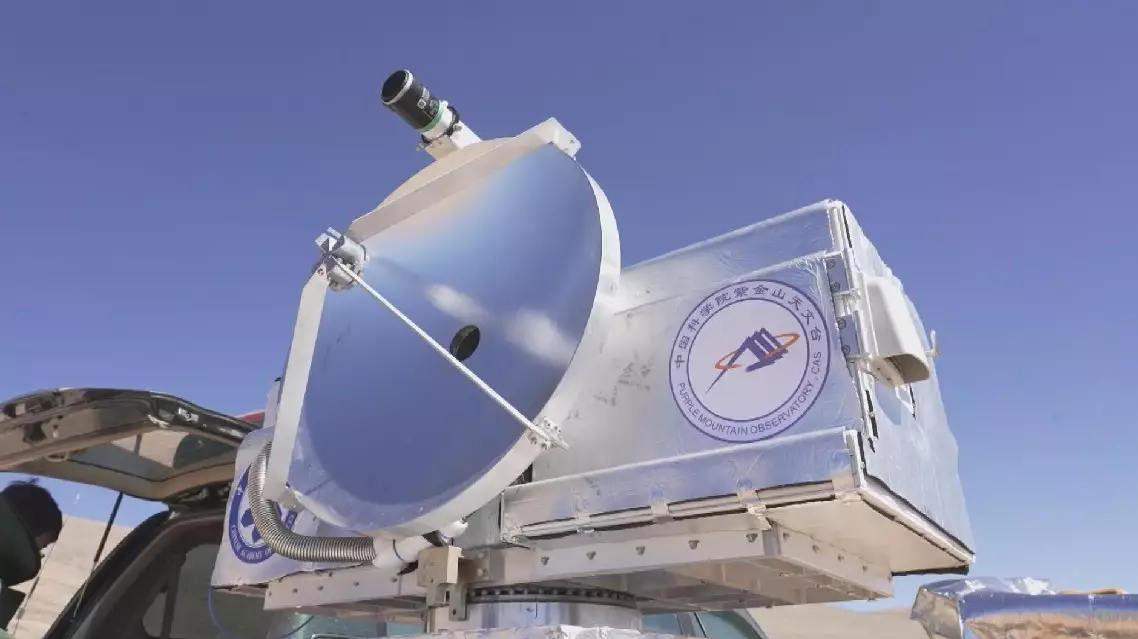
Chinese scientists achieve breakthrough in long-distance terahertz wireless communication
Chinese scientists achieve breakthrough in long-distance terahertz wireless communication
China's first two-tonne-class tethered balloon entered trial operation in a major power transmission project on Monday, providing a brand-new solution for transportation in power grid construction projects in high-altitude and ecologically sensitive areas, according to the State Grid.
The project is a massive ultra-high voltage (UHV) power transmission line that will carry clean energy from Xizang Autonomous Region in southwest China across thousands of kilometers to the Guangdong-Hong Kong-Macao Greater Bay Area in south China.
At the construction site, a large balloon with a diameter of 25 meters and a volume of 8,000 cubic meters slowly rose into the air.
As multiple mooring lines were simultaneously extended and retracted, the heavy construction materials suspended beneath the balloon were lifted off the ground and moved smoothly along a predetermined route toward the mountainous work site.
"This is our newly developed load-bearing tethered balloon. We have just completed a maximum load test of two tonnes at an altitude of 4,000 meters. Next, we will conduct a hoisting operation for power supply materials over a straight-line distance of 500 meters and a vertical drop of 120 meters," said Qin Jian, researcher at the Transmission and Transformation Engineering Technology Research Institute of the State Grid Electric Power Engineering Research Institute.
A heavy-lift tethered balloon involves launching a helium-filled balloon into the air and connecting it to the ground with one or several cables.
By adjusting the cable, the balloon's altitude and horizontal position are controlled to facilitate the transport of materials at high altitudes.
The balloon can travel up to 800 meters and carry a maximum load of two tonnes, with a positional accuracy of within 0.5 meters.
As the construction of new power grids is extending more rapidly into high-altitude, remote mountainous and ecologically sensitive areas, the transportation of materials for transmission projects has become a major challenge constraining construction progress.
Traditional road construction for transportation have long cycles and significant ecological disruption, while drones, though agile and flexible, face limitations in scenarios requiring heavy loads or prolonged continuous transport.
Tethered balloon transport technology effectively overcomes these difficulties.
"The construction section where this technology is applied is located in an uninhabited mountainous area at an altitude of over 4,000 meters. Many tower sites are situated on steep ridges inaccessible by road, making this the section with the highest altitude, most treacherous terrain and most challenging operations in the entire project. The two-tonne tethered balloon is better suited to high-altitude conditions characterized by thin air and strong winds, and its load capacity and stability can better meet transportation requirements," said Feng Tao, project manager of the State Grid Henan Power Transmission and Transformation Company.
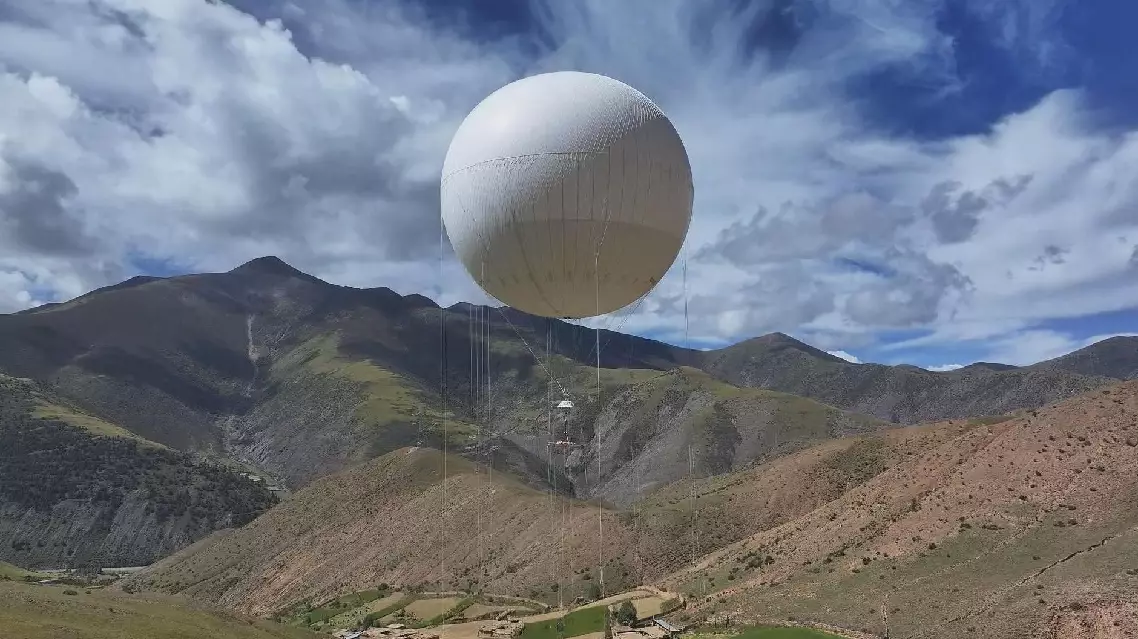
China puts first 2-tonne tethered balloon into operation