The Shenzhou-18 crew members on board China's orbiting space station Tiangong recently shared their views from space of the Yangtze River and the Yellow River, regarded as the two "mother rivers" of the Chinese nation.
Ye Guangfu, commander of the Shenzhou-18 crewed spaceflight mission, first shared the views of the Yangtze River, China's longest waterway and the world's third-longest river, sustaining a number of the country's economic powerhouses, megacities and major rice-producing areas. Along the basin of the Yangtze, many famous cities are situated, including Chongqing in southwest China, Wuhan in central China, and Nanjing and the Chinese financial hub of Shanghai in the east.
The Yangtze River Economic Belt along the golden waterway covers nine provinces and two municipalities, accounting for more than 40 percent of the country's population and economic aggregate. In recent years, China has strengthened joint environmental protection along the river to conserve biodiversity.
Li Cong, another astronaut of the Shenzhou-18 crew, then shared the views of the Yellow River, China's second-longest river. Originating in northwest China's Qinghai Province, the Yellow River, known as the cradle of Chinese civilization, runs through nine provincial-level regions including Shaanxi and Henan before emptying into the Bohai Sea in east China's Shandong Province.
As an "ecological corridor," the Yellow River, linking the Qinghai-Tibet Plateau, the Loess Plateau and plains in northern China with severe water scarcity, plays an important role in improving the ecological environment, combating desertification and providing water supply with the help of water conservancy projects.
The country has built more than 400 wetland nature reserves and national parks in the river basin, and has carried out four large-scale embankment construction projects and built water conservancy projects such as the Longyang Gorge, the Liujia Gorge hydropower projects and the Xiaolangdi Dam, achieving a major breakthrough from passive treatment to active management of sand and water in the Yellow River. The Shenzhou-18 crew are scheduled to return to the Earth in late October after staying in orbit for about six months.
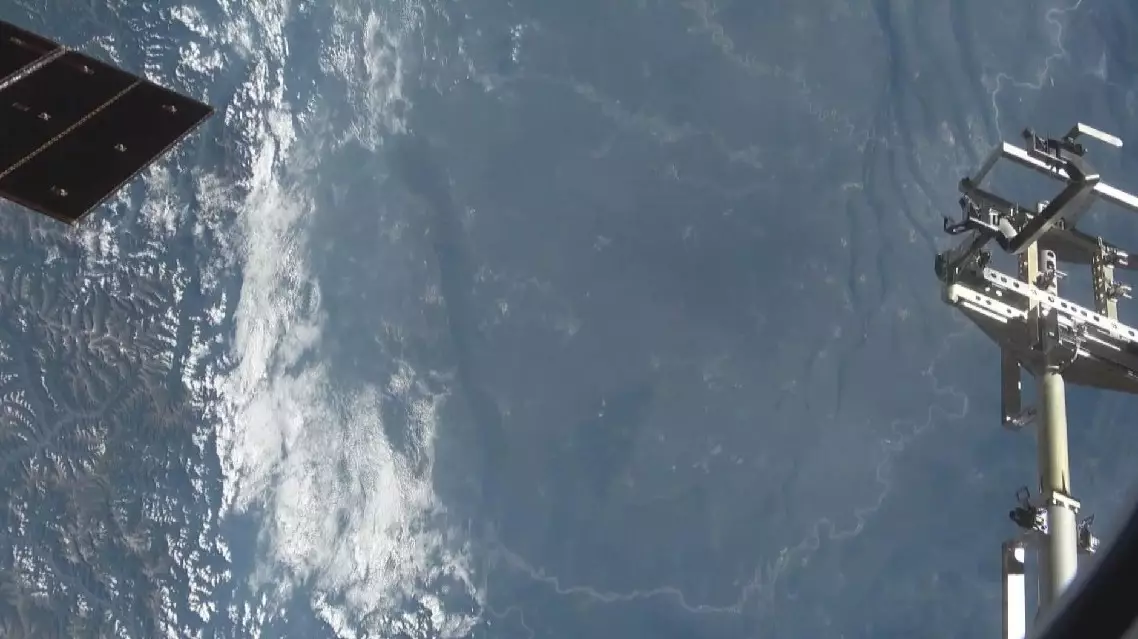
Shenzhou-18 astronauts share space views of Yangtze River, Yellow River