An art collector from the Netherlands who generously donated a substantial number of cultural relics to the Shanghai Museum has emphasized that returning the objects to China was the correct and morally sound decision.
Henk Nieuwenhuys is the first foreigner to offer such a large number of cultural relics to the Shanghai Museum free of charge.
The donation included over 150 pieces of Chinese ceramics, bronzes, ivory carvings, and other artifacts. These relics belong to the period from the Shang Dynasty (1600 BC-1046 BC) to the Ming (1368-1644) and Qing dynasties (1644-1911), spanning nearly 3,000 years.
During the Ming and Qing dynasties, Chinese porcelain was shipped to the European continent by sea, enjoying great popularity in the European market.
Nieuwenhuys's grandfather, out of personal passion, purchased and collected a large collection of export porcelain, which he later passed down to Nieuwenhuys's father.
"I grew up with Chinese porcelain because my father had it. When I was a small boy, I saw my father and I help my father wash the porcelain because he did that himself. And I was intrigued that I saw men with long hair and ponytails, because in the Netherlands you don't do that," he said.
In 1991, after his father's passing, Nieuwenhuys inherited some of the collection. Moved by his family's love for Chinese art, he decided to expand the collection.
In 2007, at the age of 56, Nieuwenhuys visited Shanghai for the first time due to work. During his visit to the Shanghai Museum, he was fascinated by the royal porcelain displayed in the museum, leading him to consider finding a more suitable place for his own collection.
In 2008, he donated a total of 97 pieces of porcelain, treasured by his family for generations, to the Shanghai Museum.
"I think the collection was very dear to me, and you can always sell it and then you get money and what you do with money? You can only eat three meals a day, which I already do. So money doesn't help. And I think it is more important for history to get a good home for the porcelain where people can enjoy and look at it and understand and appreciate how Europeans would enjoy collecting Chinese porcelain and display it at their homes. It is to set an example that those objects should return," said Nieuwenhuys.
"And there's also a show of gratitude from the Chinese government and the Shanghai Museum for the donation I've made. I received a Magnolia Gold Award. It's a great honor. I'm not Chinese, I'm from the Netherlands and to get the highest award from the Shanghai government, that gives you a very special feeling. It also confirmed that you did the right thing," he added.
After donating his collection in 2008, Nieuwenhuys decided to move to China to start a new life.
He donated more precious artifacts in 2018 and 2019 to the Shanghai Museum.
After donating all his porcelain, Nieuwenhuys became fascinated with ancient Chinese bronze and pottery from the Han Dynasty (202 BC-220 AD).
"[These] in fact are stolen cultural art. Now, there are objects which have a special history which may have an additional interest. It's illegal to sell. The right thing to do is to give that back to China," he said.
Li Zhongmou, former deputy curator of the Shanghai Museum, said that the donation offers a unique opportunity for people to explore history.
"It is a missing piece in the collection of the Shanghai Museum. They are exceptional and serve as a quintessential representation of the Maritime Silk Road, illustrating the trade between China and the West during that time," said Li.
Currently, Nieuwenhuys has settled in Changchun City, northeast China's Jilin Province, where he enjoys the various kinds of convenient living conditions. Whenever he visits Shanghai, he always returns to the Shanghai Museum to reunite with his "old friends".
"I will stay here, I will not go back to Europe to live. I'll go to Europe to visit. And many things are convenient here. The way you pay with Alipay or WeChat, things are well organized in this country," he said.
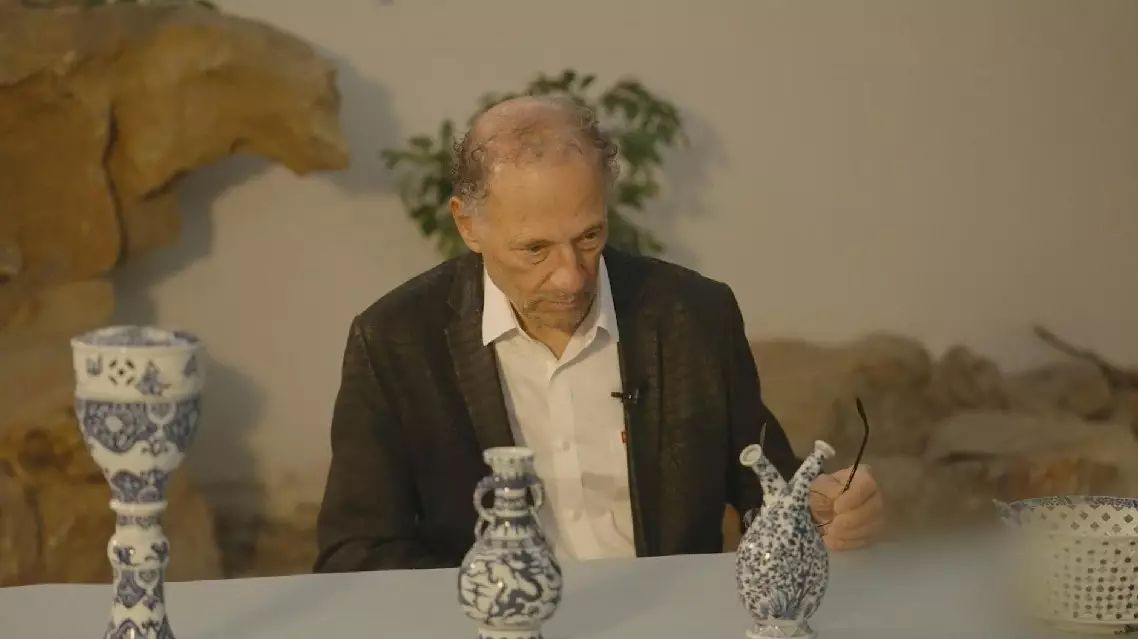
Let Chinese cultural relics come home: Dutch collector