The textile industry, a pillar of economic stability in the southern African kingdom of Lesotho, is reeling from the double blow of U.S. tariffs and the lapse of a key trade pact, pushing the country into a severe social crisis marked by jobs and livelihoods being threatened.
For an industry reliant on processing garments for American brands and exporting them to the U.S. market, the sudden imposition of tariffs has become a heavy burden -- even a disaster. The impact is starkly visible inside a garment factory in an industrial park in Maseru, the capital of Lesotho.
Before 2025, this factory produced approximately 500,000 garments monthly, primarily exporting to the United States and other Southern African countries. It employed some 2,000 local workers and generated annual revenues of about 6 million U.S. dollars.
However, following the U.S. decision to impose tariffs on products from Lesotho and the expiration of the African Growth and Opportunity Act (AGOA) -- the most crucial trade framework between the U.S. and sub-Saharan African countries -- the factory's orders plummeted to roughly 100,000 garments per month, forcing the layoff of over 1,000 employees.
The tariffs have threatened the livelihoods of thousands of families and put pressure on supporting industries including transport and housing.
"If we don't have the exports, it is very difficult for us to continue or run the factory. It really affects our production, and not only our production, but even the economy of the country. Then, it was not really easy for us when we lose, when they increase the tariffs, because we have to retrench,” said Koko, the human resources manager at a textile factory.
Some production lines in this factory have already been halted.
"We no longer have orders due to those high rates of tariffs. There are no orders. So those raises in the tariffs has really, really affected us economically and socially. We are so worried, we are so depressed, because we don't know if we are going forward or we are going backward," said one textile worker.
Mokhethi Shelile, Lesotho's minister of trade, industry, business development and tourism, said that while the U.S. later moderated the tariff rate from an initial 50 percent to 15 percent, the combined effect of losing AGOA benefits and facing additional duties on materials like synthetic fibers results in a total levy exceeding 40 percent for some textile products. This has completely eroded their price competitiveness in the U.S. market.
As orders continue to dwindle, some textile factories in Lesotho are scaling back operations and cutting workers' hours.
"Some of the factories have got to go what they call short time -- 1,000 will work for two weeks, another 1,000 would work another two weeks. That now means they are getting a reduced pay. So you can imagine somebody now having to do with half of that. We are very vulnerable, because we export a very narrow band of products - it's textile. If something goes wrong on textile, we have a general problem," Shelile said.
For Lesotho, one of the world's least developed countries as classified by the United Nations, the textile sector is crucial to its economic survival. With unemployment soaring, the Lesotho government even took the drastic measure in July 2025 of declaring a two-year "state of disaster."
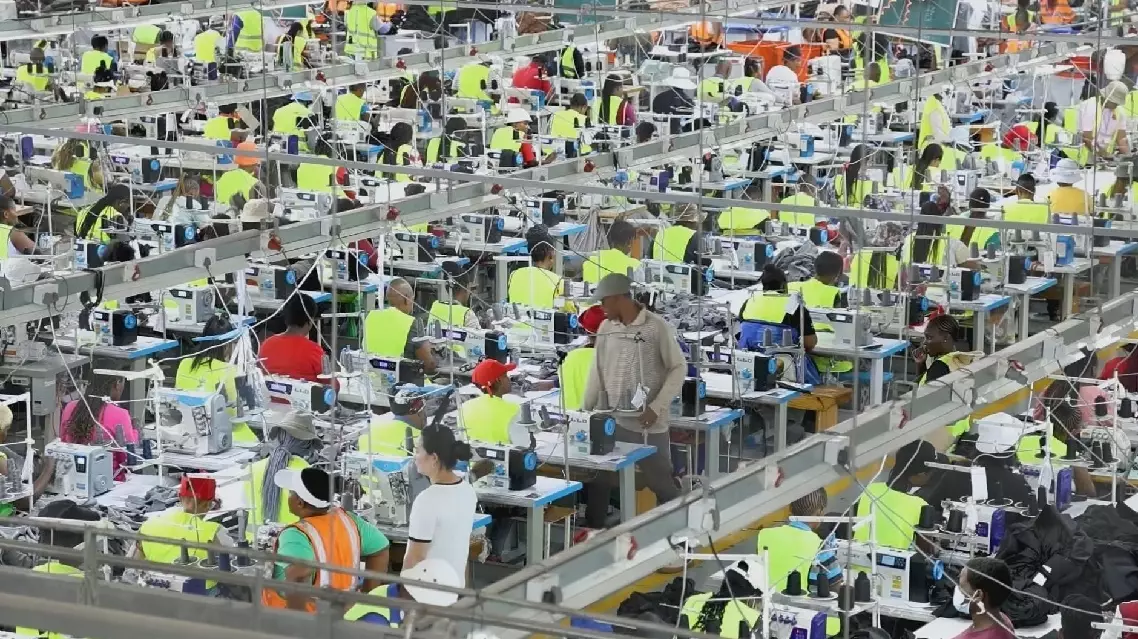
U.S. tariffs plunge Lesotho's textile industry into crisis