Distinctive wedding ceremonies in an ethnic Tajik county in northwest China's Xinjiang Uygur Autonomous Region showcase vibrant cultural heritage passed down through generations.
Inscribed on the national intangible cultural heritage list in 2008, the wedding customs of the Tajik ethnic group in Taxkorgan Tajik Autonomous County in the far west of Xinjiang region maintain unique traditions and could be aptly described as festivals of music and dance.
Lasting for three days, the traditional ethnic Tajik wedding is a grand occasion containing various rituals including the proposal, engagement, drum blessings, and the ceremony, and is typically held in autumn.
On the first day of the wedding, friends and relatives dress up in their finest clothes and bring gifts to congratulate the newlyweds, with guests gathering in the courtyard to beat drums, sing, and dance.
"This is an important feature of our ethnic Tajik wedding ceremony. You can see two people beating the drum, two playing the eagle flutes, and two dancing. It symbolizes that good things come in pairs," said a staff member who works for the county's communication department.
During the ceremony, white flour is sprinkled on the groom's shoulder as a blessing, as ethnic Tajiks consider white flour to be a symbol of purity.
On the second day of the wedding ceremony, the groom goes to the bride's home accompanied by a married young person and a group of unmarried youths while musical instruments are played and wedding songs are sung.
The bride and groom wear rings tied with red and white ribbons on their fingers, symbolizing good fortune and happiness. The bride is veiled with a red scarf and a long piece of gauze, holding a handkerchief with elegant embroidery in her hand.
"The patterns on the handkerchief are all handmade embroidery. In ethnic Tajik culture, the handkerchief is a token of affection, so she will give this to the groom," explained the communication department staff member.
The celebrations usually last until midnight on the third day of the wedding ceremony, and the bride's gauze will be unveiled three days after the wedding.
The handmade embroidery on the wedding dresses of the bride and groom has also been included in the national intangible cultural heritage list because of its unique charm.
The inheritor of this skill said the patterns on the dresses often feature natural landscapes, which are inspired by ethnic Tajik people's daily lives.
"The bride's dress and coat are adorned with embroidery created by ethnic Tajik embroiderers. The patterns typically draw inspiration from daily life, such as mountains, water, the sun, and flowers, grasses and plants. These elements are abstractly represented in the embroidery on the clothes," said the inheritor's translator.

Three-day wedding ceremonies filled with song, dance reflect ethnic Tajik traditions
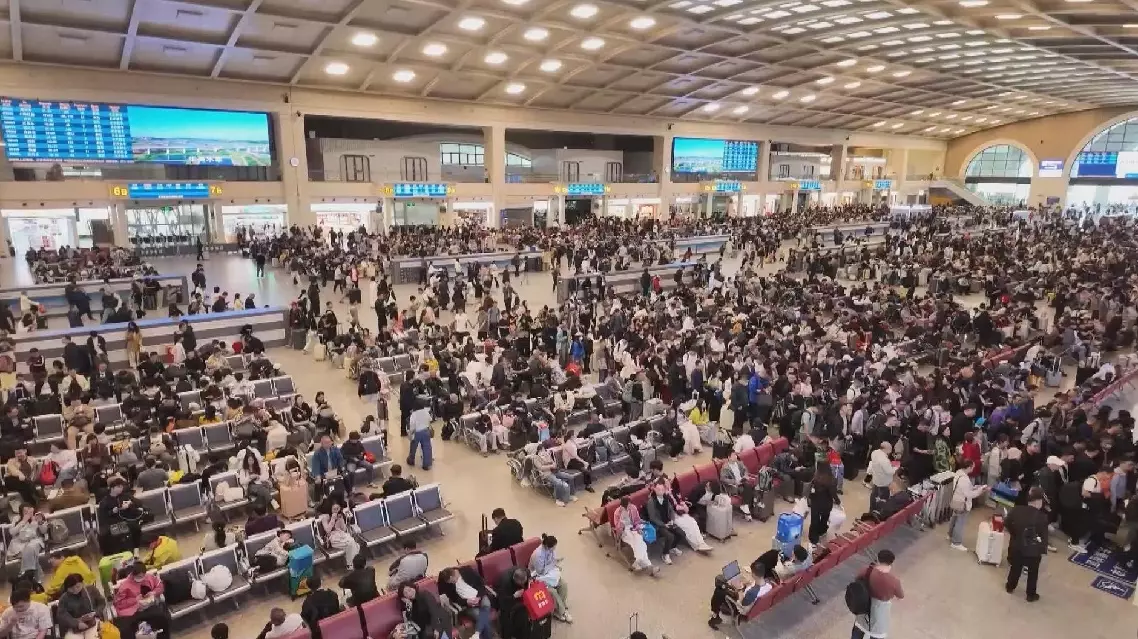
China’s transport authorities mobilized rail, road, air and waterway resources on Tuesday, the final day of the five‑day May Day holiday, to manage the peak return flow as passenger volumes surged nationwide.
The national railway system expects 23 million passenger trips on the day, with operators adding 2,225 extra trains and deploying capacity on popular routes and peak hours to handle the return flow from smaller cities to major hubs.
In Zhengzhou, central China's Henan Province, 134 trains have been temporarily added for high-demand directions including the Beijing-Tianjin-Hebei region, the Yangtze River Delta, and the Guangdong-Hong Kong-Macao Greater Bay Area.
"Railway return travel peaks today. In light of short stops and high passenger volumes, we have strengthened coordination with intermediate stations and offered guidance to passengers for smooth boarding and alighting to prevent crowding and stampedes," said Ji Yudi, a conductor of China Railway Zhengzhou Group.
Regional operators in Beijing, Chengdu and other cities have also proactively coordinated with local transit authorities to extend bus and subway operating hours, increase nighttime service frequency, and boost taxi and ride-hailing availability to ensure seamless transfers for late-arriving passengers.
With respect to highways, the national highway network is projected to record approximately 61 million vehicle trips on Tuesday. The peak traffic window is between 16:00 and 18:00, with congestion and slow-moving traffic likely around major city entry and exit points, as well as airport expressways in major cities like Beijing, Shanghai, Guangzhou and Chengdu.
To ease holiday congestion, traffic police in south China's Guangdong Province have rolled out tidal lanes and flow control measures at 24 key highway sections in nine cities.
"Using a highway interconnect system, we have conducted remote flow diversion. During this morning's peak return period, traffic efficiency on the Erenhot-Guangzhou Expressway improved significantly, showing no sign of congestion," said Dai Zhouwu, a local traffic police officer.
By water, an estimated 1.035 million passenger trips are expected to be made across the country on Tuesday, marking a 1.4-percent increase year on year.
To ensure smooth strait crossing from south China's Hainan Province, the maritime authorities in Zhanjiang City, south China's Guangdong Province have urged operators to supplement fixed sailings with extra voyages and optimized crew rotations to meet surging vessel demand.
Meanwhile, China's civil aviation sector is projected to carry 2.3 million passengers on Tuesday.
The Chengdu Shuangliu International Airport, one of the country's busiest airports in southwest China's Sichuan Province, are offering free luggage pick-up and delivering services to passengers arriving from Beijing, Shanghai, Guangzhou, and Shenzhen.
China’s transport network braces for record May Day return traffic