Chinese Vice Premier He Lifeng on Monday led a central delegation on a visit to Shihezi, a city under the 8th Division of the Xinjiang Production and Construction Corps (XPCC), met local people and carried out inspections.
He led the delegation on a visit to the Xinjiang Production and Construction Corps Reclamation Museum, which shows China's revolutionary undertaking of building the city of Shihezi and reclaiming land for farming in what was once a sparsely-populated desert. At the museum, He, also a member of the Political Bureau of the Communist Party of China (CPC) Central Committee, pointed out that people must carry forward the Corps' spirit, understand the connotations of the times, put resources related to the Party's heritage to great use, and pass down revolutionary traditions.
He said that the Corps should draw motivation from its own seven-decade history, and encourage officials and workers to stay dedicated to working and serving in Xinjiang, and make new and greater contributions.
At Xinjiang Tianye (Group), a state-owned enterprise which is affiliated to the XPCC, He listened to reports on the company's technological innovation and new industrialization development.
The vice premier said that the Corps should adhere to innovation-driven development, develop new quality productive forces according to local conditions, and accelerate a high-end, intelligent and green transition.
He urged the Corps to focus on clean and efficient use of coal, prioritize environmental protection and energy conservation, strengthen leading enterprises, and work on landmark projects in the modern coal chemical industry, to cultivate new momentum for industrial science and technology in pursuit of high-quality development.
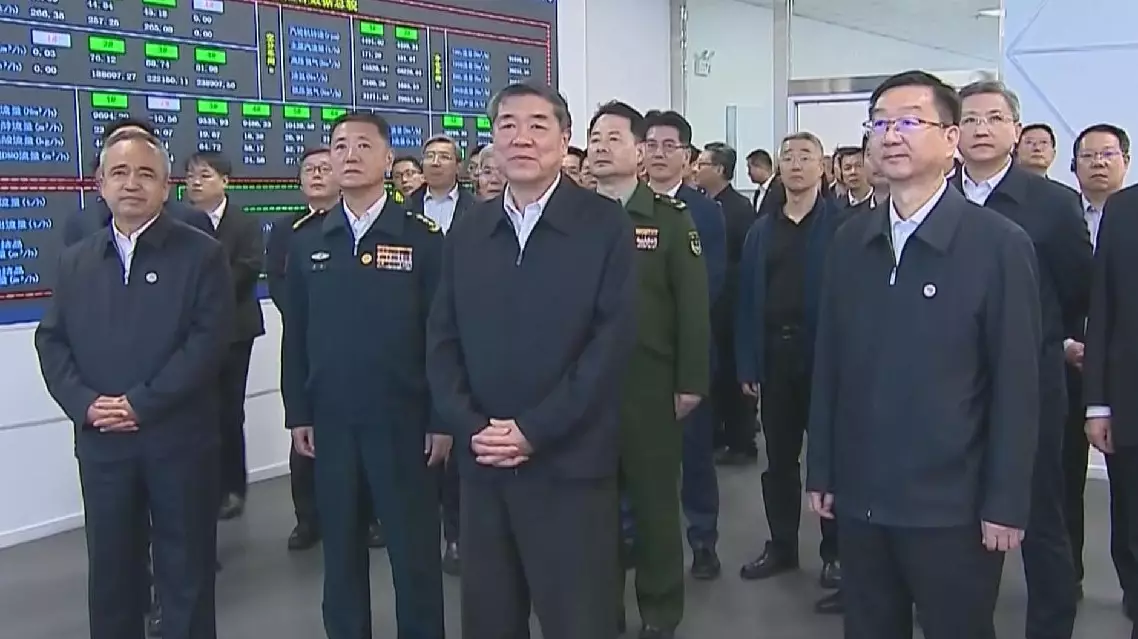
Chinese vice premier urges promotion of Xinjiang's high-quality development during inspection tour in Shihezi

Chinese President Xi Jinping's New Year message delivered on the New Year Eve has drawn positive responses from scholars and former officials from several countries, who say that the series of global initiatives proposed by Xi have provided fresh momentum for multilateralism and shared development at a time of growing uncertainty.
While the reactions touched on the broader vision outlined in Xi's New Year message, they also focused on the initiatives Xi has put forward over recent years, particularly the Global Development Initiative, the Global Security Initiative, the Global Civilization Initiative and the newly proposed Global Governance Initiative.
Highlighting the significant importance of these initiatives, they have emphasized the need for equality, inclusiveness and a fairer international order.
"We need a more just international order and a truly multilateral system. China stands almost alone today as a global force actively advancing genuine multilateralism. Therefore, these initiatives are most welcome," said Michael Schumann, chairman of the German Federal Association for Economic Development and Foreign Trade.
Former Lebanese Prime Minister Hassan Diab has placed the emphasis on dialogue and trust-building between civilizations.
"It is essential now more than ever to promote communication and understanding between China and the world to enhance cultural exchanges and build mutual trust. As President Xi has repeatedly emphasized, China supports principles of unity, inclusiveness and peacefulness. These values should guide our collective efforts to build bridges rather than walls," he said.
From a governance perspective, Russian scholar Ekaterina Zaklyazminskaya, head of the Center for World Politics and Strategic Analysis at the Institute of China and Modern Asia under the Russian Academy of Sciences, has viewed the Global Governance Initiative as a structured response to global challenges.
"The recently proposed Global Governance Initiative presents a comprehensive framework of ideas. It prioritizes establishing a more just international order, champions multilateralism, and upholds the principle of 'people first.' Through its concrete practices, financial assistance, and tangible support for multilateral bodies like the U.N., China has demonstrated that its commitments are substantive. China is taking tangible steps toward a fairer and more reasonable global governance system," she said.
Scholars from the Global South also have seen historical echoes in the initiatives.
"Some of the developed and developing countries have highly welcomed the Global Development Initiative, because this initiative emphasizes the need for partnerships -- partnerships that commit resources to end global poverty and pursue common and shared development. The Global Governance Initiative, in my view, echoes again the call that was made by Asian [and] African countries at the Bandung Conference in 1955 for equality, for mutual respect, for respect of territorial integrity, [and] for respect of sovereignty," said Bongani Maimele, director of international relations at South Africa's National School of Government.
"These initiatives are revolutionary in nature. They are reshaping the political philosophy of global governance. Today's world is far more complex than it was 80 years ago, and interdependence among nations has deepened. Therefore, we need new philosophical perspectives to examine our world and new models of engagement to foster a new type of international relations," said Sheradil Baktygulov, director of Kyrgyzstan's Institute of World Policy.
Int'l scholars praise Xi's initiatives, call for stronger multilateralism