HKSAR Government and Ministry of Commerce sign Second Agreement Concerning Amendment to CEPA Agreement on Trade in Services (with photos/video)
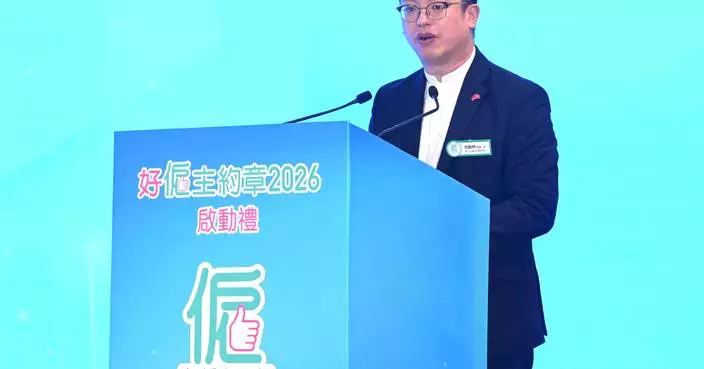
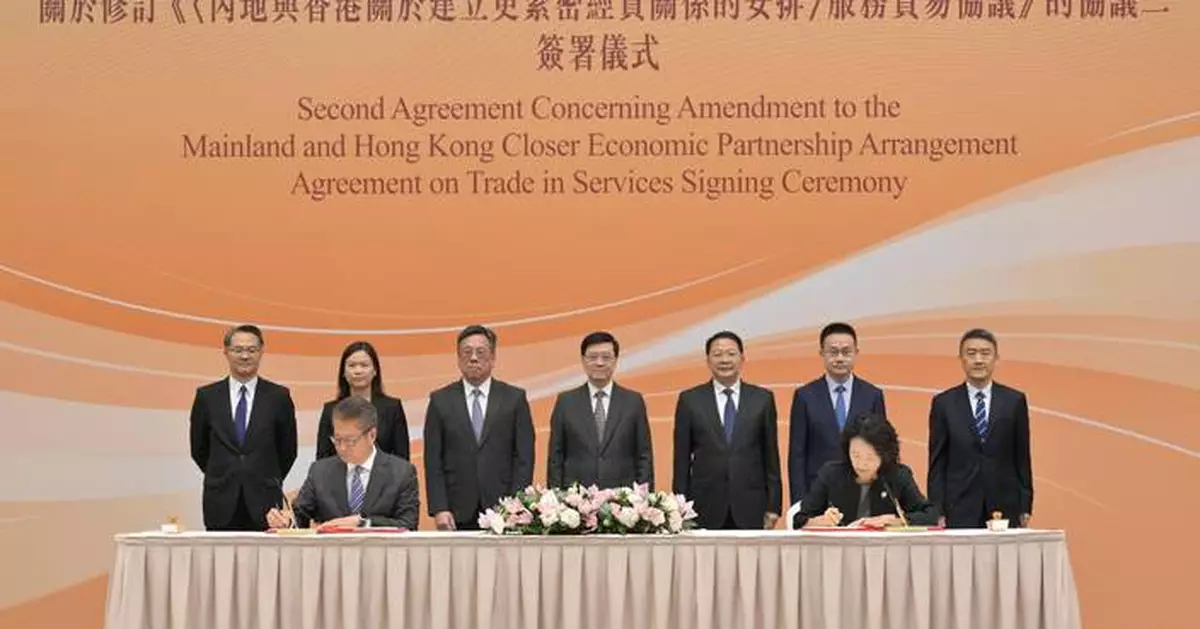
The Chief Executive, Mr John Lee, witnessed the signing of the Second Agreement Concerning Amendment to the Mainland and Hong Kong Closer Economic Partnership Arrangement (CEPA) Agreement on Trade in Services (Amendment AgreementII) by the Financial Secretary, Mr Paul Chan, and Deputy China International Trade Representative of the Ministry of Commerce Ms Li Yongjie today (October9).
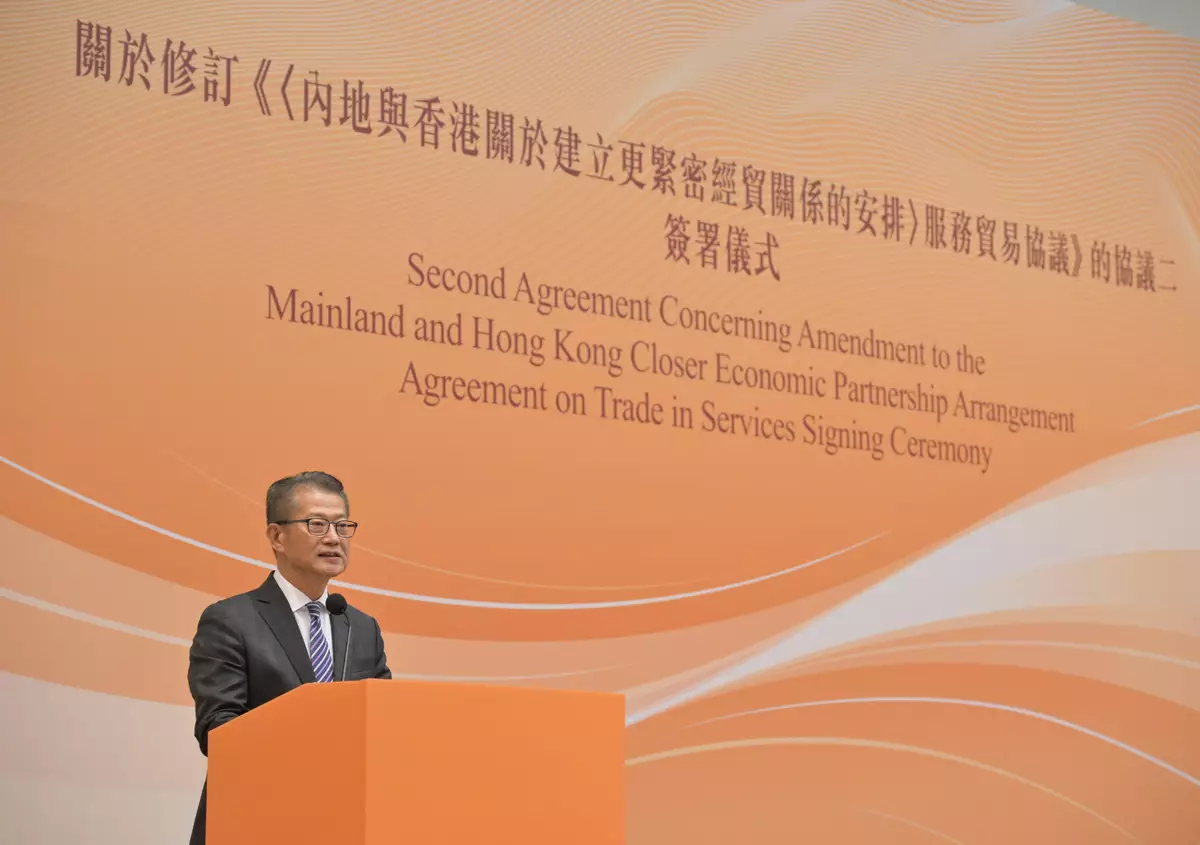
"I would like to express my sincere gratitude to the Central Government for its care and support for the Hong Kong Special Administrative Region (HKSAR). I also thank the Ministry of Commerce and relevant authorities for actively working towards the HKSAR Government's proposal of further opening up the Mainland market to Hong Kong in trade in services. The Amendment Agreement II introduces new liberalisation measures across different service sectors where Hong Kong enjoys competitive advantages, making it easier for Hong Kong service suppliers to establish enterprises and develop business on the Mainland, enabling more Hong Kong professionals to obtain qualifications to practise on the Mainland, allowing more of Hong Kong's quality services to be provided to the Mainland market, and contributing to and serving the country's development. The HKSAR Government will continue to encourage different sectors of the community to leverage the unique advantages of 'one country, two systems' and join hands with their counterparts on the Mainland to promote the competitiveness of the professional services sector, in order to inject new impetus to economic development and achieve high-quality development," said Mr Lee.
The HKSAR Government and the Ministry of Commerce signed the Agreement on Trade in Services (Services Agreement) under the framework of CEPA in November2015 to basically achieve liberalisation of trade in services between the Mainland and Hong Kong. The two sides signed an agreement in November2019 to amend the Services Agreement and add new liberalisation measures that have been implemented since June 2020. To further enhance liberalisation and facilitate trade in services in response to the aspirations of the Hong Kong business community for greater participation in the development of the Mainland market, the two sides agreed to make further amendments to the Services Agreement and signed the new agreement today.
The Amendment AgreementII introduces new liberalisation measures across several service sectors where HongKong enjoys competitive advantages, such as financial services, construction and related engineering services, testing and certification, telecommunications, motion pictures, television and tourism services. The liberalisation measures take various forms, including removing or relaxing restrictions on equity shareholding and business scope in the establishment of enterprises; relaxing qualification requirements for Hong Kong professionals providing services; and easing restrictions on Hong Kong's exports of services to the Mainland market. Most of the liberalisation measures apply to the whole Mainland, while some of them are designated for pilot implementation in the nine Pearl River Delta municipalities in the Guangdong-HongKong-Macao Greater Bay Area (GBA). Examples are as follows:
(1) Construction and related engineering services: To allow Hong Kong general practice surveying enterprises to provide professional services in Guangdong Province through filing of records; and to allow Hong Kong engineering construction consultant enterprises that have completed filing of records to bid for consultancy services projects in joint venture in compliance with the laws in the nine Pearl River Delta municipalities in the GBA;
(2) Motion pictures: To remove the restriction on investment in enterprises engaging in film production by Hong Kong service suppliers; and to allow enterprises established by Hong Kong service suppliers and approved by the relevant Mainland authorities to operate distribution of imported buy-out Hong Kong motion pictures;
(3) Television: To remove the quantitative restriction on Hong Kong people participating as principal creative personnel in online television dramas; and to allow imported dramas produced in Hong Kong to be broadcast during prime time in television stations on the Mainland after obtaining approval from the National Radio and Television Administration;
(4) Tourism services: To optimise the implementation of the 144-hour visa-exemption policy for foreign group tours entering Guangdong from Hong Kong through increasing the number of inbound control points and expanding the stay areas to the whole of Guangdong Province, and to provide facilitation for Mainland travel agents when receiving group tours at West Kowloon Station of the High Speed Rail; and to support cruise companies to arrange international cruise itineraries involving port-of-call in the Mainland cruise ports in accordance with the laws. In respect of Mainland visitors participating in such cruise itineraries, they can travel to Hong Kong in transit to join all sorts of cruise itineraries, by presenting their passports and confirmation documents of the relevant cruise itineraries; and
(5) Financial services: To remove the asset requirement of not less than US$2 billion as at the end of the most recent year for Hong Kong financial institutions investing in shares of insurance companies; to remove the restriction prohibiting foreign bank branches established by Hong Kong service suppliers from conducting bank cards services; to consider extending the scope of eligible products under the mutual market access programme by including REITs (Real Estate Investment Trusts); to continuously promote and enhance the Cross-boundary Wealth Management Connect Pilot Scheme and the Mainland-Hong Kong Mutual Recognition of Funds scheme; and to continuously promote the cross listing arrangement of the Mainland and Hong Kong ETF (open-ended index-tracking exchange-traded funds) as well as enhance Southbound Trading and Northbound Trading under Bond Connect.
In addition, the Amendment AgreementII brings institutional innovation and collaboration enhancement, including:
(1) Addition of "allowing Hong Kong-invested enterprises to adopt Hong Kong law" and "allowing Hong Kong-invested enterprises to choose for arbitration to be seated in Hong Kong" as facilitation measures for Hong Kong investors, supporting Hong Kong-invested enterprises registered in the pilot municipalities of the GBA to adopt Hong Kong law or Macao law as the applicable law in their contracts; as well as supporting Hong Kong-invested enterprises registered in the nine Pearl River Delta municipalities in the GBA to choose Hong Kong or Macao as the seat of arbitration. The measures provide flexibility and convenience for Hong Kong enterprises, facilitating their investment and business development on the Mainland;
(2) Addition of commitments regarding domestic regulation to ensure transparency, predictability and efficiency of regulations on trade in services, so as to align with high-standard international economic and trade rules, cutting red tape and lowering trade costs when enterprises supply their services in a market to facilitate trade in services; and
(3) Removal of the period requirement on Hong Kong service suppliers to engage in substantive business operations in Hong Kong for three years in most service sectors, allowing Hong Kong start-ups to enjoy the preferential treatment under CEPA in a shorter time and attracting enterprises and talent from around the world to establish a presence in Hong Kong and explore the Mainland market, thus increasing local employment, promoting Hong Kong's economic development and giving full play to Hong Kong's roles as a "super connector" and "super value-adder".
The Amendment AgreementII will be implemented on March1, 2025. Details and the latest information on CEPA are available on the Trade and Industry Department website at www.tid.gov.hk/english/cepa/index.html.
HKSAR Government and Ministry of Commerce sign Second Agreement Concerning Amendment to CEPA Agreement on Trade in Services (with photos/video) Source: HKSAR Government Press Releases
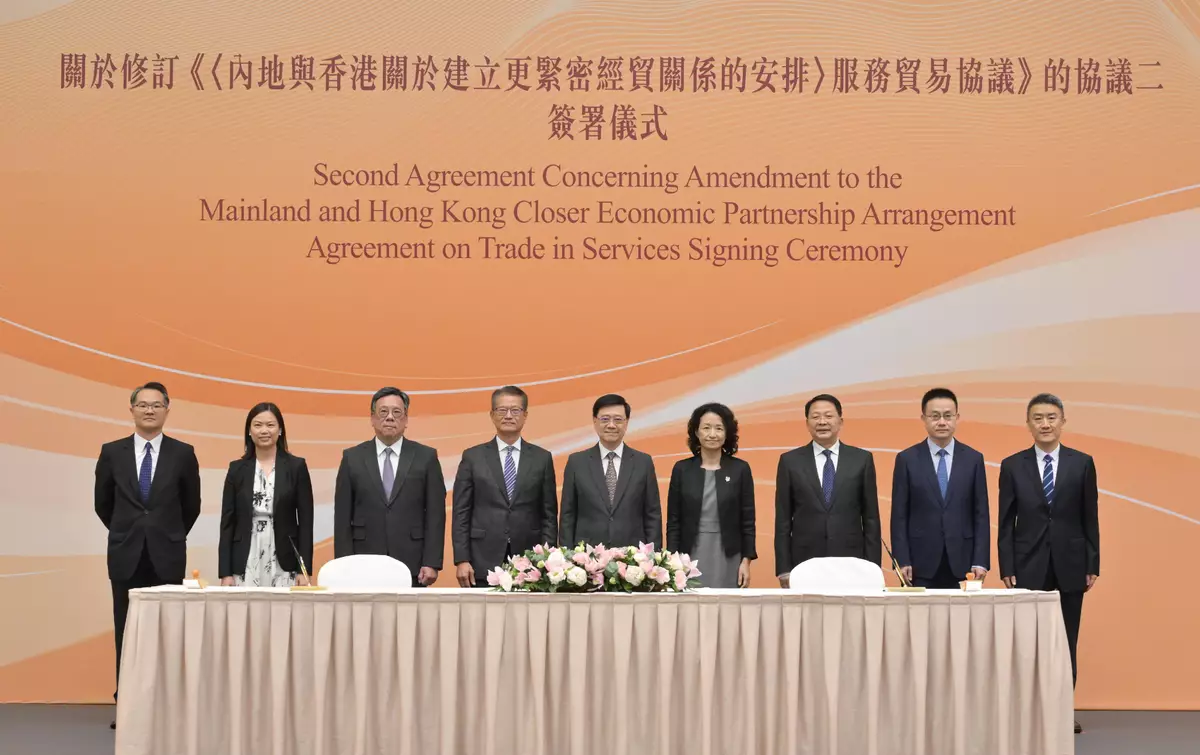
HKSAR Government and Ministry of Commerce sign Second Agreement Concerning Amendment to CEPA Agreement on Trade in Services (with photos/video) Source: HKSAR Government Press Releases
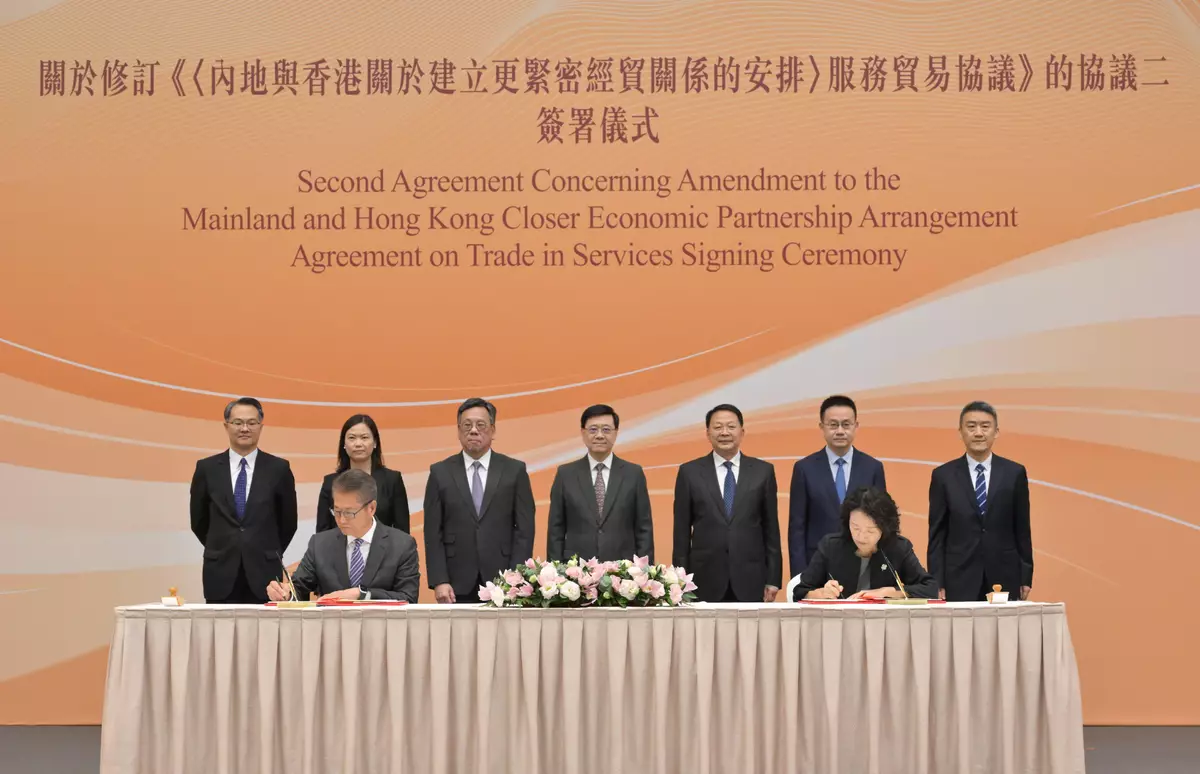
HKSAR Government and Ministry of Commerce sign Second Agreement Concerning Amendment to CEPA Agreement on Trade in Services (with photos/video) Source: HKSAR Government Press Releases