Skip to Content Facebook Feature Image

Hong Kong Launches Port Community System for Smarter, Integrated Maritime Operations

HK

Hong Kong Launches Port Community System for Smarter, Integrated Maritime Operations
HK

HK

Hong Kong Launches Port Community System for Smarter, Integrated Maritime Operations

2026-01-16 18:12 Last Updated At:18:28

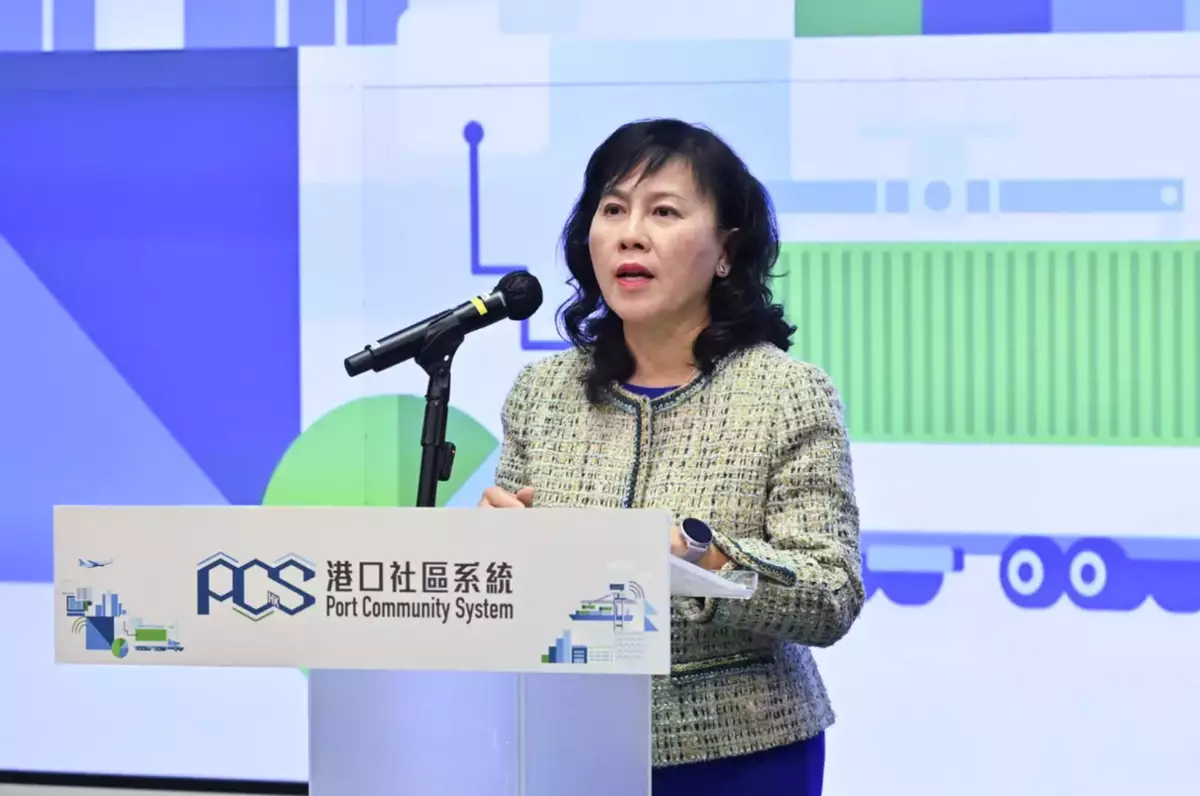
Speech by STL at rollout ceremony of Port Community System

Following is the speech by the Secretary for Transport and Logistics, Ms Mable Chan, at the rollout ceremony of the Port Community System today (January 16):

Recognising that some of our guests are non-Chinese speaking, I would also like to extend our warm welcome to you all in English as well. Today marks a pivotal moment in Hong Kong's journey towards a smarter, more connected future as an international maritime centre, as our Port Community System (PCS) is finally in place for full roll-out for the industry's use.

In the face of global transformation in the digital world, port digitalisation is a strategic imperative. The PCS is our foundational digital infrastructure, designed to integrate multimodal transport information and enhance transparency. Its core mission is to connect transport information, trade flows with capital flows, thereby solidifying Hong Kong's multifaceted role as an international financial, trade and maritime centre.

Looking ahead, we will unlock even greater value from the PCS. We will collaborate with the Customs and Excise Department to develop a dedicated module on the PCS platform. As the first phase, the PCS will help digitise the cargo detention notification process, thereby providing industry players with faster and more transparent information. This marks a concrete step towards a "Smart Customs" vision, enhancing customs clearance efficiency through digital collaboration.

Furthermore, LSCM (Logistics and Supply Chain MultiTech R&D Centre) and my bureau will sign a tripartite Memorandum of Understanding with FUNDel Limited, a local fintech start-up that connects e-commerce merchants, logistics companies, and financial institutions to collaborate in catalysing the development of innovative financial products by leveraging the trusted logistics data within the PCS. I look forward to the success of this collaboration; this is the first step, and I look forward to seeing more, which will help transform data potential into tangible financial benefits, particularly for our SMEs.

The PCS system that we roll out formally today signifies the shared vision for our port in three "i's": that is intelligent, interconnected, and indispensable to global trade. A port where data does not only track cargo but fuels growth, unlocks finance, and builds trust within our industry.

Indeed, maritime and port are closely entwined with logistics, and so is the PCS, which covers sea, land and air. Hence, I am very delighted to announce two more achievements on logistics development on this momentous day. First, we will announce the findings of the planning study on the development of a modern logistics cluster in Hung Shui Kiu/Ha Tsuen New Development Area later today. Our aim is to leverage the transport network under planning in the area and Hong Kong's edge in sea, land and air cargo transport, and create a market-enabling environment through introducing market-oriented provisions and development terms as well as innovative measures to answer the industry's needs. Together, we hope to build a smart and green modern logistics cluster in our pivotal and strategic location in Hung Shui Kiu and Ha Tsuen New Development Area. We will invite expressions of interest from the industries to attract major enterprises to lead the cluster's development based on an enterprise-oriented development principle. Second, we are also releasing today an ESG data collection toolkit that will help the trade, especially the SMEs, the frontline industry practitioners, to effectively collect and record ESG data, so as to enable them to better comply with international and global ESG compliance requirements. Thank you very much.

(Please also refer to the Chinese portion of the speech.)
Source: AI-found images

Source: AI-found images

CHP announces one new melioidosis case

The Centre for Health Protection (CHP) of the Department of Health today (January 16) announced that one new melioidosis case was recorded in the past week (January 9 to 15). The CHP appealed to members of the public to maintain personal and environmental hygiene to prevent melioidosis. The CHP also specifically reminded high-risk groups, including the elderly and people with underlying diseases, to avoid contact with soil or muddy water after typhoons or storms with a view to lowering infection risk.

The case involves a 58-year-old male with underlying illnesses living in Kwai Tsing District. He presented with a fever and vomiting since January 10, followed by confusion on the next day (January 11). He was then sent to the Accident and Emergency Department of Yan Chai Hospital and is currently in the intensive care unit in critical condition. The clinical diagnosis was pneumonia. His clinical sample was confirmed to be positive for Burkholderia pseudomallei upon testing.

The CHP is investigating the infection source of the case. Initial epidemiological investigations revealed that the case is sporadic. No epidemiological linkages have been established between this case and other confirmed cases previously recorded in Hong Kong.

As of yesterday (January 15), one melioidosis case has been recorded in Hong Kong this year. In 2025, 21 melioidosis cases were recorded.

Person-to-person transmission and animal-to-human transmission are rare, but the bacteria causing melioidosis can survive in the local environment. Melioidosis is an endemic disease in Hong Kong, and melioidosis cases have been recorded in Hong Kong each year.

According to literature, melioidosis cases are more common after typhoons or rainstorms. The bacterium Burkholderia pseudomallei in soil and muddy water may become exposed to the ground after typhoons or rainstorms, and the bacteria could spread more easily with strong winds or rainstorms. As such, the number of melioidosis cases may increase.

With this in mind, where practicable, members of the public should stay indoors during typhoons and rainstorms, avoid travelling to areas with potential flooding, and not wade in or have contact with muddy water and soil. In addition, high-risk individuals should avoid paths near stormwater drains where aerosols may be generated from contaminated water.

Members of the public should also take the following preventive measures against infection:

  • Avoid contact with contaminated soil;
  • Wear appropriate protective clothing or footwear when participating in activities with possible contact with soil or water, e.g. using gloves and wearing boots. High-risk individuals may also consider wearing a surgical mask;
  • Wash or shower after exposure to contaminated water or soil;
  • Always clean any wounds as soon as possible and cover them with waterproof dressings;
  • Wash hands with liquid soap and water after handling soil or gardening;
  • Observe food hygiene and avoid drinking raw water; and
  • Travellers can contract the disease through outdoor water sports. Risk of infection can be minimised by avoiding exposure to water sources (such as rivers, ponds or lakes) that might be contaminated.
  • The CHP appealed to members of the public to seek medical advice if they develop symptoms, in particular people with diabetes or other immunocompromising conditions, in order to receive an appropriate medical diagnosis and treatment. For more information on melioidosis, please visit the website of the CHP atwww.chp.gov.hk/en/healthtopics/content/24/101110.html.

    Source: AI-found images

    Source: AI-found images

    Recommended Articles