Speech by FS at Joint Business Community Luncheon
Following is the speech by the Financial Secretary, Mr Paul Chan, at the Joint Business Community Luncheon today (March 13):
Agnes (Chairman of the Hong Kong General Chamber of Commerce, Ms Agnes Chan), Anthony (Chairman of Federation of Hong Kong Industries, Mr Anthony Lam), Wingco (President of the Chinese Manufacturers' Association of Hong Kong, Dr Wingco Lo), Jonathan (Chairman of the Chinese General Chamber of Commerce, Hong Kong, Dr Jonathan Choi), presidents and chairmen of chambers of commerce, Consuls-General, distinguished guests, ladies and gentlemen,
Good afternoon. Thank you for the kind welcome. It's a great pleasure to be with you again.
I am grateful for the opportunity to share with you the key thinking behind this year's Budget and, more importantly, to hear your views on how we can better support our businesses to prosper and create more opportunities for our people.
We are living in a time when the world faces greater uncertainty: geopolitics, re-globalisation, technological disruption, especially artificial intelligence. Old assumptions don't hold the way they used to. But Hong Kong has never been brought down by uncertainty. We are defined by agility, confidence and innovative spirit, and by our ability to turn challenges into opportunities.
For the Budget, I want to speak on three topics: first, where our economy stands; second, how we should align with the National 15th Five-Year Plan, making full use of our competitive advantages under the "one country, two systems" framework. These two form the backdrop to which the Budget was prepared. And third, how to advance our economy along two major themes, namely "AI+" and "Finance+", to drive high-quality, inclusive growth.
The economy
In the past year, our economy showed much resilience and grew steadily. Our GDP growth was 3.5 per cent. Merchandise export was a key driver, increasing by about 12 per cent, while services export rose by about 6.3 per cent, supported by a very vibrant financial market and the continued growth in visitor arrivals - close to 50 million. Capital investment also increased by about 4.3 per cent, reflecting more optimistic business sentiment.
Private consumption, including retail and F&B, was our weaker spot, but still grew by about 1.7 per cent, with further gradual improvement in recent months. Inflation had stayed low, at about 1.1 per cent. The labour market remains broadly stable, with the unemployment rate at around 3.9 per cent, Some sectors have been under greater pressure, notably retail, F&B and construction. However, the residential property market has been improving, with transaction volumes back to pre-COVID levels. Coupled with a steady economic outlook, we are seeing clearer signs of pick-up in construction activities.
There is an oversupply in the commercial property sector. That is why we have stopped selling commercial land since 2024. Besides, we are promoting more flexible use of suitable office premises, for example, as student hostels, to improve their utilisation. This situation is improving, with rental pressure for office property easing in core areas. In fact, office demand from financial institutions, in particular firms in asset and wealth management as well as digital assets, is increasing notably.
As you may recall, the Hong Kong Investment Corporation Limited, or HKIC, is a company established for the purpose of, among other things, assisting the Government in attracting businesses and investments as well as building ecosystems that will enhance Hong Kong's competitiveness and help diversify our economic structure. The HKIC will collaborate with long-term capital, such as sovereign wealth funds, to invest in high-quality commercial property projects and match them with enterprises in target industries that have been attracted to Hong Kong.
Coming back to the overall economy, we forecast growth of 2.5 per cent to 3.5 per cent for this year. However, the events that are currently unfolding in the Middle East may weigh on the global economy and affect Hong Kong too. The impact will be assessed continuously.
National 15th Five-Year Plan and Hong Kong's role
The second part of the backdrop to this Budget is the National 15th Five-Year Plan, which sets out a blueprint for Chinese modernisation and the country's high-quality development in the years ahead.
Several themes in the Plan matter greatly for Hong Kong. First, it places a strong emphasis on building a modernised industrial system and advancing technological self-reliance. In the years to come, we can expect more breakthroughs from China in frontier fields - AI, quantum computing, semiconductors, biotechnology, communications, and new energy. And we can expect key technological "chokepoints" that have held back China's development in certain critical areas to be overcome.
Second, the Plan underscores a continued drive for high-level, two-way opening up. The purpose is clear: to strengthen the country's strategic resilience by diversifying and deepening economic relationships. On the one hand, more Mainland enterprises will be encouraged to go global as supply chains and industrial chains are being reconfigured. On the other, the country is welcoming more high-quality foreign goods and services to enter the domestic market. China is becoming a consumption powerhouse.
For Hong Kong, our strategy is clear: we must align proactively with national development strategies, while fully leveraging our unique advantages under the "one country, two systems" framework.
We have long been a trusted gateway for two-way trade and investment. But we can do more. We can contribute to the country's efforts in building a modernised industrial system and advance technological innovation, accelerating our rise as an international innovation and technology hub.
Budget main lines: "AI+" and "Finance+"
A key theme of this year's Budget is therefore making good use of finance and technological innovation to drive Hong Kong's future development.
We call this "AI+" and "Finance+". But they are not two separate tracks but one strategy. Done right, each will strengthen the other - creating momentum that brings new value, new jobs and new opportunities for Hong Kong.
AI+
Let me begin with "AI+". Globally, AI is an unstoppable wave. The real question is not whether to embrace it, but how we can lead.
Hong Kong is well placed to lead. In basic research, three of our universities rank among the world's top 20 in data science and AI, with two more among the top 50. Hong Kong is also a natural hub, where global talent, Mainland and international standards, real-world use cases, and cross-border data converge and connect. And Hong Kong, together with the Greater Bay Area, is where high-end manufacturing capabilities and cutting-edge technologies simultaneously reside.
Over the past year, the pace of AI development has shocked the world. Its power to strengthen industries and reshape daily life is no longer a distant promise - it is already here. Just look at the recent headlines around OpenClaw. We are seeing a breakthrough of large-language-model application from dialogue to execution: instead of simply providing answers to your questions, it gets the job done. That is a glimpse of what is coming as AI agents become personal assistants who will work for you 24x7 without tea breaks. Of course, we need to address the associated challenges such as privacy, cybersecurity and token costs.
To seize the first-mover advantage in AI+, I am establishing the Committee on AI+ and Industry Development Strategy. We must embed AI into different industries and accelerate our progress in high-potential areas.
We will start with the areas that Hong Kong already has competitive strengths in, that is life and health technology; and where the next frontier is opening fast, that is embodied intelligence. Life and health technology is a natural fit for Hong Kong, with our world-class medical professionals, universities, and healthcare institutions. With AI, researchers can predict molecular structures more accurately, shorten the path to new medicines, and strengthen clinical research.
For embodied intelligence, Hong Kong can offer something invaluable: real-world applications where safety, reliability and usefulness can be proven in domestic settings and in service environments. If it works here, it can be refined, improved and scaled well beyond Hong Kong.
At the same time, we fully recognise that AI also creates genuine concerns - the impact on jobs, the risk of leaving behind those who are not AI-literate, the spread of misinformation, and the rise of scams. That is why we must popularise AI understanding and empower people to use it safely and productively. This is the rationale behind our "AI Training for All" initiative. From schoolchildren to working adults and the wider community, we aim to provide suitable training options so that everyone can better equip themselves for the AI era.
Finance+
Another integral part of our strategy is "Finance+". It means applying the strengths of Hong Kong's financial services to power our technological innovation and grow our industries.
As you all know, Hong Kong is a leading international financial centre, offering a full range of funding options supporting companies in different sectors and at different stages of development. Today, I would like to highlight two points.
First, patient capital. Often, cutting-edge sectors, such as semiconductors, require long-term investment. The HKIC is supporting this by channelling capital into such sectors. It has so far invested in over 190 projects, with 10 investee companies already listed, and 20 in the pipeline for listing this year. Every dollar invested by the HKIC attracted over eight dollars of long-term capital investment.
Second, new financial and professional services will emerge with the new wave of technology growth. Demand will rise for newer kinds of services and expertise, such as in the valuation and risk assessment of intellectual property and other intangible assets, and the relevant accounting, certification and financing services.
Northern Metropolis
Meanwhile, no discussion would be complete without the Northern Metropolis, which remains a key focus of this year’s Budget. We are making substantial investments, including a $10 billion injection each into the Hetao Hong Kong Park Company and the dedicated companies for the San Tin Technopole and Hung Shui Kiu Industry Park. We are also supporting the NM University Town through $10 billion in loans for campus development.
We are also adopting an innovative mindset for development. Major land disposal projects are being rolled out, and dedicated legislation will be introduced soon to accelerate the development of the Northern Metropolis. The Budget also encourages developers to partner with technology enterprises in submitting joint development proposals to the Government. And we have prepared preferential policy packages covering land and tax concessions, financial support and co-investment to attract target industries to establish their presence in Hong Kong.
Closing
Ladies and gentlemen, I hope our efforts would inspire further confidence in our economic future and stimulate your interest in increasing your investment in Hong Kong and in exploring more multi-party business collaboration.
I look forward to hearing your views and taking your questions. Thank you very much.
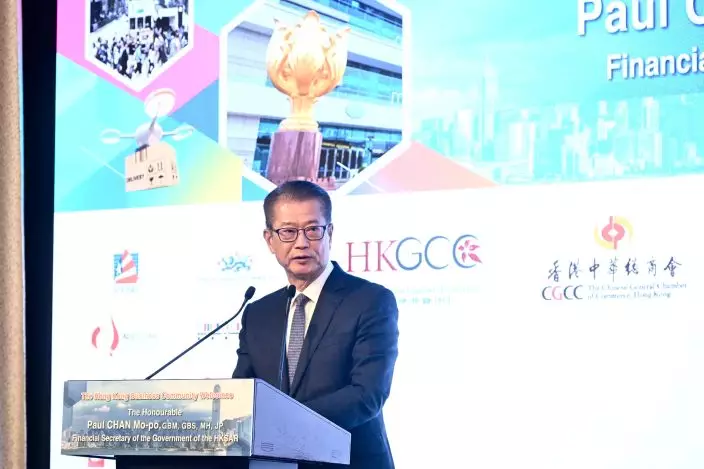
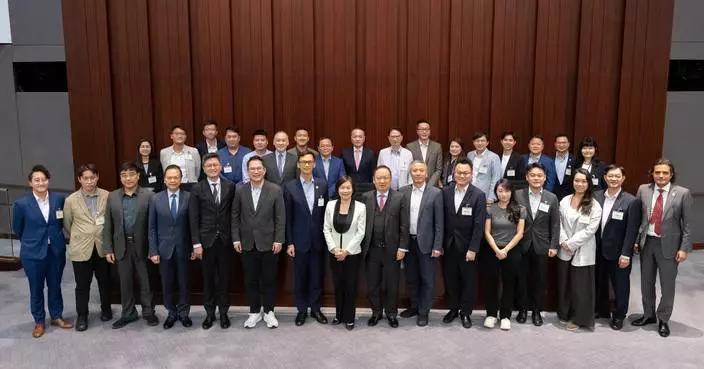
The Financial Secretary, Mr Paul Chan, speaks at the Joint Business Community Luncheon today (March 13). Source: HKSAR Government Press Releases