The German government is expecting the economy to shrink by 0.2 percent this year, revising its previous forecast of 0.3 percent growth, Vice Chancellor and Minister of Economics Robert Habeck said on Wednesday.
Habeck said Germany has made progresses in tackling short-term factors that hindered economic output, such as high inflation, high interest rates, and high energy costs.
However, long-term structural issues, including a significant shortage of skilled labor and inadequate infrastructure investment, continued to impede growth, according to Habeck.
The German economy shrank 0.1 percent in the second quarter this year, following an increase of 0.2 percent in the first quarter. It was previously estimated that the momentum of economic recovery could pick up in the second half of this year.
The estimation has failed to materialize according to the monthly report about the economy published by the German Central Bank, Bundesbank, last month.
Weak domestic demand played a leading role in dragging down the recovery. While high financing costs dampened demand for industrial goods and production plans, private consumption remained weak as consumers chose to save more despite the rise of real income, according to the report.
New orders in the manufacturing sector went down by 5.8 percent in August, compared to the previous month, provisional figures published by the Federal Statistical Office showed on Monday.
Business sentiment among German companies remains gloomy. The ifo Business Climate Index, an indicator of business confidence in Germany, plunged to 85.4 points in September, the fourth decline in a row.
Germany's economy shrank by 0.3 percent in 2023.

Germany's economy set to contract in 2024

Germany's economy set to contract in 2024
The continuing conflict between Israel and Lebanon has not only displaced people from their homes, but also pushed farmers off the land they depend on in the south of the country, as an estimated 80 percent have stopped working due to damaged fields, unsafe roads, and fears of contamination.
Despite Israel and Lebanon agreeing last Thursday to a three-week extension of an original 10-day ceasefire deal which began between in mid-April, deadly Israeli strikes have continued to hit southern parts of Lebanon, resulting in numerous deaths and widespread damage.
Controversy has also arisen over the Israeli military's efforts to extend the territories it occupies in southern Lebanon as part of what it terms as a "security buffer zone" along the border.
Lebanese residents have been warned against returning to their homes within this area, with Israel announcing that anyone who approaches this so-called "Yellow Line" will be considered a threat.
However, in spite of these difficulties, some farmers in the southern city of Tyre are trying to keep their connection to the soil alive.
A group of women have been bravely planting on borrowed land, because their own is now too dangerous to reach. Here, there are growing herbs such as basil, sage, rosemary, mint and thyme in neat rows.
For displaced local farmer Zainab, who hails from the border town of Naqoura, this field is not home, but it is where she has found a way to keep going amid times of crisis.
"I was displaced from my own land. I'm a farmer. I used to farm my land in Naqoura, so I started farming here, too. As you know, most of us from the south are farmers. Agriculture is the main thing we do," she said.
Across southern Lebanon, roughly 80 percent of local farmers have stopped working either because they are unable to reach their land or they fear it is no longer safe.
More than 17,000 farmers have been affected, with their fields damaged by shelling, fires, bulldozing, and contamination.
Officials have condemned the Israeli attacks on the region which have put the livelihood of ordinary people at risk and have cost some innocent civilian their lives.
"Under the recent acts of aggression, there was difficulty for the farmers to get to their lands. Most of the times they would even be targeted. I know some farms owners who hired workers to harvest the crops -- as a result, unfortunately, some of them were killed," said Alwan Charafeddine, the Deputy Mayor of Tyre City.
Agriculture is a key part of the Lebanese economy, but also the backbone of daily life in the south of the country. The region produces staples like olives, citrus, tobacco and vegetables, and when farmers are forced off their land, the consequences are felt across the country.
"I left the land. I left the crops I had planted, which, according to the season, were cabbage, cauliflower, fava beans and peas. More than leaving the land, I left my whole life behind, and now I'm here," said Zainab.
"After the targeting of the bridge that connected Tyre with Sidon, it became hard to get many of the supplies we used to get through there, which has caused the prices of agricultural products to rise," said the deputy mayor.
But amid these hard times, a glimmer of hope remains. On land belonging to local authorities, the Seeds of Tyre project is giving displaced women work, a source of income, and an outlet which allows them to pass on their skills.
Using donated seeds of aromatic herbs, they are producing basil and rose water and orange blossom, generating a small economy which is taking root in the middle of a much larger loss.
For Zainab, working the soil here offers some stability at a time of conflict, with this temporary field helping farmers tick over as they wait for safe access to their own land.
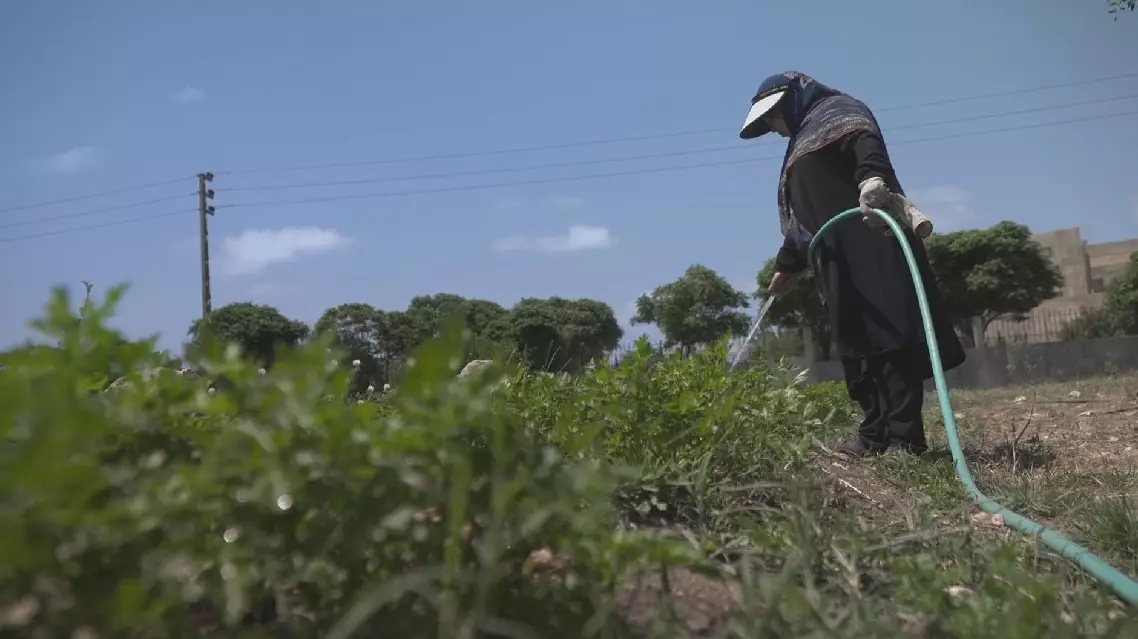
Farmers turn to temporary fields as swathes of land destroyed in southern Lebanon
Farmers turn to temporary fields as swathes of land destroyed in southern Lebanon