The latest separatist remarks by Taiwan region's leader Lai Ching-te have gone against the historical trend, revealing his sinister intention of seeking political self-interest at the risk of undermining peace and stability across the Taiwan Strait, according to a commentary released by the China Media Group(CMG) on Friday.
An edited English-language version of the commentary is as follows:
Since taking office in May, Lai has been peddling the separatist fallacy of "Taiwan independence" in various ways.
In a speech on May 20, upon assuming the role of Taiwan region's leader, Lai presented a new version of the "two states" theory, claiming that the two sides of the Taiwan Strait are "not subordinate" to each other.
Amid the week-long nationwide celebrations of the 75th anniversary of the founding of the People's Republic of China, Lai made comments about the concept of "motherland" during an event in Taipei on Saturday, claiming that "in terms of age, it is impossible for the People's Republic of China to be the motherland of the people of the Republic of China," which sparked criticism from various sectors both on the mainland and in Taiwan.
In a speech delivered in Taipei on Oct. 10, Lai continued to propagate the new "two states" theory and fabricate "Taiwan independence" fallacies, demonstrating his unwavering "Taiwan independence" stance
However, no matter what bizarre theories Lai Ching-te fabricates, they cannot change the objective fact that both sides of the Taiwan Strait belong to one China and that Taiwan is part of China.
The 1943 Cairo Declaration and the 1945 Potsdam Proclamation clearly stipulated that Taiwan, a Chinese territory stolen by Japan, shall be restored to China. This constitutes an important part of the post-World War II international order and also lays the legal foundation that Taiwan is inalienable territory of China.
Fifty-three years ago, the 26th session of the U.N. General Assembly adopted Resolution 2758 with an overwhelming majority, and decided to restore all the rights of the People's Republic of China in the United Nations and to recognize the representatives of the Government of the People's Republic of China as the only legitimate representatives of China to the United Nations, and immediately expelled the representatives of Taiwan from the United Nations and its affiliated organizations.
Resolution 2758 once and for all resolved the issue of representing the whole of China, including Taiwan, in the UN and made clear that there is no such thing as "two Chinas" or "one China, one Taiwan." There is no gray area or room for ambiguity on this matter of principle.
Under the premise of the one-China principle, China has established diplomatic relations with 183 countries. This fully demonstrates that upholding the one-China principle is an international justice and a reflection of the will of the people and the trend of the times. No matter how the DPP authorities stir things up, they will only face greater failure.
In his speech on Thursday, Lai asked the mainland to "shoulder international responsibilities together with Taiwan," which aimed to position cross-Strait relations as a "relationship between two countries" and justify his "Taiwan independence" fallacy.
Taiwan is China's Taiwan, not the so-called "Taiwan of the world." Where does the saying that China "should shoulder international responsibilities together with Taiwan" come from?
Facts showed that it has been widely recognized in the Taiwan region that Lai Ching-te's pursuit of "independence" and provocation is the root cause of unrest and instability in the Taiwan Strait. It will bring disaster to the people in Taiwan and cause them to miss out on development opportunities.
In September, the Chinese mainland announced that it would stop implementing the policy of exempting import tariffs on 34 agricultural products from Taiwan, effective Sept. 25.
Initially in 2005 and again in 2007, guided by the belief that people on both sides of the Taiwan Strait belong to the same family, the mainland exempted import tariffs on 34 agricultural products from Taiwan, including fresh fruits, vegetables, and seafood. This policy effectively helped these products expand their markets on the mainland, bringing tangible benefits to workers in the island’s agriculture and fishery sectors.
However, since Lai took office as the island's leader, the Taiwan authorities have stubbornly maintained a "Taiwan independence" stance, continuously provoking tensions, escalating cross-Strait hostility, and obstructing exchange and cooperation.
The future of Taiwan lies in China's reunification, and the wellbeing of the people in Taiwan hinges on the rejuvenation of the Chinese nation. No matter what "Taiwan independence" theories Lai Ching-te puts forward, they cannot change the legal status of Taiwan as part of China, or the fact and reality that both sides of the Taiwan Strait belong to one China, nor can they deceive the international community.
Lai and others' provocation for "independence" is doomed to fail. China will surely achieve complete reunification. This is a historical trend that no one or any force can stop.
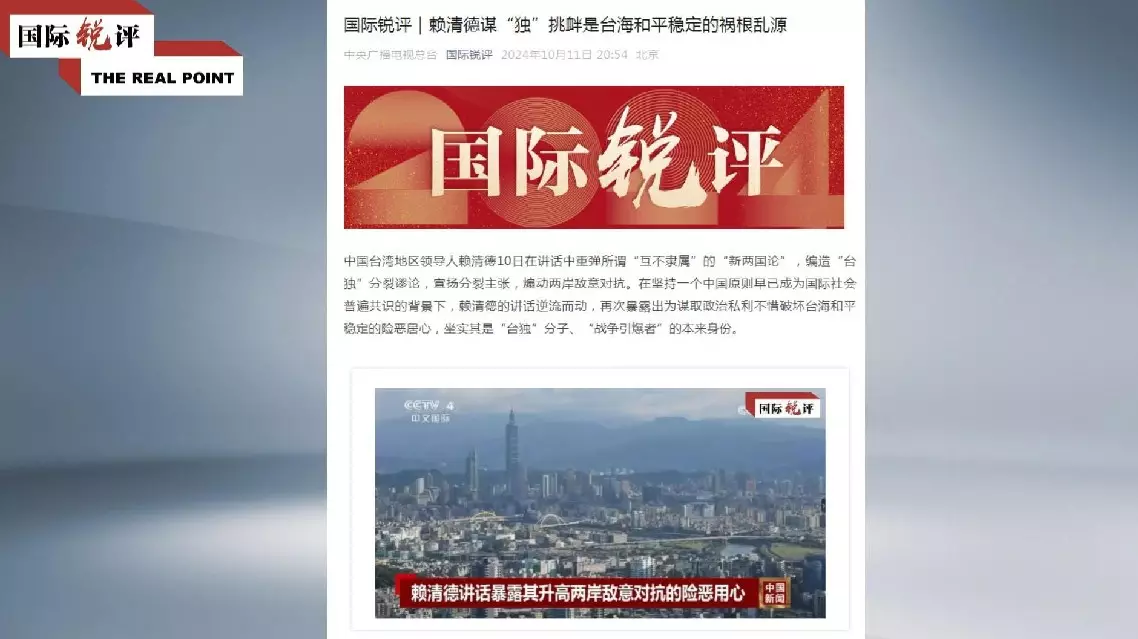
Lai's pursuit of "Taiwan independence" root cause of instability in Taiwan Strait: commentary