The annual return rate of the pension funds entrusted for investment by local governments in China has reached 5 percent since the end of 2016, according to a report released on Saturday by the National Council for Social Security Fund (NCSSF).
The local pension fund is part of the basic pension fund. China started market operation of the basic pension fund in December 2016, with the aim of preserving and increasing its value.
Since then, the local pension funds managed by the NCSSF have earned an investment income of 306.671 billion yuan (about 43.4 billion U.S. dollars), achieving an average annual investment return rate of 5 percent, says the report.
In 2023, investment income of the local pension funds amounted to 39.589 billion yuan (5.6 billion U.S. dollars), with an investment return rate of 2.42 percent, it says.
According to the report, the total assets of the basic pension funds had reached over 2.23 trillion yuan (about 315.81 billion U.S. dollars) by the end of 2023.

China's local pension fund investment achieves 5 pct average annual return: report
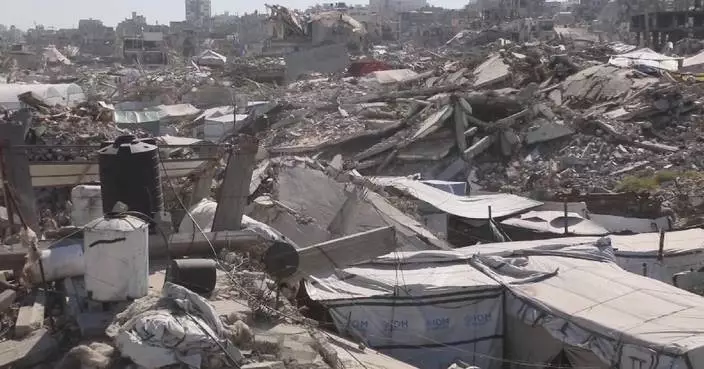
Displaced Palestinians in the Gaza Strip are manually removing rubble using basic tools, in the absence of heavy machinery and international reconstruction assistance.
Seven months into a fragile ceasefire, large-scale reconstruction remains largely stalled in Gaza, with Israeli restrictions on construction materials and unresolved political disputes deemed as key obstacles.
Many families in the enclave say they can no longer wait for rebuilding plans to begin.
Mohammad Adel, who lost his seven-story home in Khan Younis during the war, has been living with his family under difficult displacement conditions in the crowded tents of Al Mawasi for more than two years.
Unable to wait any longer, Adel decided to begin clearing the rubble of his home by hand.
"We see that there will be no reconstruction for Gaza and the closure is very strict on us. Waiting for reconstruction will take a very long time, so we started working and removing the rubble with our own hands. As you can see, this will cost us money, but we are trying to prepare the place so we can live in it," he said.
For some unemployed workers, clearing debris has become a temporary source of income amid the economic collapse caused by the war.
"Today, financial means have become nonexistent. Before the war, I had a chicken farm, but my work stopped because of the war. So I searched for another job that could provide me with an income, and I have no choice except this extremely exhausting work," said Abdullah Al Bayouk, a worker.
Palestinian officials warn that the continued delay in reconstruction is forcing thousands of displaced families to remain inside tents or unsafe damaged buildings, under worsening humanitarian conditions.
"Over 400,000 residential buildings have been either totally destroyed or rendered uninhabitable, along with more than 60 million tons of rubble. And 3,000 more housing units are at risk of collapse, yet people are still living inside them," said Mohannad Abboud, director of reconstruction of the Palestinian Ministry of Public Works.
A recent UN report showed that rebuilding Gaza and clearing the debris will require more than 71 billion U.S. dollars over the next decade. The rubble is estimated to cover around 78 percent of buildings across the strip.
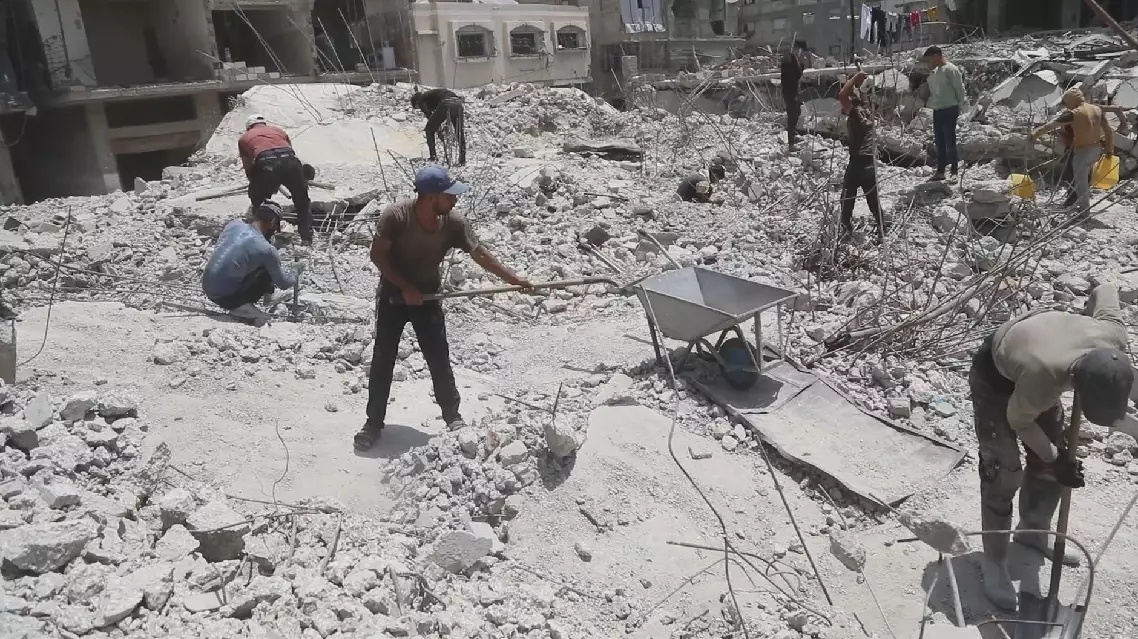
Gaza residents clear rubble by hand as large-scale reconstruction stalls