Skip to Content Facebook Feature Image

CMG hosts exchange event to mark China-Germany comprehensive strategic partnership

China

China

China

CMG hosts exchange event to mark China-Germany comprehensive strategic partnership

2024-10-12 16:29 Last Updated At:20:17

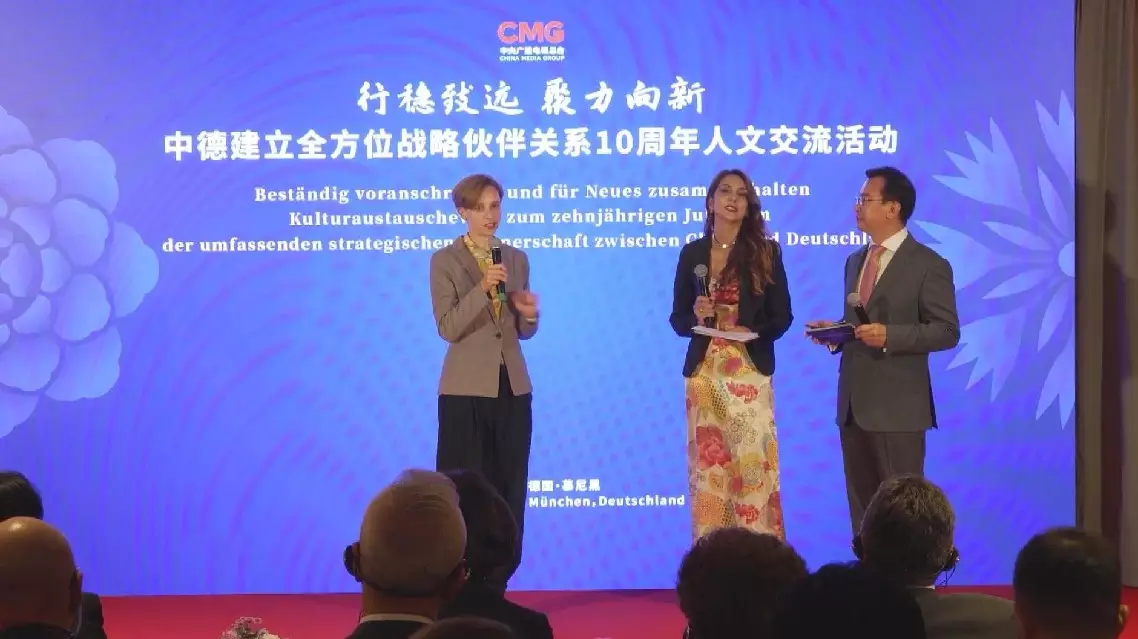
A people-to-people and cultural exchange event hosted by China Media Group (CMG) was held in Munich on Friday to celebrate the 10th anniversary of the establishment of a comprehensive strategic partnership between China and Germany.

The event took place on the 52nd anniversary of the establishment of diplomatic relations between China and Germany, and a number of cooperation projects in the fields of media, film and television were launched.

Xing Bo, Deputy Director of CMG, Zeng Yingru, Minister of the Chinese Embassy in Germany, Franz Josef Pschierer, former Bavarian State Minister of Economic Affairs, Regional Development and Energy, and Armin Schwimmbeck, Director of Asian and Bavarian Affairs of the Bavarian State Office of Foreign Trade, attended the event and delivered speeches.

In her speech, Xing said that this year marks the 10th anniversary of the establishment of a comprehensive strategic partnership between China and Germany. The world is undergoing a century of rapid changes, and the risks and challenges facing human society are increasing. To solve these problems, cooperation between major countries is essential. CMG is willing to work hand in hand with friends from all walks of life in Germany to be a promoter of the prosperity and development of China and Germany, and to share the opportunities and dividends brought by China's further comprehensive deepening of reforms.

Pschierer said that Bavaria and China have a long history of traditional friendship. Many companies have actively invested in China and achieved great success, benefiting greatly from the common growth with China. Through reports from Chinese media, he also found that German classical music is very popular in China, and musicians including Beethoven and Strauss are well-known in China. He hopes to build a bridge of friendship and promote more cooperation between the two countries in the fields of economy and other fields through the sharing of culture and art.

Zeng said that for more than 50 years, China and Germany have continued to promote the healthy and stable development of bilateral relations. Since President Xi Jinping visited Germany in 2014 and the two countries established a comprehensive strategic partnership 10 years ago, the political mutual trust between the two sides has been continuously strengthened, pragmatic cooperation has yielded fruitful results, and cultural exchanges have become more active. This exchange event hosted by CMG will become an important platform to promote the mutual understanding between the two peoples and the mutual learning of civilizations, she said.

Schwimmbeck said that China has been Bavaria's largest trading partner for seven consecutive years. China's importance to Bavaria is not only economic, but multi-dimensional. Bavaria is committed to developing close and sincere cooperation with China and firmly opposes trade protectionism. He believes that through face-to-face exchanges and discussions, the cooperation and mutual trust between Germany and China can be further enhanced.

At the event, CMG Europe and Germany's Vogel Communications Group jointly launched an exchange project "Understanding China - German Journalists' China Trip in 2025". In cooperation with CMG, Vogel will send journalists to China in 2025 to experience the vivid practice of Chinese path to modernization.

The international version of documentary "Time: A Journey through Thousands of Years", co-produced by CMG and German Television ZDF, was released at the event. The film will be shown at the Cannes Television Festival in autumn, using the power of images to show mankind's unremitting exploration of time itself.

The event also announced CMG’s "Giant Pandas in Germany" video cooperation plan, which shares detailed video clips of the life of giant pandas in Germany. A corresponding section was launched simultaneously at CMG's official website.

The Chinese Choir of the Burg Gymnasium, a German high school, performed Chinese songs "Let's Start Rowing the Oars" and "On Wings of Song" on the spot. The choir members also carefully prepared a collection of photo albums and presented them to CMG.

The event was attended by Xia Yongmin, deputy editor-in-chief of CGTN, Teng Yunping, director of the CMG International Communication Planning Bureau, and nearly 100 guests from various sectors in Germany.
CMG hosts exchange event to mark China-Germany comprehensive strategic partnership


CMG hosts exchange event to mark China-Germany comprehensive strategic partnership
Major breakthroughs by Chinese scientists have laid the foundation for a future where space-based solar power stations are capable of wirelessly transmitting energy to Earth and spacecraft, though significant engineering problems remain.

A research team from Xidian University in northwest China's Shaanxi Province has made significant progress on the Sun Chasing project, or "Zhuri" in Chinese. The team has developed a ground-based test system for wireless power transmission that can charge multiple moving targets at the same time.

In recent tests, the system achieved a wireless power transmission efficiency of 20.8 percent from direct current to direct current over a distance of 100 meters. It delivered 1,180 watts of power. The team has also built a wireless charging system for drones. In a test, a drone flying at 30 kilometers per hour was able to receive 143 watts of stable power from 30 meters away.

A space solar power station works exactly as its name suggests: a huge array of solar panels placed in orbit. It would collect sunlight in space, where the sun always shines, and then convert that energy into microwaves or lasers to beam down to Earth or directly to satellites and spacecraft. This could address two significant issues: supplying uninterrupted power for space missions and alleviating energy shortages on the ground.

"The construction of space solar power stations could become a major undertaking in the future. One potential benefit is access to a virtually unlimited power supply. Because energy can be collected continuously in space 24 hours a day, electricity could be supplied on an uninterrupted basis," said Fan Guanheng, an associate professor at the School of Mechano-Electronic Engineering at Xidian University.

"Secondly, it could reduce our dependence on fossil fuels, thereby lowering carbon emissions and helping protect the environment. Thirdly, it could support the development of charging infrastructure in space and enable wireless microwave charging for spacecraft, changing the way power is supplied to space vehicles," the professor added.

In 2018, the research team launched the first phase of the Sun Chasing project to build a ground test system. By June 2022, they had completed the world's first full-link, full-system ground validation system for a space solar power station. Now, the team has moved to phase two. The goal now is to solve the challenges of generating high power in space and transmitting it efficiently over long distances.

According to Duan Baoyan, an expert at Xidian University and an academician of the Chinese Academy of Engineering, recent breakthroughs include improving the efficiency of solar energy collection and conversion, increasing the precision of microwave beam control to reduce energy loss, and making the transmitting and receiving antennas smaller and lighter, which is critical for space application.

The team has also solved the problem of how to power multiple moving targets at once using a single transmitter. This means that in the future, one space power station could potentially supply electricity to several satellites or ground vehicles at the same time, Duan said.

Despite the advances in ground-based validation, a series of technical challenges must still be overcome before the technology can be deployed in space.

"The first issue that needs to be addressed is the adaptability of components to the space environment, as conditions in space are completely different from those on Earth, including radiation exposure and extreme temperatures. Another challenge involves the deployment and retraction design of transmitting and receiving antennas. We also need to develop thermal management systems to cope with extreme temperatures and temperature fluctuations in space. These are all areas where further breakthroughs are needed," said Qian Sihao, an associate professor at the School of Mechano-Electronic Engineering at Xidian University.

"We have now completed the development and validation of a ground-based test system, and our next step is to carry out in-orbit wireless microwave power transmission," Fan said.

With ground validation complete, the team now turns its attention to overcoming the harsh realities of space, aiming to demonstrate in-orbit wireless power transmission and bring the vision of orbital solar energy closer to reality.

Space-to-earth solar power moves closer to reality although hurdles remain: scientists

Space-to-earth solar power moves closer to reality although hurdles remain: scientists

Recommended Articles