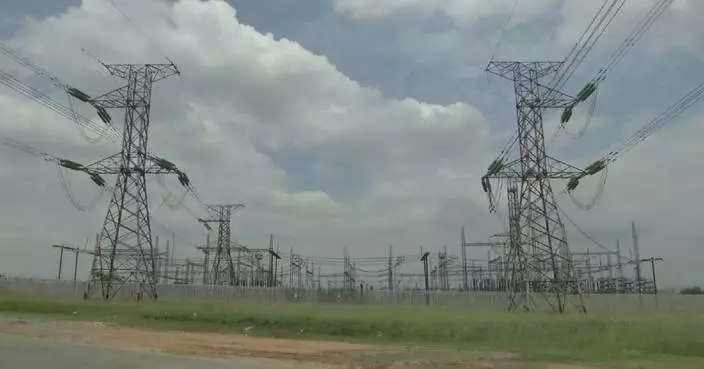
Typhoon Dolphin has brought strong winds and heavy rainfall to east China after making two landfalls along the coast of east China's Zhejiang Province, prompting local authorities to take active measures for disaster response.
The typhoon made its second landfall at Yueqing in Wenzhou City of east China's Zhejiang Province at around 18:40 on Sunday, about an hour after it first landed at Yuhuan in Taizhou City, Zhejiang.
China's National Commission for Disaster Prevention, Reduction and Relief on Monday activated a Level-IV national disaster relief emergency response for Zhejiang Province after the region was severely affected by Typhoon Dolphin, the 13th typhoon of the year.
The county-level city of Yuhuan has seen infrastructure damage and crop losses. Police officers and sanitary workers have been working overnight to clear fallen trees and debris from roads, as well as push stalled vehicles to safety.
Heavy rainfall has caused severe flooding in Chatou Village of Qinggang Town, trapping villagers and blocking roads. Rescue teams arrived promptly with inflatable boats to conduct door-to-door evacuations and assist stranded residents.
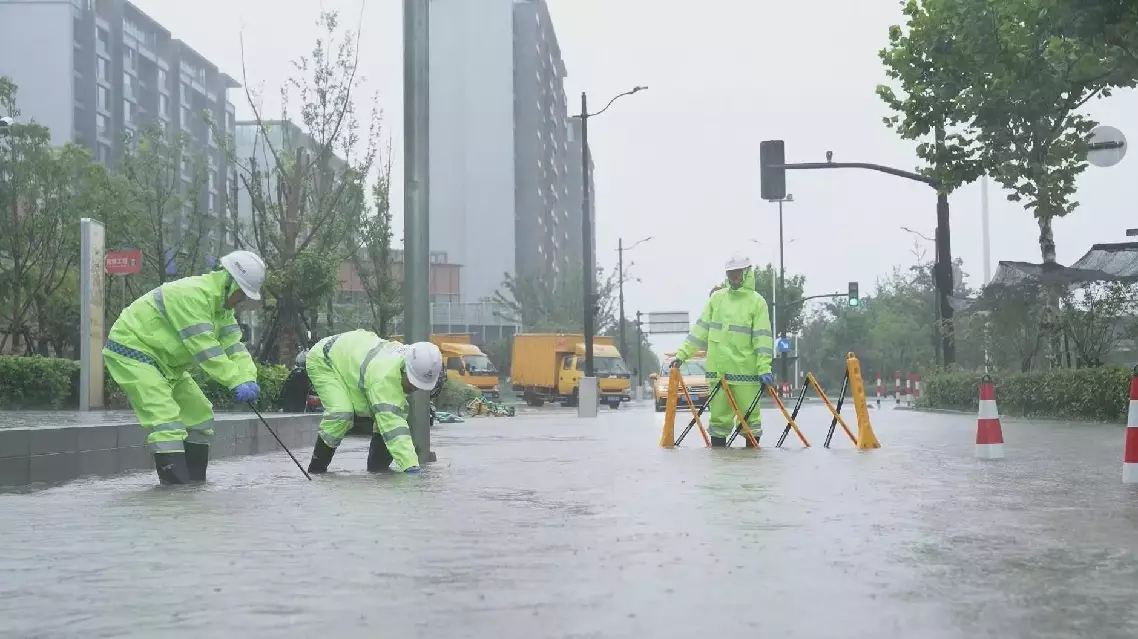
In Yueqing, persistent heavy rain has led to nine localized flooding areas since Sunday night. Over 400 flood relief personnel have been mobilized to carry out drainage operations.
As the typhoon is gradually moving away from Zhejiang, both airport and railway services in Wenzhou City have resumed orderly operations.
Shanghai issued an orange alert for rainstorm on Monday morning. Some road sections were severely flooded, affecting traffic. Communities in low-lying areas have seen water logging.
Meanwhile, water levels continued to rise in the Suzhou River, submerging some waterfront platforms. Emergency services deployed high-capacity pumping devices, manually transferring water from the river into the Huangpu River to safeguard flood defenses along 25 drainage systems.
Suzhou City and Nantong City in Jiangsu Province also experienced strong winds, prompting rapid deployment of typhoon response measures, including vessel control at fishing ports and traffic restrictions on cross-river bridges.
In Wuxi, a steel plate from a construction site was blown onto the road by strong winds, and a car was accidentally crushed by the steel plate. Firefighters lost no time to reach the scene and promptly handled the situation.
Authorities are monitoring flood-prone river channels, mountain runoff areas, waterlogged bridges and key transportation infrastructure to prepare for emergencies.
China has a four-tier color-coded weather warning system, with red representing the most severe, followed by orange, yellow and blue. It also has a four-tier emergency response system, with Level I being the highest.
Typhoon Dolphin hits east China with heavy rains, prompting emergency response

American high schoolers kicked off an eight-day tour of China on Monday, playing series of friendly pickleball and table tennis matches with local students in Beijing.
During their time in the Chinese capital, the students from the U.S. state of Iowa also practiced Wushu, an ancient form of Chinese martial arts, and visited the Olympic Education Museum.
Their trip will also take them to Qingdao, a coastal city in eastern China's Shandong Province, and Hebi City in central China's Henan Province, where they will visit cultural and natural attractions, according to China's Ministry of Education.
The sports exchange took place at the Capital University of Physical Education and Sports, one of the main stops of the 2026 U.S. Youth Pickleball People-to-People Exchange China Tour.
Originating in the United States, pickleball is a paddle sport that blends elements of tennis, badminton and table tennis. The popularity of the three sports in China has helped fuel pickleball's growing appeal across the country.
"I've had a lot of fun. I've learned a couple of new things. And I've been able to share those experiences with new people I've been meeting," said Nora Say, a high school student from Iowa.
Pickleball has grown increasingly popular among young people in both countries, leading to its incorporation into youth exchange programs in recent years. Students built connections through the game.
"Honestly, working with him was probably the best part. Just like being with your teammate out there, and trying your best," said Anthony Aguilar, a high school student from Iowa, speaking about his Chinese pickleball partner.
"We are very happy. I enjoy playing with him," said Yu Zongsheng, a student from Capital Normal University Pingguoyuan High School.
Table tennis, a sport with a rich history in China, was another part of the exchange. Before the U.S. students arrived, their Chinese peers got ready to welcome them and introduce them to the game.
"I prepared by thinking about some simple ways to communicate with them, practicing more to get a better feel for the game, and figuring out how I could help them get a better understanding of table tennis," said Cui Yimeng, a student from Capital University of Physical Education and Sports.
The visitors said they learned a lot about the sport during the exchange.
"I think it's pretty fun. I did not expect a lot of certainties on how to hold the paddle, where to put your fingers, how to angle your paddle," said Elsie Aguilar, a recent high school graduate from Iowa.
Sports have played a notable role in China-U.S. relations for decades. In 1971, a U.S. table tennis team made a historic trip to China, marking the reopening of channels for friendly people-to-people exchanges between the two countries.
China launched an initiative in November 2023 to invite 50,000 young Americans to visit the country for exchange and educational programs over a five-year period. According to China's Ministry of Foreign Affairs, more than 50,000 young Americans have since visited China, reaching the target two-and-a-half years ahead of schedule.
US students visiting Beijing enjoy sports exchanges with Chinese peers