ASEAN secretary-general Kao Kim Hourn said he looks forward to seeing a broader range of product availability in both China and the Southeast Asian region following the recent upgrading of the China-ASEAN Free Trade Area (FTA).
At the 27th ASEAN-China Summit held in Vientiane, Laos on Thursday, the parties announced they had agreed to the FTA to to Version 3.0, providing an institutional guarantee for the two sides to jointly build a hyper-scale market, a significant step toward leading economic integration in East Asia.
In an interview with China Central Television (CCTV), Kao said this upgrade will promote mutually beneficial cooperation between ASEAN and China in various fields.
"Well, after almost two years of negotiations, both sides, ASEAN and China, have already reached substantial outcomes on the negotiation for the upgrade of ASEAN-China FTA 3.0. So this is a very substantial outcome. This will be a major contribution to the economic cooperation between ASEAN and China because ASEAN and China are the largest trade partner of each other. So we expect with the upgrade, we hope that trade, investment and tourism will continue to increase even more. And I think that would be a positive and major development and transformation between ASEAN and China in terms of working together in the area of economic cooperation," he said.
He also expressed expectations that the upgrade will promote trade facilitation and drive cooperation between ASEAN and China in areas such as logistics and the service industry.
"Open trade means that the products will become much more available on both sides. And I think, for example, ASEAN has been exporting a lot of agricultural products to China. And with this upgrade, we will see more flows of goods on both sides, goods and services. So this is the kind of thing we hope to see. At the same time, of course, we want to see more cooperation in the tourism sector, we want to see more investment from both sides," he said.
China and ASEAN, together accounting for a quarter of the world's population, have been each other's largest trading partners in the last four years. In 2023, China's investment in ASEAN increased by as much as 44.6 percent, while accumulated two-way investment between China and ASEAN countries has surpassed 380 billion U.S. dollars.
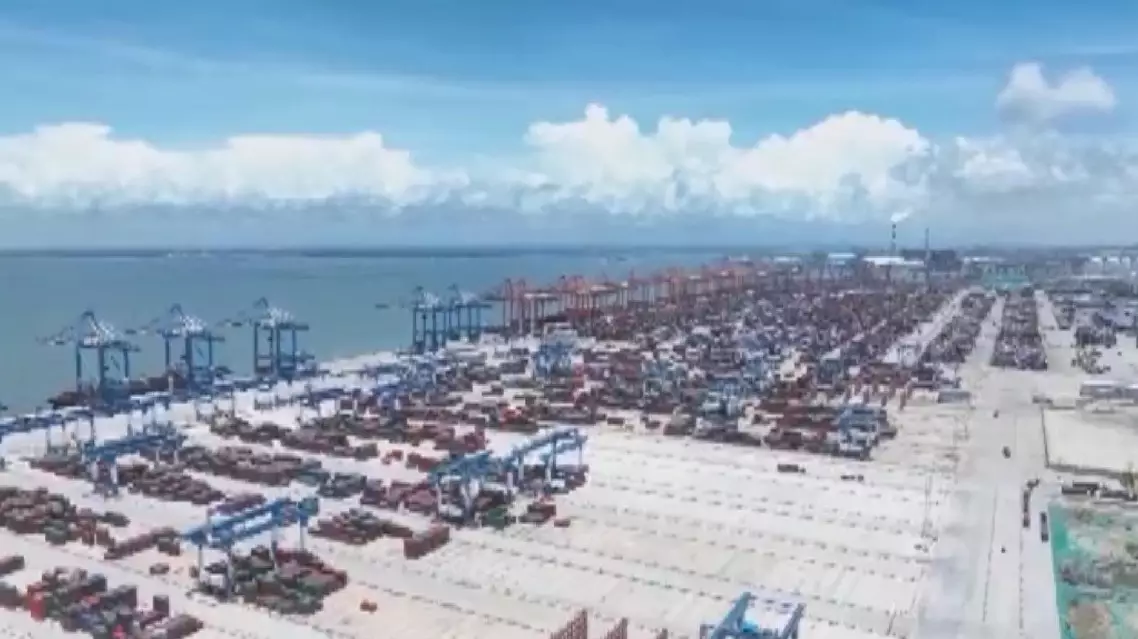
ASEAN Secretary-General expects wider product availability across region under FTA upgrade
China's first 500-kV cross-border alternating-current power interconnection project entered service Monday, creating the highest voltage grid tie between the two countries and advancing Belt and Road energy cooperation.
The project raises two-way power transfer capacity between the two countries from 50,000 kW to 1.5 million kW, enabling the annual transmission of about 3 billion kWh of clean electricity, roughly 30 times the capacity of previous lines, according to China Southern Power Grid.
As the largest cross-border grid project and the highest-voltage power link between China and Laos, it connects southwest China's Yunnan Province with Oudomxay and Luang Namtha provinces in northern Laos.
Cross-border electricity trading began as the project entered operation. About 4.81 million kWh of power from clean energy bases in northern Laos was transmitted to Yunnan through the new line, marking a more regular and institutionalized phase of power connectivity between the two countries.
It is also the first time an overseas new energy project has participated in China's electricity market, the company said. The power involved in the transaction came from a large mountain photovoltaic project in Laos, one of the core supporting power sources for the interconnection line.
"This project is the cross-border power grid project with the highest voltage level between China and Laos. Leveraging the China-Laos power grid interconnection and the power markets in southern China, surplus hydropower from Laos can be transmitted to China during the rainy season, while China can supply supplemental power to northern Laos during the dry season. This project represents yet another landmark achievement between China and Laos in deepening power cooperation and jointly advancing the high-quality development of the Belt and Road Initiative," said Li Jingru, general manager of Electricite du Laos Transmission Company Limited (EDL-T), a joint venture of China Southern Power Grid and Lao state-run Electricite du Laos.
The solar project has an average annual power generation capacity of about 1.65 billion kWh. In 2026, it is expected to transmit about 1.1 billion kWh of solar power across the border, supporting energy complementarity between the two countries.
"In the future, efforts will be made to further promote normalized cross-border electricity trading, meet the trading needs such as electricity transmission from Laos to China's Yunnan, from China's Yunnan to Laos, and from Laos to China's Guangdong, and facilitate the optimal allocation of energy resources in the Lancang-Mekong region," said Li Minhong, marketing director of China Southern Power Grid.
Construction of the interconnection project began in late February last year. Spanning a total length of 177.5 km, the transmission line includes a 145-km Chinese section and a 32.5-km Lao section.
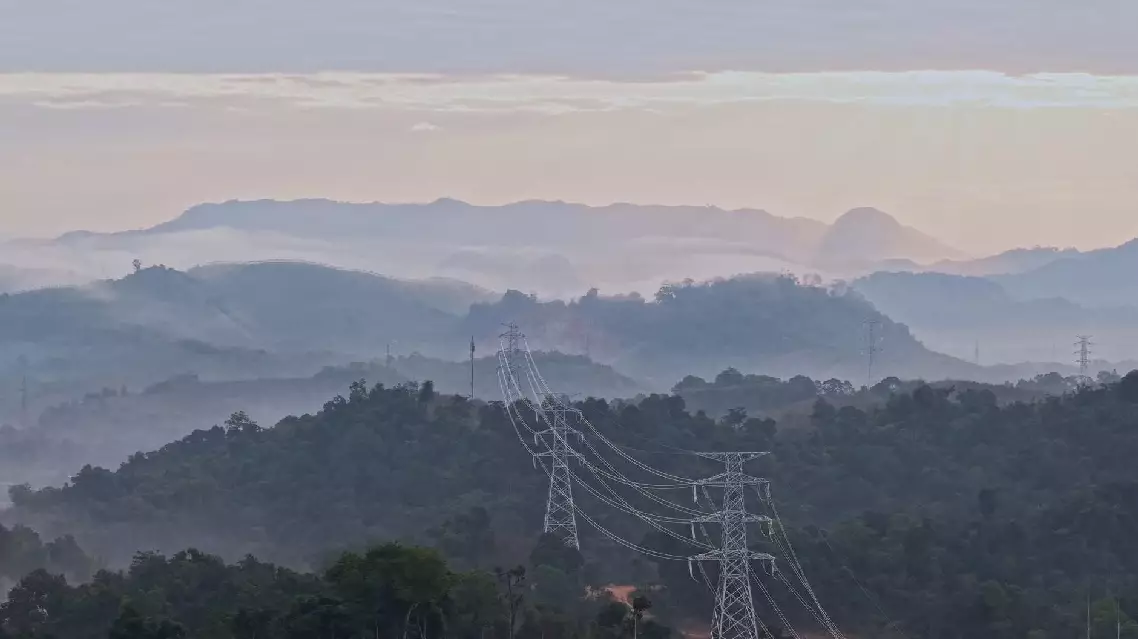
New China-Laos power link expands transfer capacity 30-fold, boosts electricity trading