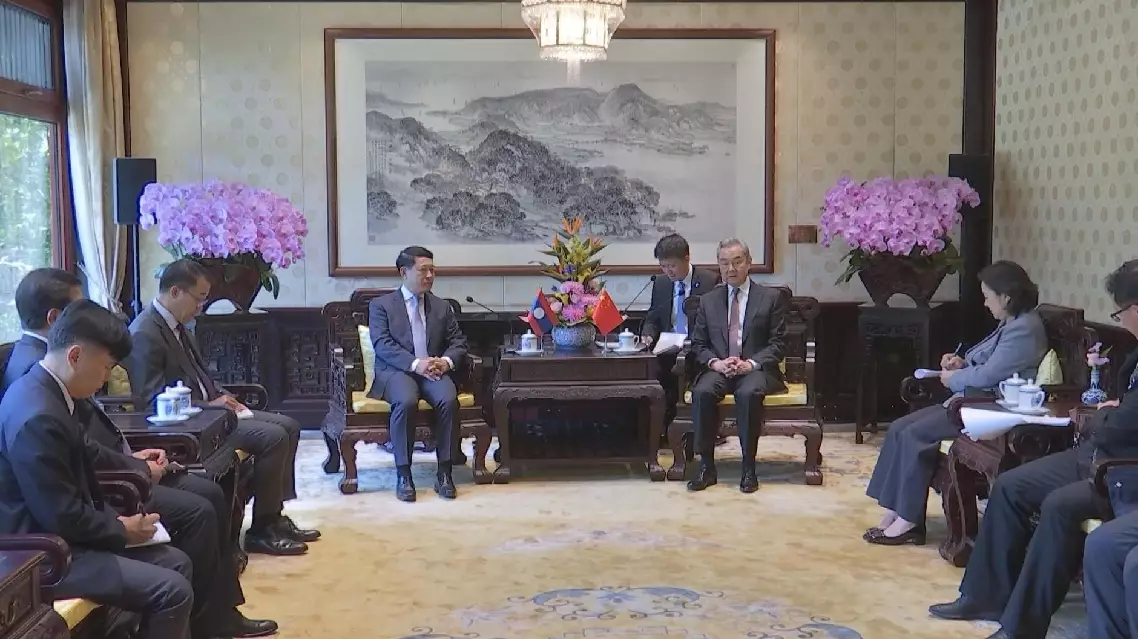
The year 2026 marks the 65th anniversary of diplomatic relations between China and Laos as well as the Year of China-Laos Friendship, presenting important opportunities for the development of bilateral relations, Chinese Foreign Minister Wang Yi said on Tuesday.
Wang, also a member of the Political Bureau of the Communist Party of China Central Committee, made the remarks when meeting with Lao Deputy Prime Minister Saleumxay Kommasith, who is visiting China as special envoy of Thongloun Sisoulith, general secretary of the Lao People's Revolutionary Party (LPRP) Central Committee and president of Laos.
Wang welcomed Saleumxay to visit China, saying the visit fully reflects the high level of the China-Laos community with a shared future and will further enhance the strategic mutual trust between the two sides.
Wang called on both sides to strengthen inter-governmental institutional dialogues, enhance the quality and efficiency of China-Laos railway connectivity, jointly build an upgraded version of the China-Laos Economic Corridor, and deliver more tangible outcomes in advancing regional connectivity.
China will leverage its strengths to align development strategies with Laos, boost whole-industry-chain cooperation in minerals, electricity and other sectors, deepen human resources development, and support Laos in economic transformation and industrial growth, he said.
Saleumxay, also a member of the Political Bureau of the LPRP Central Committee, said Laos is willing to maintain close high-level exchanges with China, jointly hold successful celebration activities for the 65th anniversary of diplomatic relations, and deepen cooperation in areas such as connectivity, energy and minerals.
Saleumxay expressed appreciation for China's stance and role in major international and regional affairs, saying Laos is ready to strengthen coordination and cooperation with China.
China-Laos ties face important opportunities in 2026: Chinese FM
A year after issuing its first ocean forecasting AI system, Chinese scientists on Saturday rolled out LangYa 2.0, a major upgrade that moves beyond basic sea variables to predict complex marine phenomena including typhoons, extreme rainfall and storm surges.
The new model was unveiled at the ongoing Fourth China Digital Earth Conference in Qingdao, a coastal city of east China's Shandong Province.
Developed by the Institute of Oceanology under the Chinese Academy of Sciences (IOCAS), LangYa 2.0 marks a leap from global ocean state forecasting to intelligent prediction of complex marine phenomena, making ocean forecasts perceptible, actionable, and decision-ready, according to Wang Fan, president of IOCAS.
It will provide intelligent support for marine disaster prevention, shipping safety, polar navigation, and climate response, he added.
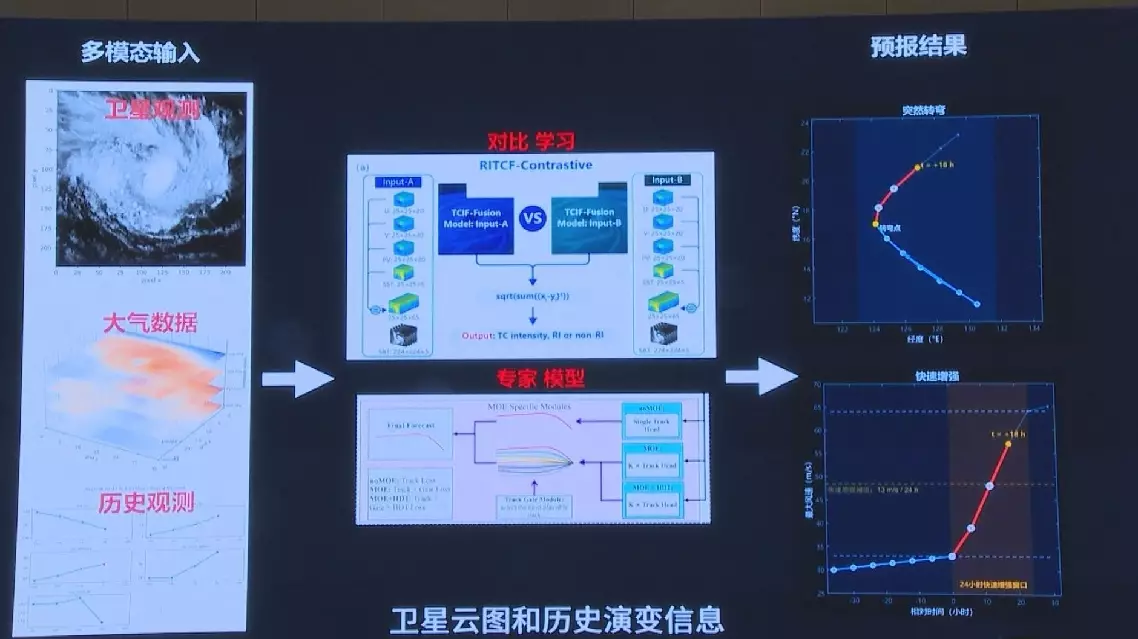
The upgraded system now predicts six key marine phenomena -- typhoons, extreme rainfall, storm surges, internal solitary waves, mesoscale eddies, and sea ice.
It does so via six specialized vertical sub-models, each trained on unique datasets and physical mechanisms. Together, they form what the research team calls "a diagnostic AI," which delivers direct, actionable forecasts.
Take typhoons for example. The typhoon module fuses atmospheric and oceanic fields, satellite cloud imagery and historical typhoon tracks. It is specifically designed to handle two notoriously hard-to-predict behaviors: rapid intensification and sudden turning. For coastal communities, those few hours of extra warning can mean the difference between evacuation and disaster.
For offshore engineering, LangYa 2.0 can identify internal solitary waves -- the powerful, hidden currents that can damage oil platforms.
It forecasts their evolution over the following 30 days and allows users to query speed, amplitude and other key parameters for the coming week, according to the research team.
Even before its official release, version 2.0 has begun to prove its worth.
Independently validated by the Sea Ice Prediction Network, an international collaboration of scientists and research institutions dedicated to improving seasonal forecasts of Arctic sea ice, LangYa 2.0 ranked first among multiple global models in the 2025 seasonal forecast for September Arctic sea ice extent, which refers to the area of ocean covered by ice.
It delivers monthly-scale predictions at three-kilometer resolution, which is critical for Arctic shipping routes, climate research and polar navigation safety, the team noted.
China releases LangYa 2.0 AI model for full-blown marine phenomenon forecasting