Skip to Content Facebook Feature Image

Poor harvest, short supply fuel cabbage price surge in South Korea

China

China

China

Poor harvest, short supply fuel cabbage price surge in South Korea

2024-10-16 20:15 Last Updated At:20:37

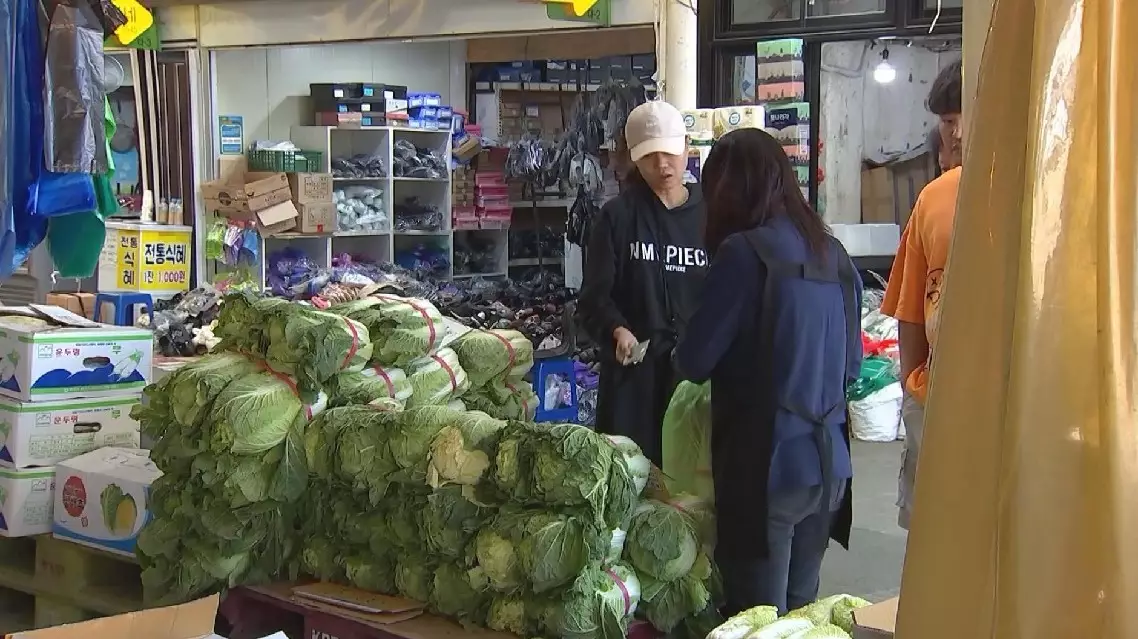
Cabbage prices are soaring in South Korea amid poor autumn harvests and a short supply in the market, which have imposed an additional burden on people's livelihoods.

Cabbage is a key ingredient of kimchi, the country's famed fiery fermented dish which many South Koreans eat every day.

Due to the blistering summer heat and prolonged drought, cabbage grown in many parts of the country, including the main producing area Gangwon-do, suffered poor growth, rotten roots and diseases, resulting in a significant drop in output.

In the second week of this month, cabbage shipment for the largest wholesale market of farm products in the country's capital Seoul fell over 30 percent compared with the previous week. As a result, the average wholesale price of 10 kilograms of cabbage jumped 86 percent year on year to about 17.01 U.S. dollars.

"Although some cabbage hasn't fully matured, many farmers harvest them in advance when the cabbage prices are high in the market. This leads to a sharp decline in shipment from cabbage producing areas. Therefore, the vegetable's prices will remain high in the short term," said a staff member with the wholesale market.

Data from the Korea Agro-Fisheries and Food Trade Corporation showed on Tuesday that the average retail price of a head of cabbage is about about 6.47 U.S. dollars, an increase of more than 30 percent from the previous year.

The high prices have dissuaded many customers despite their wish to use them to make kimchi.

"The cabbage prices are so high that I can't make kimchi now. I'll reconsider it when the price drops," said a customer.

The country has increased cabbage imports from its neighbor China to alleviate short supply in the market.

Data from the country's Ministry of Agriculture, Food and Rural Affairs showed on Tuesday that since the end of last month, South Korea has imported 48 tons of cabbage from China, with another 54 tons to arrive via the Pyeongtaek port on Thursday.

The total cabbage imports are expected to reach 1,100 tons by the end of this month.
Poor harvest, short supply fuel cabbage price surge in South Korea

Poor harvest, short supply fuel cabbage price surge in South Korea

As Cuba's fuel shortage deepens following a U.S. oil embargo imposed last month, Russia, Mexico and Chile have stepped in with humanitarian assistance while also calling for dialogue to ease tensions and address the sanctions.

On January 29, U.S. President Donald Trump signed an executive order threatening to impose tariffs on countries that sell or provide oil to the Caribbean nation. The embargo has sharply worsened the island nation's energy shortages, disrupting critical social services including healthcare and transportation.

"It is really serious. It hasn't been so tough for Cubans for many, many years. It isn't just the fact that some airlines can't come in -- some ones aren't coming in -- because they can't get fuel to get out. It means that the tourist industry, what little was left, has collapsed. And also cargo flights aren't getting in. Remember that without fuel, there's no electricity. There are constant blackouts. Hospitals are in trouble. The government's had to ration fuel. How do you get to work if public transport isn't working? So times really are very tough," introduced CGTN correspondent in Cuba Michael Voss.

"The Cubans are resilient. How can they manage to keep 1950s American cars on the road without any spare parts? Now people, for example, are stockpiling carbon so that they can cook on it. It's times [which] are very tough and it's very difficult to know where it's going to go from here," he added.

On Thursday, Kremlin spokesman Dmitry Peskov said Russia hopes to pursue constructive dialogue with the U.S. regarding the embargo and does not seek escalation over its assistance to Cuba. Russian media Izvestia, citing the country's embassy in Havana, reported that Moscow will soon deliver crude oil and fuel to Cuba as humanitarian aid.

The same day, two Mexican Navy logistics vessels carrying approximately 814 tonnes of humanitarian supplies docked at the Havana Port. The shipment, including milk powder, meat products, beans, biscuits and hygiene items, marked the first Mexican government aid to arrive following Washington's tariff warning. Mexican President Claudia Sheinbaum described the assistance as a gesture of "solidarity" and said Mexico is willing to facilitate dialogue between the U.S. and Cuba if both sides agree.

Chilean President Gabriel Boric also announced humanitarian support for Cuba, criticizing the recent tightening of U.S. measures as criminal actions and infringement to human rights of the whole Cuban nation, and calling for an end to the decades-long blockade. He said that while disagreements may exist, civilians, particularly children, should not bear the consequences.

The president also urged the international community to heed repeated United Nations General Assembly calls to lift the sanctions.

Cuba fuel crisis intensifies under U.S. embargo, international community extends humanitarian aids

Cuba fuel crisis intensifies under U.S. embargo, international community extends humanitarian aids

Recommended Articles