President of the Brazilian Space Agency Marco Antonio Chamon called for enhanced space collaboration among BRICS countries.
Chamon expressed his profound admiration for the blooming development of the space industry, especially in the realm of private enterprises, during an interview with China Global Television Network (CGTN) at the 75th International Astronautical Congress (IAC) held in Milan, Italy from Monday to Friday.
The IAC, held annually since 1950, is the largest global event in the aerospace sector.
During this year's event, over 200 technical sessions were held, covering a wide range of topics, including sustainable exploration of the Moon and Mars, space-based Earth observation for climate change, the role of private companies in space development, and applications of artificial intelligence.
"Very impressed here with the blossoming of the industry in space, the private industries, the private business we have here. One thing that is very impressive is space stations. We have a lot of proposals of private space stations done by many companies here. I saw many companies providing complete solutions for small satellite constellations. In fact, a great, a real revolution in space," said Chamon.
Chamon also expressed his hope for increased space cooperation between Brazil and China, citing the longstanding collaboration between the two countries in the space sector.
Over the past 30 years, China and Brazil have achieved fruitful results in the China-Brazil Earth Resource Satellite (CBERS) project.
China and Brazil have jointly developed six earth-resource satellites, and the CBERS-4 and CBERS-4A satellites are operating smoothly in orbit.
"We have today two satellites in orbit operating, CBERS-4 and 4A, that we share in terms of data and control. But now we are moving forward for other technologies. One, radar, it's very useful, two for land imaging and meteorology that is very important to us in terms of monitoring and forecasting of natural disasters. We will discuss and we will act in terms of lunar or space exploration outside the orbit of Earth, with China. So, it's really a fantastic and very fruitful collaboration that we have between Brazil and China," he said.
Chamon also sees broad prospects for aerospace cooperation among the BRICS countries, which have signed an agreement on cooperation in sharing remote sensing satellite data.
The agreement enables BRICS space agencies to jointly build a "virtual constellation of remote sensing satellites," which works as a data sharing mechanism.
"We need more and more collaborations and I think BRICS and other multilateral mechanisms, BRICS in particular, is very important for that. The remote sensing agreement that we have signed among BRICS countries is a very important sign that we can and we do things together. But we have already implemented some projects inside this agreement and very successfully. I think that the future of BRICS and BRICS Plus is to expand our collaboration in remote sensing, including other technologies and capacity building," said Chamon.
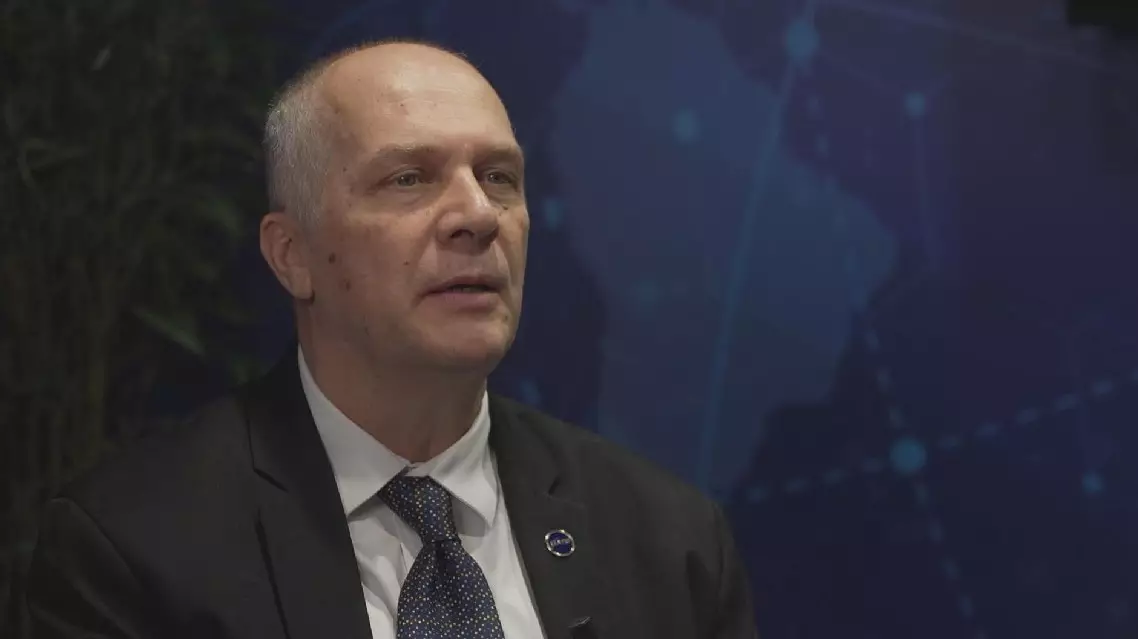
Brazilian space chief calls for enhanced collaboration among BRICS countries