Switzerland and Italy have to redraw their shared border in the Alps, as the glaciers marking part of the territorial boundary between the two European neighbors are melting, according to the Swiss government.
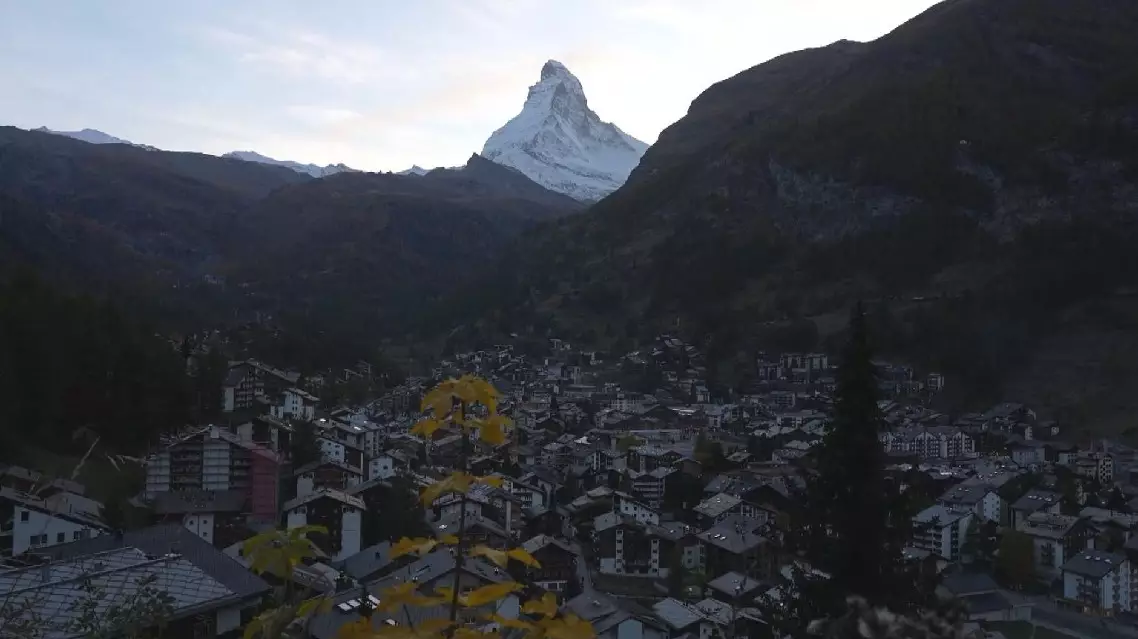
The Zermatt region has seen changes in its glaciers and ridgelines over the past few years due to melting glaciers caused by climate change, which is why Switzerland and Italy need to renegotiate the border in Zermatt.
Located at the foot of the Matterhorn in the Alps, Zermatt is a popular outdoor sports destination in Europe, where hikers and ski enthusiasts can traverse the valleys and glaciers between the two countries.
Hence, the shifting of national borders not only involves natural ecology, but also certain practical life and business factors.
"Due to the glacier retreat or melting ice, the border still is always in movement. And [in] this case, the concerned buildings suddenly were not anymore in Italy, but in Switzerland. It's not always only about taxes, about rights, about employees where you can get your stuff at a restaurant, but also in terms of rescue, because if there is an accident in one nation, so the rescue teams from this nation will be responsible for the rescue, so not that we have two helicopters on both sides starting and try to rescue the people concerned," said Raphael Wyss, business supervisor at the Swiss Federal Office of Topography, or Swisstopo.
A draft to the border changes were agreed back in 2023. The Swiss government has officially approved the adjustment, while the process for approval is underway in Italy.
As soon as both parties have signed, the agreement will be published, with details of the new border to be made public.
Swiss geographers say that the Zermatt region's glaciers are not the only ones affected by climate change. The glaciers in Switzerland are melting faster than ever before, such as the Aletsch Glacier, the largest in the Alps, which has retreated more than three kilometers from its highest level.
"In the last years, it was faster to retreat, so about 50 meters per year. On a hot summer day, there is a loss of about 10 centimeters per day. So that's quite a big loss. Since 1850, there was a temperature increase in the Alps, about two degrees. Worldwide it was one degree. So it's the double. And this has an influence on the glaciers, and the glaciers are melting due to the climate change," said Jessica Oehler, a geographer for the Foundation UNESCO World Heritage Swiss Alps Jungfrau-Aletsch.
Glaciers play a big role in many fields, storing vast amounts of water resources that can be used for hydropower generation and agricultural irrigation, as well as stabilizing mountains.
Many of Switzerland's borders are defined by topography. The country's survey department Swisstopo conducts regular surveys on the landform along borders and monitors changes in the natural environment in the border areas with its five neighboring countries of France, Germany, Austria, Italy and Liechtenstein.
Eastern and southern Switzerland have been particularly affected by climate change, with the country losing 10 percent of its glaciers in the past two years, according to the Swisstopo.
"Usually we would expect that landscape is changing especially by construction, by human intervention. But actually, changes of the landscape tend to be more and more natural, for natural phenomena, for climate change. For example, in the vicinity of glaciers, when they retrieve for example, the ground cover changes, the course of running water changes, there are new mountain lakes formed or the trails will change. The global warming is real. We can see that in the change, because changes are accelerated in the last few years," said Wyss.
Switzerland, Italy redrawing border due to glacier melting
Switzerland, Italy redrawing border due to glacier melting