Government welcomes passage of Rating (Amendment) Bill 2024
The Government welcomed the passage of the Rating (Amendment) Bill 2024 by the Legislative Council today (October 23). The Bill gives effect to the progressive rating system for domestic tenements, which will take effect from the fourth quarter of this financial year (i.e. January to March 2025), to uphold the principle of "affordable users pay".
Starting from the fourth quarter of this financial year, for domestic tenements with a rateable value (RV) of $550,000 or below, rates will continue to be charged at 5 per cent of the RV. For domestic tenements with an RV exceeding $550,000, rates will be charged at the same rate of 5 per cent for the first $550,000, 8 per cent for the next $250,000, and 12 per cent for the remaining RV.
Non-domestic tenements, including tenements used for business activities or social services, e.g. commercial building, industrial building, shop, hotel, nursery, home for the elderly, youth hostel, holiday camp, etc, will not be subject to the progressive rating system.
The Secretary for Financial Services and the Treasury, Mr Christopher Hui, said, "The progressive rating system endeavours to strike a balance between upholding the 'affordable users pay' principle and minimising the number of ratepayers affected. In formulating the progressive rating system, the Government has taken into account a basket of factors, including the affordability of ratepayers of domestic tenements, the market rentals as reflected in the RV, the number of affected ratepayers and the amount of additional rates to be paid, the estimated increase in revenue from rates, as well as the fundamental principle of maintaining a simple rating system. The progressive rating system is part of the Government's comprehensive fiscal consolidation programme. It is expected that government revenue will increase by about $820 million each year. The affected domestic tenements account for about 1.9 per cent of the total number of private domestic tenements in Hong Kong."
The Bill will be gazetted on November 1. The Rating and Valuation Department will inform the affected ratepayers. The quarterly demands to be issued in the fourth quarter of this financial year will reflect the progressive rates for applicable cases.
CEDB promotes new mega exhibition "The Festival of Connoisseurs" at Monaco Yacht Show
The Commerce and Economic Development Bureau (CEDB) promoted "The Festival of Connoisseurs" (TFOC) at the Monaco Yacht Show 2026 held in Monaco on September 23 (Monaco time). The TFOC is the first exhibition supported by the Hong Kong Special Administrative Region (HKSAR) Government's $100 million funding initiative and will be held for the first time in Hong Kong from November 4 to 6 this year.
Representing the HKSAR Government at the Monaco Yacht Show and speaking at the Hong Kong Reception held on September 23 (Monaco time), the Special Representative for Hong Kong Economic and Trade Affairs to the European Union of the Hong Kong Economic and Trade Office in Brussels (Brussels ETO), Ms Shirley Yung, introduced to the audience theTFOC, a new international flagship exhibition showcasing superyachts and premium lifestyles, and invited them to come to the inaugural edition in Hong Kong this November to discover the exceptional products and Hong Kong's unique strengths and charm as a global city.
"The TFOC marks a significant milestone not only for Hong Kong's convention and exhibition industry but also for the city's emergence as a premier destination for celebrating the art of fine living." Ms Yung said. "It will bring together some of the world's most prestigious brands and experiences, spanning superyachts, supercars, fine jewellery and watches, private aviation, fine art and other exquisite lifestyle offerings, all of which will be meticulously curated to create an unparalleled experiential journey for visitors."
Organised by Informa Markets, the TFOC is the first exhibition to receive support from the new funding of $100 million earmarked for the CEDB by the Government to attract large-scale international exhibitions featuring new and distinctive elements to Hong Kong. Adopting an innovative "city-as-your-showroom" concept, the TFOC will unfold across multiple iconic locations in Hong Kong, transforming the city's landmarks into immersive backdrops for luxury and lifestyle.
Ms Yung also took the opportunity to update the audience on Hong Kong's efforts to promote the development of the yacht economy and its strategic position as a leading yacht hub in Asia. She highlighted a series of initiatives rolled out by the HKSAR Government to attract yachts from around the world to choose Hong Kong as their destination, including the implementation of cross-boundary facilitation measures to streamline the procedures for yachts visiting Hong Kong.
Hosted by the Hong Kong delegation which comprised Brussels ETO, Invest Hong Kong, the Airport Authority Hong Kong, AsiaWorld-Expo, the Hong Kong Tourism Board, and the Hong Kong Trade Development Council, and organised by Informa Markets, the organiser of TFOC, the Hong Kong Reception was well attended by key stakeholders in the maritime and yacht sectors in Europe and other parts of the world. Established in 1991, the Monaco Yacht Show is a world-renowned annual exhibition dedicated to the superyacht industry which brings together exhibitors as well as highly qualified professionals and companies specialising in luxury products and services for yachting.
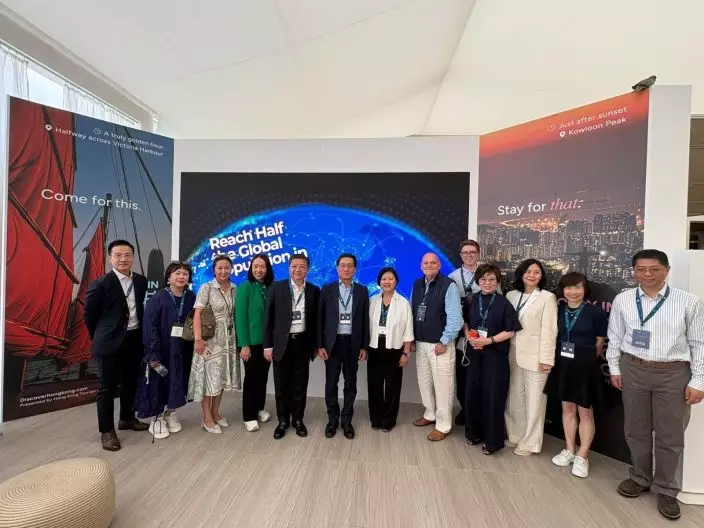
The Commerce and Economic Development Bureau promoted "The Festival of Connoisseurs" (TFOC) at the Monaco Yacht Show 2026 held in Monaco on September 23 (Monaco time). Photo shows the Deputy Representative of the Hong Kong Economic and Trade Office in Brussels, Mr Kasper Ng (front row, first left); the Chief Strategy Officer of AsiaWorld-Expo, Ms Enid Low (front row, second left); the General Manager, Mega Events, MICE & Cruise at the Hong Kong Tourism Board, Ms Marilyn Tham (front row, fourth left); the Executive Director of the Hong Kong Tourism Board, Mr Anthony Lau (front row, fifth left); the Chairman of the Airport Authority Hong Kong, Mr Fred Lam (front row, sixth left); the Special Representative for Hong Kong Economic and Trade Affairs to the European Union, Ms Shirley Yung (front row, seventh left); the Executive Chair of Informa Prestige, Mr John Paton (front row, eighth left); the Chief Executive Officer of AsiaWorld-Expo, Ms Irene Chan (front row, ninth left); the Chief Financial Officer of Informa Markets Asia, Ms Suzanne Wang (front row, tenth left); the Executive Director, Commercial of the Airport Authority Hong Kong, Ms Cissy Chan (front row, eleventh left); and the Vice President of Strategic Initiatives of Informa Markets Asia, Mr Dan Ye (front row, twelfth left) at the Hong Kong booth at the Monaco Yacht Show on September 23 (Monaco time). Source: HKSAR Government Press Releases
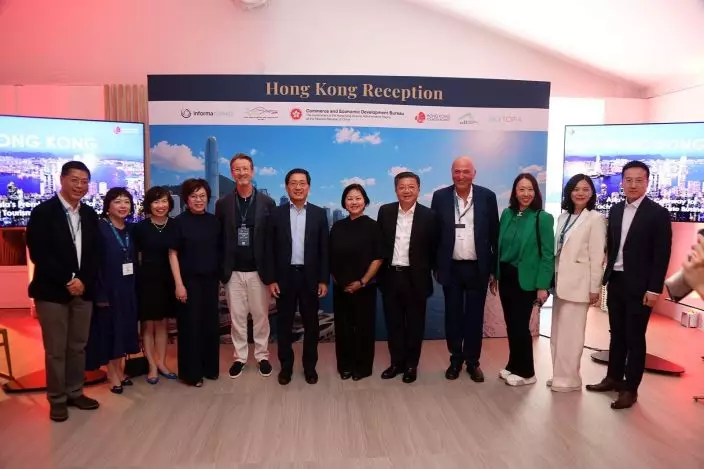
The Commerce and Economic Development Bureau promoted "The Festival of Connoisseurs" (TFOC) at the Monaco Yacht Show 2026 held in Monaco on September 23 (Monaco time). Photo shows (from left) the Vice President of Strategic Initiatives of Informa Markets Asia, Mr Dan Ye; the Chief Strategy Officer of AsiaWorld-Expo, Ms Enid Low; the Executive Director, Commercial of the Airport Authority Hong Kong, Ms Cissy Chan; the Chief Executive Officer of AsiaWorld-Expo, Ms Irene Chan; the Chief Executive Officer of Informa PLC, Mr Stephen Carter; the Chairman of the Airport Authority Hong Kong, Mr Fred Lam; the Special Representative for Hong Kong Economic and Trade Affairs to the European Union, Ms Shirley Yung; the Executive Director of the Hong Kong Tourism Board, Mr Anthony Lau; the Consultant (Milan), Invest Hong Kong, Mr Stefano De Paoli; the General Manager, Mega Events, MICE & Cruise at the Hong Kong Tourism Board, Ms Marilyn Tham; the Chief Financial Officer of Informa Markets Asia, Ms Suzanne Wang; and the Deputy Representative of the Hong Kong Economic and Trade Office in Brussels, Mr Kasper Ng, at the reception. Source: HKSAR Government Press Releases