NEW YORK (AP) — The WNBA looks promising heading into the offseason after a banner year with record ratings, attendance and a first-time champion in New York.
Soon after the confetti stopped falling on the sellout crowd at Barclays Center following Game 5 of the WNBA Finals, the league and its players turned their attention to 2025.
Less than 24 hours after Sunday night's game and days before the Liberty's championship parade on Thursday, the players' union opted out of the current collective bargaining agreement. The decision was expected with a new 11-year media rights deal worth approximately $200 million per year beginning in 2026. The players are looking for a bigger share of the revenue pie among other things, including pensions and higher salaries.
The current CBA will still be in effect throughout next season, but both sides would like to get a deal done sooner rather than later.
Negotiations are always intense, but those associated with the WNBA have much to be excited about.
The league is expanding and will increase the number of regular season games to 44. The WNBA will hold an expansion draft for Golden State in December. The Valkyries will be the league's 13th franchise. The league will add franchises in Toronto and Portland in 2026, with at least one other team starting in either 2027 or 2028.
Although the WNBA could lose one of its iconic stars if Diana Taurasi announces her retirement, league officials are looking forward to another highly anticipated draft. The draft lottery is next month. It will determine who gets the first pick and potentially Paige Bueckers, who 21 years after Taurasi could become the next UConn guard to be selected No. 1.
Many of the league's top players will remain in the U.S. this winter and play in January in Unrivaled — the 3-on-3 league started by WNBA Finals standouts Breanna Stewart and Napheesa Collier.
The Stewart and Collier championship showdown led to strong ratings, with all five games having more than a million TV viewers. The decisive Game 5 drew an average of 2.2 million viewers, peaking at 3.3 million, which made it the most-watched WNBA game in 25 years.
The league as a whole had its most-watched regular season in 24 years and best attendance in 22 seasons. During the 40-game regular season, 22 telecasts topped at least a million viewers on a host of networks.
The league's rookie class, led by Caitlin Clark and Angel Reese, was a big part of that success — and all should come back stronger and better next year.
“When Caitlin Clark announced she was going to enter the draft, I remember ... the wave of enthusiasm that came from a player that wasn’t even going to play for the Lynx,” Minnesota coach Cheryl Reeve said. “So there was a lot of excitement and momentum for the WNBA. But to see it actually translate business-wise across the league, whatever the reasons were. There’s one really big reason and a lot of other little reasons why. And I think the movement that we’re in now is exciting.”
Not everything has been positive around the league's growth.
Nearly half of the WNBA franchises have fired coaches in the past month. Atlanta, Chicago, Dallas, Los Angeles and Washington are all looking for new leaders on the sidelines. All of the coaches who were let go had three years or less with their teams.
Off the court, players say they were targets of increasing online racial and homophobic threats, including one to Stewart and her wife during the WNBA Finals.
Commissioner Cathy Engelbert addressed the rising number of abusive comments players have dealt with on social media at her state of the league address before the start of the WNBA Finals. She said the league will work with the players’ union to figure out what they can do together to combat it.
The online abuse and the CBA are two of the offseason issues the WNBA and its players must address, but they have arguably the strongest foundation since the league's launch to build on.
AP WNBA: https://apnews.com/hub/wnba-basketball

New York Liberty guard Sabrina Ionescu (20) reacts after scoring against the Minnesota Lynx during the third quarter of Game 5 of the WNBA basketball final series, Sunday, Oct. 20, 2024, in New York. (AP Photo/Pamela Smith)

FILE - WNBA Commissioner Cathy Engelbert speaks at a news conference before Game 1 of basketball's WNBA Finals between the Connecticut Sun and the Washington Mystics, Sunday, Sept. 29, 2019, in Washington. The WNBA will expand its Finals next year to a best-of-7 format the league announced on Thursday, Oct. 10, 2024. (AP Photo/Patrick Semansky, File)

FILE - The WNBA logo and hoop are seen at a WNBA basketball game at Mohegan Sun Arena, Tuesday, May 14, 2019, in Uncasville, Conn. (AP Photo/Jessica Hill, File)
REGGIO EMILIA, Italy (AP) — Britain’s Princess Catherine made her first overseas trip since announcing her cancer was in remission, traveling to Italy on Wednesday for a two-day tour focused on an early childhood educational approach that was developed here and exported globally.
The princess, commonly known as Kate, was received by huge cheering crowds as she arrived in Reggio Emilia in northern Italy to learn about its eponymous child-centered approach to early education. The trip is part of what her office called an international “fact-finding mission” to explore different approaches to supporting young children and their carers.
The princess, who spent a gap year in Florence when she was younger, spoke a few words of Italian to a group of preschool children, introducing herself as Caterina.
“Parlo un po’ d’italiano,” she said, explaining that she spoke a little Italian. She then asked their names in Italian and added: “Io sono Catarina” (I am Catherine.)
The Reggio Emilia approach is based on the idea that young children have many different ways of thinking, understanding and expressing themselves, and that teachers need to work with their students to help them learn.
“It is extraordinary and that is why I wanted to come and visit Reggio Emilia because your history is so rich and I have always been fascinated by the philosophy,” the princess said as she began her program.
The choice of destination for Kate’s first trip abroad since her 2024 cancer diagnosis is no coincidence as early years development is the signature cause of the mother of three who will one day be queen.
“She wants to make a point that she is going to keep making this her cause,” said Joe Little, managing editor of Majesty Magazine.
Her visit will highlight the idea that the environment and human relationships that surround children are crucial to laying the foundations for a resilient and healthy future, Kensington Palace said in a statement.
“The Reggio Emilia approach clearly suits the narrative at the start of international operations,’’ Little said.
The visit is part of her work with the Royal Foundation Centre for Early Childhood, which she founded in 2021 to increase public understanding of the importance of supporting children in the first five years of life.
One of Britain’s most popular royals, the Princess of Wales has proved to be adept at focusing attention on matters she cares about.
When Kate announced that she had completed chemotherapy treatment in a soft-focus, Insta-ready video, she ventured into realms not previously inhabited by the royal family, whose members traditionally shied away from talking about their health.
And she did it in a new way, using social media to share the fact that for all her wealth and privilege, her life had been upended by cancer, like so many others.
Then, later, when she announced she was in remission, she spent the day supporting other cancer patients at the hospital where she received treatment.
In a statement on social media, she offered her thanks to everyone who helped her and her husband, Prince William, as they navigated the ups and downs of treatment and recovery. She hugged patients at the Royal Marsden Hospital in London and described her own treatment as “exceptional.”
“It is a relief to now be in remission and I remain focused on recovery,” the princess, now 44, wrote in a note signed with her initial, C. “As anyone who has experienced a cancer diagnosis will know, it takes time to adjust to a new normal.”
Her new normal involves becoming the go-to advocate for early years education, which refers to the learning and development of children from birth to five years of age.
There’s lots to do in Britain, where advocates say there aren’t enough spaces to go around and many teachers don’t have the training they need.
Edoardo Masset, associate research director at the National Institute of Economic and Social Research, said Kate’s focus on early childhood development is important because it brings attention to an issue that really matters to children.
“This relationship between early years education and success later in life is supported not only by strong theoretical arguments, but also by a large body of evidence on the effectiveness of programs for preschool children,’’ Masset said in a blog post.
Residents of Reggio Emilia said Wednesday they were honored the princess had chosen their city and its public preschools for her first visit since her remission. Francesca Valli, a teacher of the Reggio Emilia approach, was waiting for her.
“I also feel very honored to be here, almost as a representative of my school,” she said. “For her first visit — and, among other things, her first solo visit after a long illness — the princess has made a very judicious, appropriate and well-considered choice, and this certainly does her honor.”
—-
Kirka reported from London.
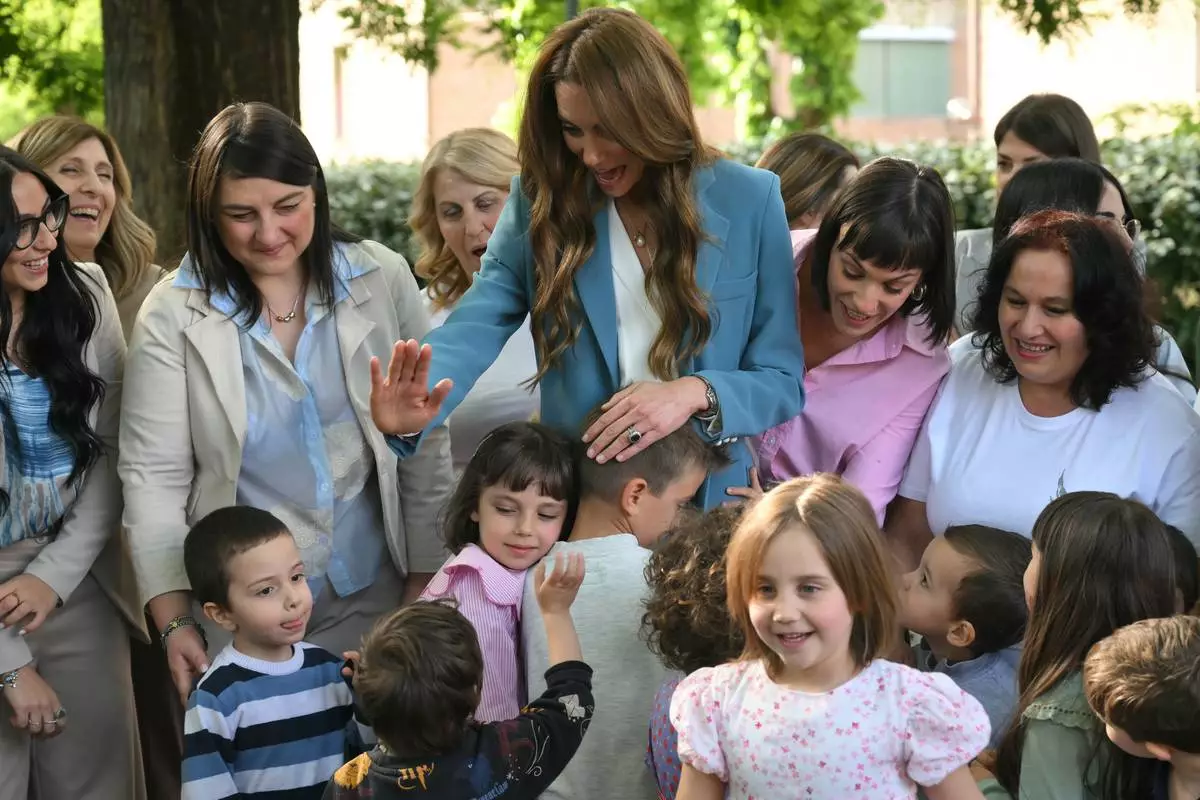
Britain's Kate, Princess of Wales, center, visits the Scuola Comunale d'infanzia Anna Frank, a municipal pre-school for 3 – 6-year-olds, part of a two-day trip, in Reggio Emilia, Italy, Wednesday, May 13, 2026. (Marco Bertorello/Pool Photo via AP)
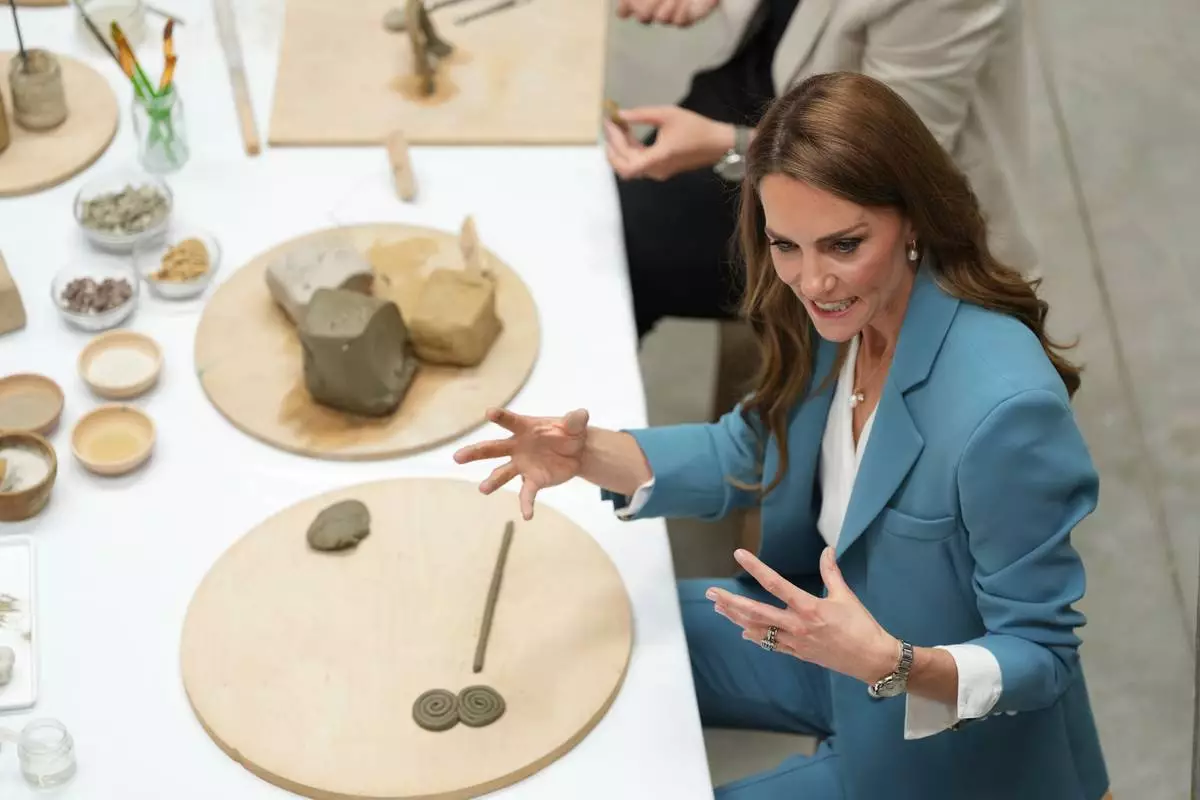
Britain's Kate, Princess of Wales, takes part in an immersive clay atelier workshop at the Loris Malaguzzi International Centre, part of a two-day trip, in Reggio Emilia, Italy, Wednesday, May 13, 2026. (AP Photo/Antonio Calanni, Pool)
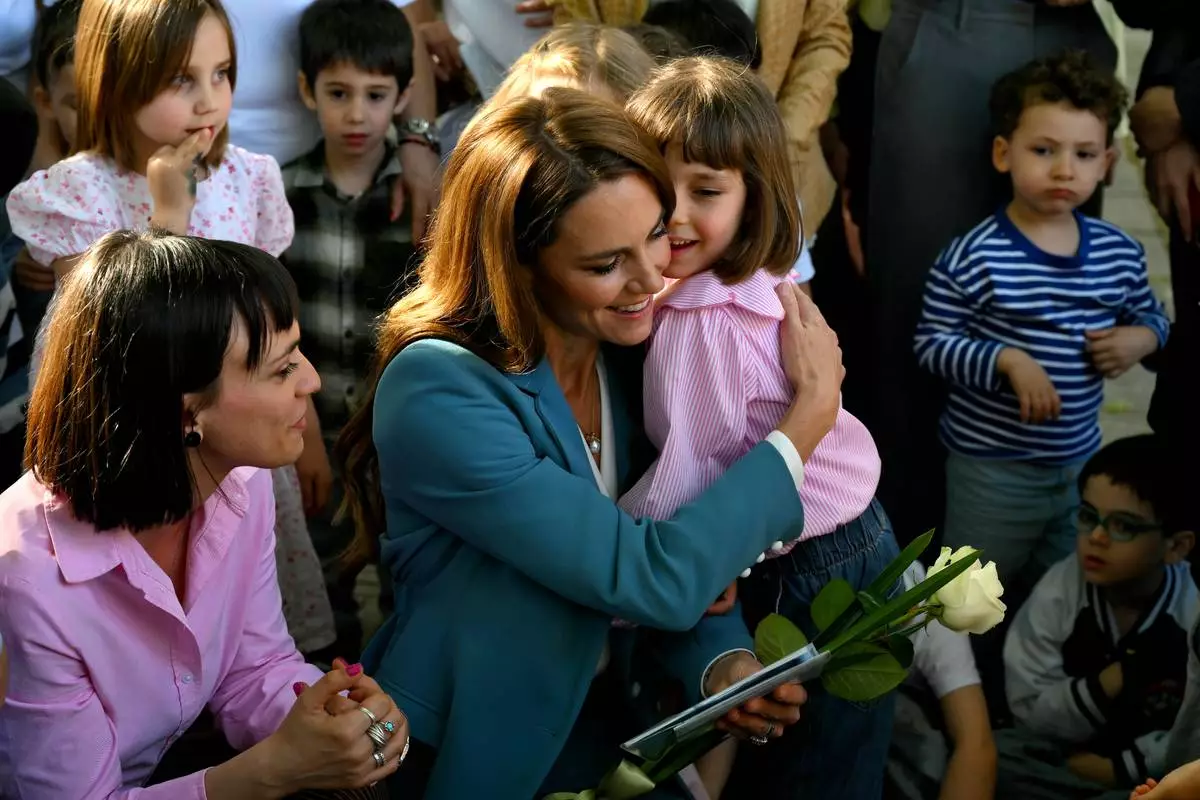
Britain's Kate, Princess of Wales, center, hugs a child during her visit to the Scuola Comunale d'infanzia Anna Frank, a municipal pre-school for 3 – 6-year-olds, part of a two-day trip, in Reggio Emilia, Italy, Wednesday, May 13, 2026. (Marco Bertorello/Pool Photo via AP)
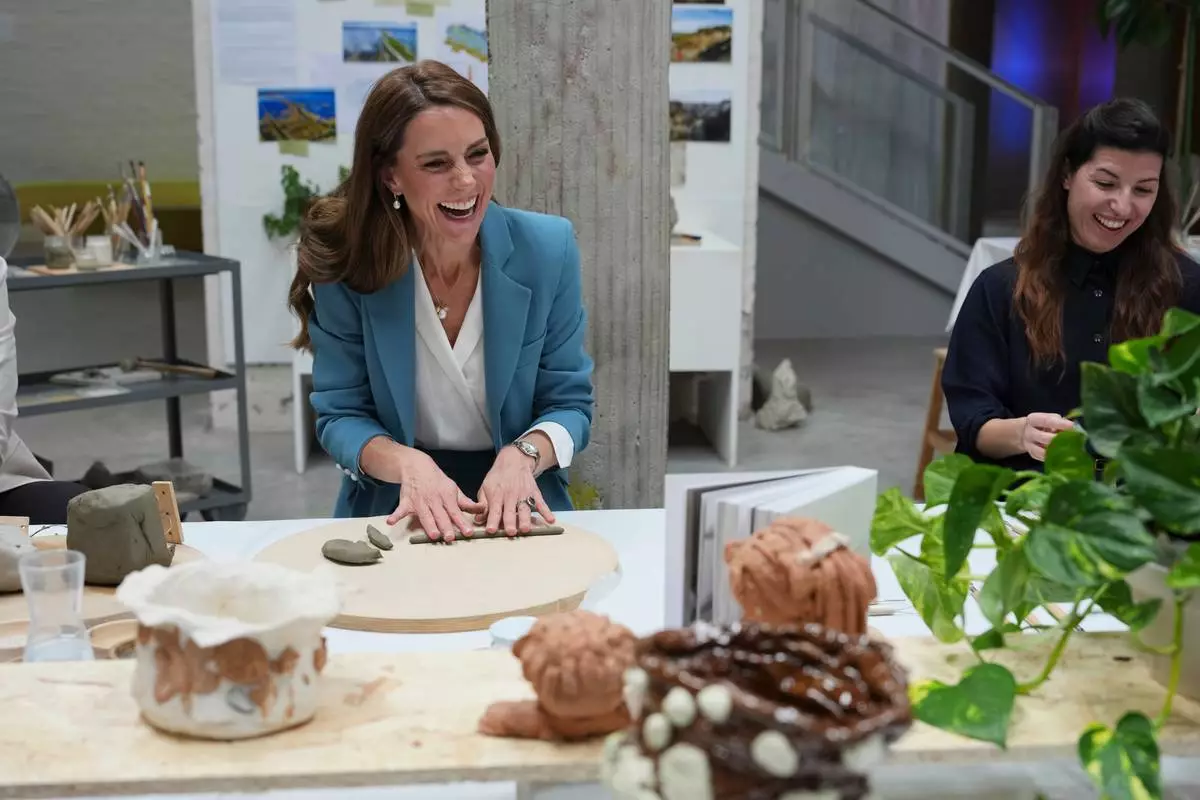
Britain's Kate, Princess of Wales, takes part in an immersive clay atelier workshop at the Loris Malaguzzi International Centre, part of a two-day trip, in Reggio Emilia, Italy, Wednesday, May 13, 2026. (AP Photo/Antonio Calanni, Pool)
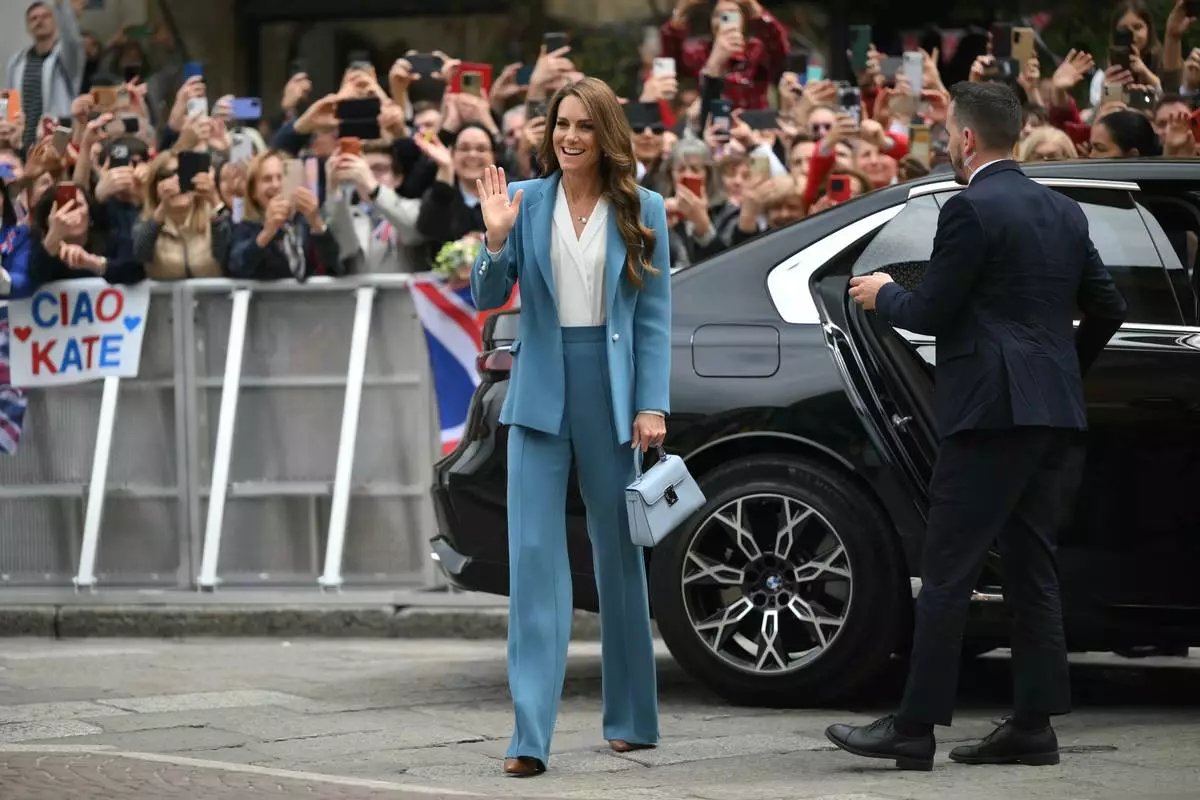
Britain's Kate, Princess of Wales, waves as she arrives at the town hall, part of a two-day trip, in Reggio Emilia, Italy, Wednesday, May 13, 2026. (Marco Bertorello/Pool Photo via AP)
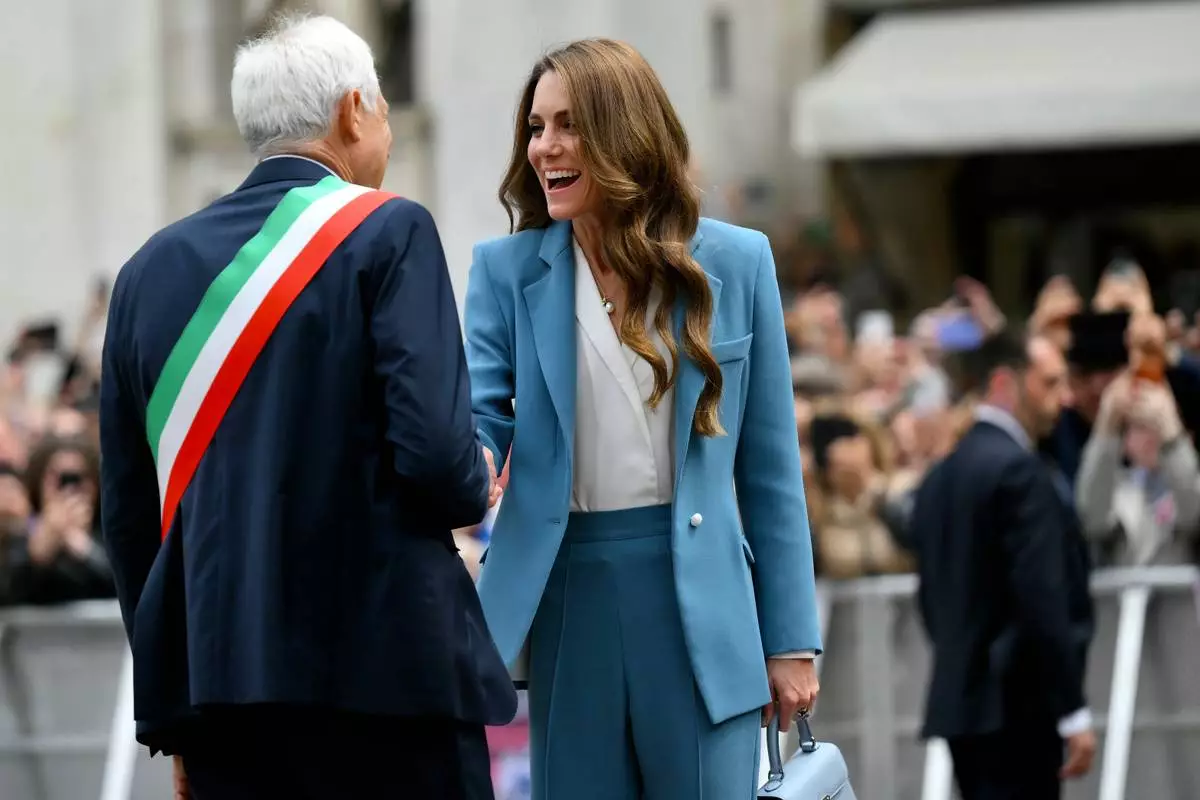
Britain's Kate, Princess of Wales, is welcomed by Mayor of Reggio Emilia Marco Massari as she arrives at the town hall, part of a two-day trip, in Reggio Emilia, Italy, Wednesday, May 13, 2026. (Marco Bertorello/Pool Photo via AP)
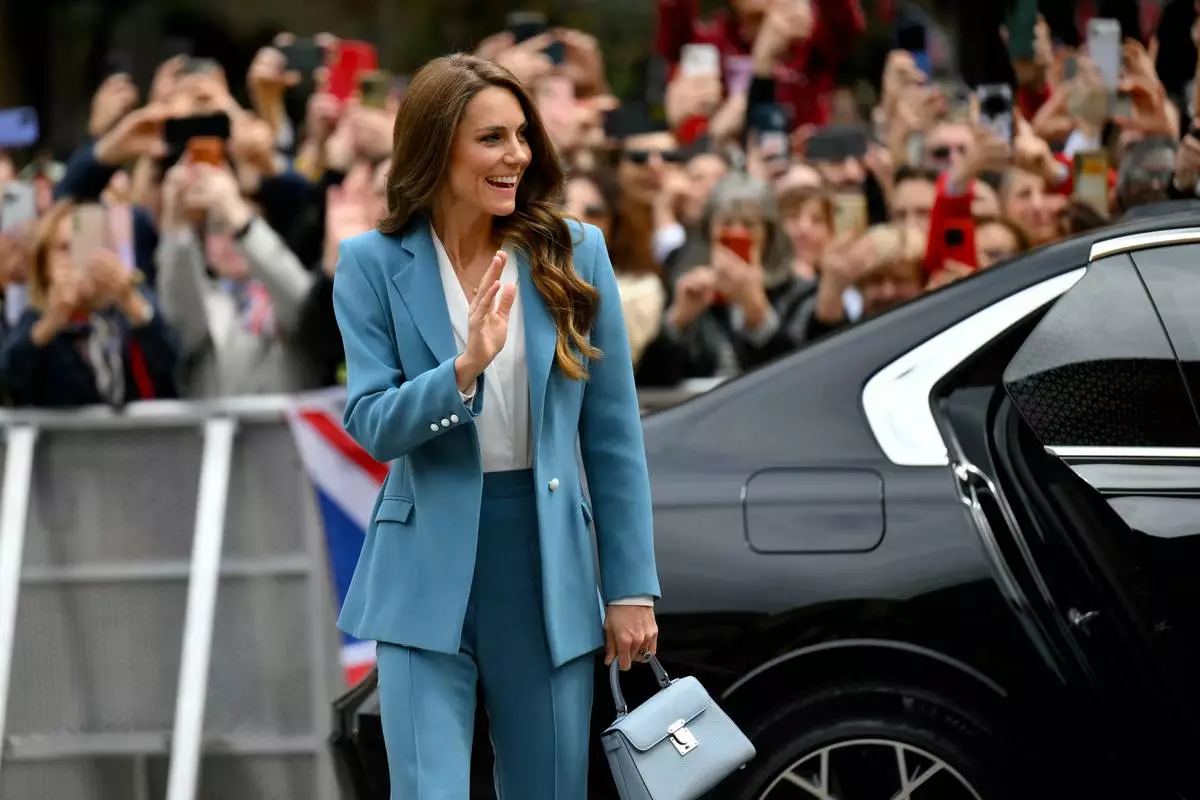
Britain's Kate, Princess of Wales, waves as she arrives at the town hall, part of a two-day trip, in Reggio Emilia, Italy, Wednesday, May 13, 2026. (Marco Bertorello/Pool Photo via AP)
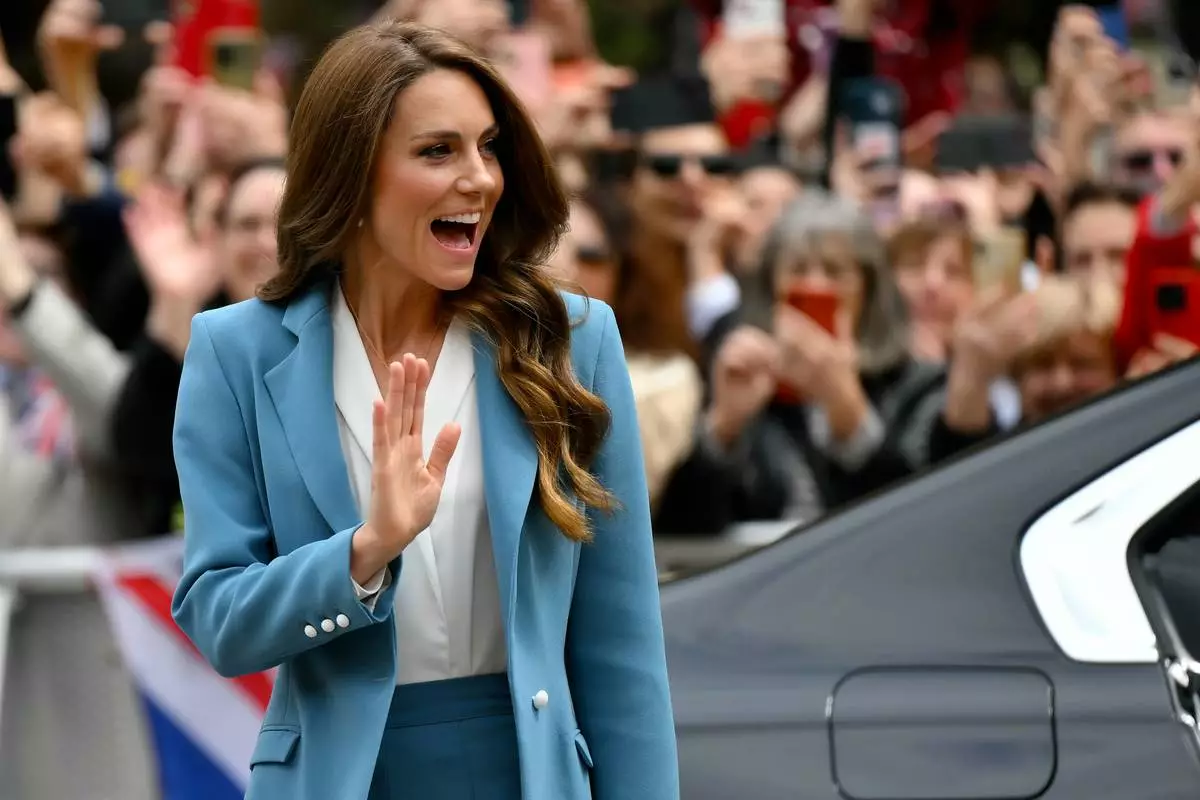
Britain's Kate, Princess of Wales, waves as she arrives at the town hall, part of a two-day trip, in Reggio Emilia, Italy, Wednesday, May 13, 2026. (Marco Bertorello/Pool Photo via AP)
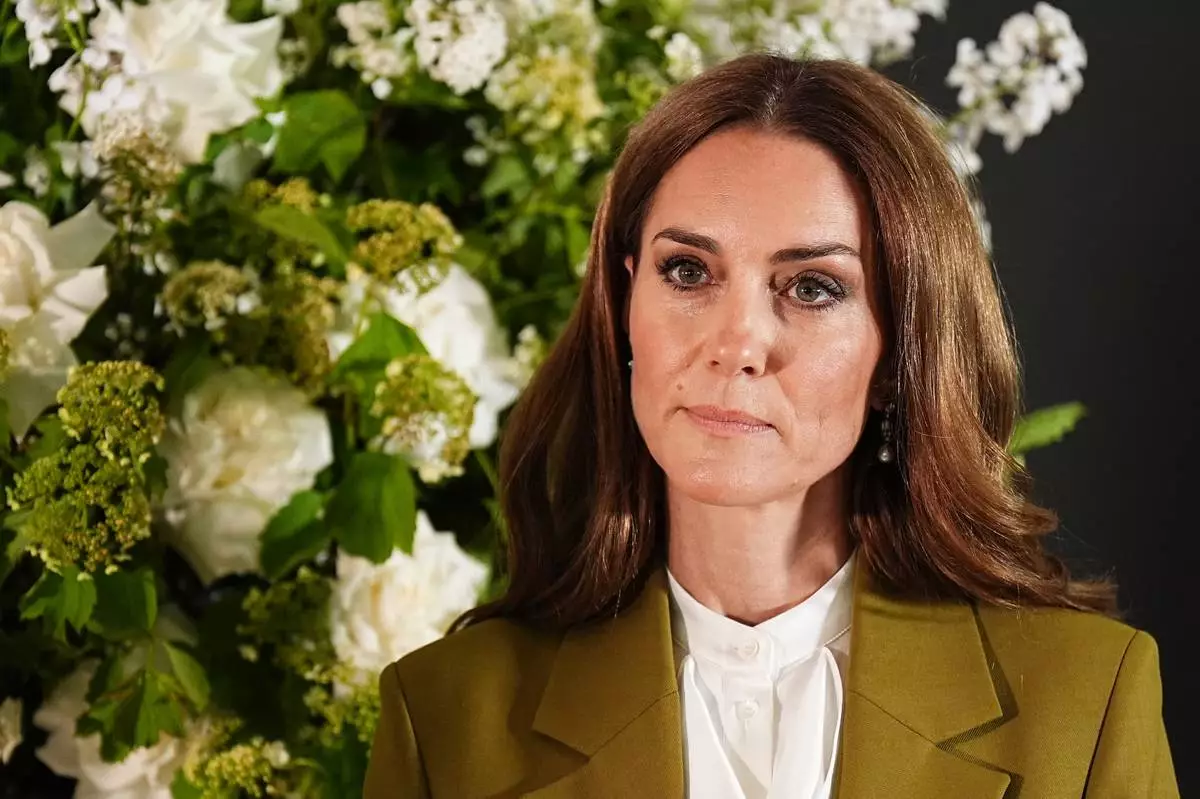
FILE - Britain's Princess Kate is seen at the British Fashion Council at 180 Studios in central London on May 13, 2025. (Aaron Chown, Pool Photo via AP, File)