The 2024 World Internet Conference (WIC) Wuzhen Summit will be held from Nov. 19 to 22 in the water-town of Wuzhen in east China's Zhejiang Province, with artificial intelligence at the forefront of the agenda, according to a press conference held on Thursday.
Themed "Embracing a People-centered and artificial intelligence (AI)-for-good Digital Future - Building a Community with a Shared Future in Cyberspace," the 2024 summit will feature 24 sub-forums on topics such as the China-proposed Global Development Initiative, digital economy, and innovations and governance of AI technologies.
A special focus will be placed on AI, with sub-forums covering topics, including innovations and governance of AI technologies, AI empowering new quality productive forces, as well as the responsible development and application of AI. These discussions aim to foster global cooperation and consensus on strengthening AI governance.
"The conference will give out the 'WIC Outstanding Contribution Awards' to recognize individuals and companies who have made outstanding contributions in the global internet-related fields. Additionally, the summit will also see the establishment of a special committee on AI. As the first specialized and regular branch institution established after the WIC declared itself an international organization, the special committee will build an international platform for AI exchange and cooperation," said Ren Xianliang, secretary-general of the WIC.
The WIC, which has been organizing summits since 2014, has about 170 institutions, organizations, companies, and individuals from over 30 countries and regions across six continents as members.

2024 World Internet Conference Wuzhen Summit to open in November
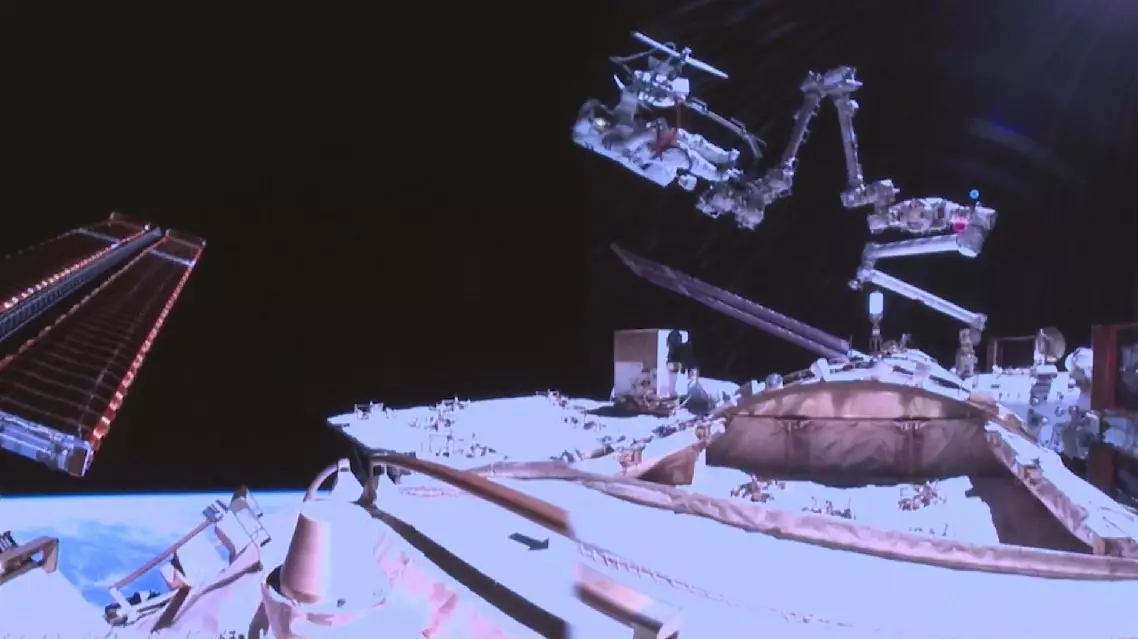
The Shenzhou-21 crew aboard China's orbiting Tiangong space station completed their mission's third series of extravehicular activities (EVAs) on Friday, according to the China Manned Space Agency (CMSA).
The astronaut trio -- Zhang Lu, Wu Fei and Zhang Hongzhang -- worked for roughly five and a half hours and completed their EVAs at 01:36 (Beijing Time), assisted by the space station's robotic arm and a team on Earth.
The trio completed the installation of a space debris protection device for the space station, and extravehicular equipment and facility inspections, among other tasks. Zhang Lu, the commander of the Shenzhou-21 mission, and Wu Fei conducted the spacewalk and returned to the Wentian lab module safely, according to the CMSA.
Zhang Lu has so far carried out seven EVAs, making him one of the Chinese astronauts with the most spacewalks to date.
Since completing their second series of EVAs on March 16, the Shenzhou-21 astronauts have steadily advanced experiments in areas such as space life sciences, human research, and microgravity physical science. They have carries out in-orbit environmental monitoring, equipment inspection and maintenance, and supply management. The crew has also completed a full-system pressure emergency drill, emergency life-support training, and preparations for extravehicular activities.
The three astronauts have been in orbit for more than five months and remain in good working and living condition.
To further validate technologies related to long-term human habitation in orbit and to maximize the comprehensive benefits of using the Shenzhou-22 spacecraft as an emergency launch vehicle to resupply the space station, it has been decided, after careful evaluation and assessment, that the crew's stay in orbit will be extended by approximately one month.
During the upcoming phase of their space journey, the crew will continue to conduct scientific experiments and technical tests, and will also celebrate the Space Day of China, which is marked annually on April 24, and the International Workers' Day on May 1 while in orbit.
Shenzhou-21 astronauts complete 3rd series of extravehicular activities