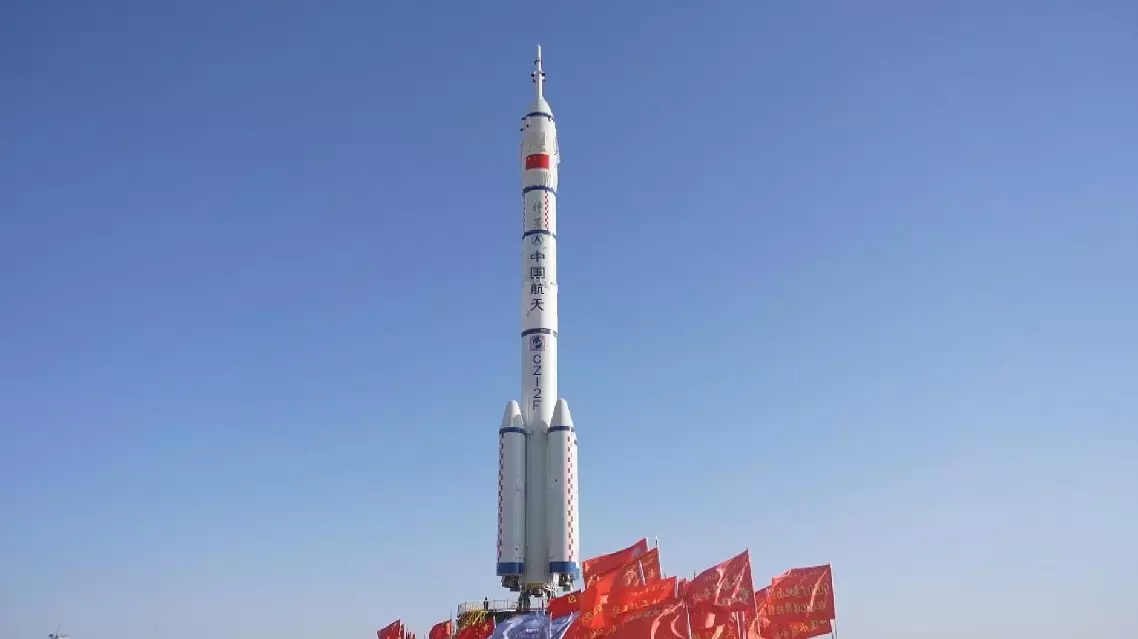
The test and launch process for China's Long March 2F rocket has been optimized, with the time span shortened from 37 to 30 days, according to the development team.
According to the requirements of the space station mission, the Long March 2F rocket has been executing a rolling backup mode of 'launching one, backing up one' since the Shenzhou-12 mission, meaning one rocket will go through two stages, first as the standby rocket for emergency rescue and second as the mission rocket for normal launch.
"In the previous test and launch process, the standby rocket and the mission rocket would each undergo an electrical system test in their respective stages. So for one rocket, it needed to have two rounds of electrical system tests. After the optimization of the test and launch process, in order to improve the efficiency, we have shortened the test process of the standby rocket. So generally speaking, the total test and launch process has been cut down from 37 days to 30 days," said Chen Muye, a staff member at the China Aerospace Science and Technology Corporation.
According to the development team, the optimization is achieved based on practices established since the construction of the space station and a continuous striving for higher efficiency and reliability. At present, the next Long March 2F rocket to be launched is on standby in the factory.
"Behind us is the Yao-20 rocket, which is the same as our Yao-19 rocket that after completing the installation of the rocket body, the installation of instruments and pyrotechnics, it can be on duty for emergency rescue and it no longer needs to undergo an electrical system test in the standby state," Chen said.
A Long March 2F carrier rocket, topped with the Shenzhou-19 spacecraft, now sits on its pad at the Jiuquan Satellite Launch Center in northwest China, ready to send it to the Tiangong space station early on Wednesday.
Test, launch of Long March 2F rocket optimized for higher efficiency
The Chinese government has stepped up its ecological conservation and green development efforts this year, with new policies aimed at ensuring harmony between humanity and nature as the country modernizes.
To upgrade its legal system for ecological protection, China this year has adopted a new Ecological and Environmental Code, a new National Parks Law and revised Regulations on Nature Reserves.
China has also started implementing its stricter ambient air quality standards since March and is taking measures in key counties to tackle pollution and stagnant water in small water bodies, and remove heavy metal pollution from agricultural soil.
"Building a beautiful China is a major strategic effort being made by the Communist Party of China Central Committee with Xi Jinping at its core, taking into account the overall situation of modernization featuring harmony between humanity and nature as well as people's aspirations for a better life. It requires us to reject the short-sighted approach of draining the pond to catch the fish and the practice of leaving ecological deficits to future generations. Instead, it asks us to shoulder the historical responsibility of benefiting generations to come by laying a solid ecological foundation for the great rejuvenation of the Chinese nation. This is not only a change in the development paradigm, but also an innovation in the concept of civilization," said Li Hongwei, a professor at the Social and Ecological Civilization Teaching and Research Department of the Central Party School of the Communist Party of China.
In addition to national measures, countless local projects are also underway to address specific issues.
Jiangsu Province in east China has established the country's first application and service system presenting real-time 3D visualizations of the province and its cities and counties to provide digital support for targeted ecological governance.
In east China's Jiangxi and Zhejiang, a number of protection and restoration projects for abandoned mines and marine ecosystems are accelerating.
"Now, we have started the application process for Shan-Shui Initiative projects, encouraging and guiding neighboring provinces to break down boundaries, plan and jointly apply for cross-provincial Shan-Shui Initiative projects for the same natural geographical unit, and carry out inter-provincial prevention and control efforts around national ecological security barriers such as the Three Eco-zones and Four Shelterbelts," said Zhang Jianjun, deputy director general of the Department of Territorial Space Ecological Restoration at the Ministry of Natural Resources.
The Shan-Shui Initiative, which translates as "mountains and rivers" initiative, is China's ambitious country-wide effort to restore 10 million hectares of natural spaces, including mountains, forests, grasslands and waterways, by 2030.
The Three Eco-zones and Four Shelterbelts are the Qinghai-Tibet Plateau Eco-zone, the Yellow River Eco-zone (including the Loess Plateau Ecological Barrier), the Yangtze River Eco-zone (including the Sichuan-Yunnan Ecological Barrier), and the Northeast, North, South, and Coastal Shelterbelts.
This year, the Ministry of Ecology and Environment will push for implementing ultra-low emission standards for 100 million tons of cement clinker production and 50 million tons of coking production.
In the meantime, the ministry will promote the building of more zero-carbon industrial parks and factories, revise regulations for the management of carbon emission trading, and continue increasing supply for the national voluntary greenhouse gas emission reduction trading market.
China has already seen fruitful results from its ecological conservation efforts this year.
The Xiliao River, once the only major river among China's seven major river systems to suffer long-term drought, has seen full spring water flow return for the second consecutive year, signaling new progress in the ecological recovery of the river basin.
The latest satellite remote-sensing images show that in some sections, the water area has increased from less than 5 percent of the waterway in 2024 to 90 percent today.
The rising water levels over the past two years have also led to the return of migratory birds and other ecological improvements.
Progress has also been made in biodiversity. This year, a breakthrough has been made in wild reproduction of the Chinese sturgeon, a group of endangered Baer's pochards were released into the wild for the first time in the world by Chinese biologists, and the populations of giant pandas, crested ibises, and Hainan gibbons continue to recover.
On the consumption front, China has improved a trade-in subsidies program for consumers choosing to upgrade to energy-efficient home appliances.
Meanwhile, a national campaign to double the number of charging facilities for electric vehicles in three years is in full swing, with a goal of establishing a nationwide network of 28 million charging facilities by the end of 2027 to meet the needs of more than 80 million electric vehicles.

China intensifies conservation, green development programs