Skip to Content Facebook Feature Image

Germany's economy isn't growing. But its quarrelsome government can't agree on a way forward

News

Germany's economy isn't growing. But its quarrelsome government can't agree on a way forward
News

News

Germany's economy isn't growing. But its quarrelsome government can't agree on a way forward

2024-10-30 13:24 Last Updated At:13:50

BERLIN (AP) — Germany's economy isn't growing and the governing coalition has a lot of ideas on how to fix it. But it can't agree which the right one is.

The latest outbreak of infighting in Chancellor Olaf Scholz's government has raised questions about whether it will get anything done in the 11 months before Germany's next election is due — and whether it will survive until then.

There's agreement that the state of the German economy, Europe's biggest, demands action. It is expected to shrink in 2024 for the second year in a row, or at best stagnate, battered by external shocks and home-grown problems including red tape and a shortage of skilled labor.

But there's no unity on the solution. As Finance Minister Christian Lindner put it last week: “There's no shortage of ideas. What there is a shortage of at present is agreement in the governing coalition.”

Lindner himself has been a central player in the cacophony, adding to a long list of publicly aired disagreements that have helped make the nearly three-year-old government very unpopular.

Scholz’s center-left Social Democrats, Vice Chancellor Robert Habeck’s environmentalist, left-leaning Greens and Lindner’s pro-business Free Democrats — a party that in recent decades has mostly allied with conservatives — set out in 2021 to form an ambitious, progressive coalition straddling ideological divisions that would modernize Germany.

The government can point to achievements: preventing an energy crunch after Russia cut off its gas supplies to Germany, initiating the modernization of the military and a series of social reforms. But the impression it has left with many Germans is of deepening dysfunction.

“Each party is going its own way — you get the impression they’re already in election campaign mode,” Clemens Fuest, the head of the Ifo economic think-tank, told ZDF television. “If that’s the case, if the chancellor can’t manage to get the government to pull together, then they should actually end the coalition."

Last week, Habeck proposed a state investment fund to help companies of every size. It was promptly rejected by both Lindner and Scholz. Lindner's party organized a meeting with leaders of business associations for Tuesday, the same day that Scholz had already arranged a closed-door meeting of his own with industry and union leaders.

Scholz said that “we must get away from theater stages; we must get away from something being presented and proposed that then isn't accepted by everyone." Still, his coalition partners weren't invited to his own meeting with industry leaders.

The divisions are particularly deep on economic and financial issues. Politicians on the left want to see massive state investment and reject talk of cutting welfare programs. Lindner's Free Democrats categorically reject any tax increases or changes to Germany's strict self-imposed limits on running up debt, and say it's time to save money — for example, on benefits for the long-term unemployed.

The collision of philosophies has complicated putting together the national budget since Germany’s highest court last November annulled a government maneuver to repurpose 60 billion euros ($64.8 billion) originally meant to cushion the impact of the COVID-19 pandemic for measures to help combat climate change and modernize the country.

That forced the coalition into a hasty rehash of the 2024 budget, including subsidy cuts that prompted protests by farmers.

The 2025 budget only intensified the friction, which continued unabated through campaigns for European and state elections in which the governing parties were punished.

Scholz, Lindner and Habeck presented an agreement in July on a budget that includes higher spending on defense and affordable housing, along with a stimulus package. But it got bogged down in another internal dispute, and the coalition leaders took more than a month to emerge with a second deal tweaking details.

That budget has yet to go through parliament. Lawmakers need to iron out the final draft by Nov. 14, and the recent skirmishes inside the coalition have some wondering whether the government will survive beyond that.

“This government is to all intents and purposes no longer capable of acting,” opposition leader Friedrich Merz told ARD television on Sunday. “It is at an end.”

On the face of it, there's little incentive for the governing parties to risk facing voters earlier than next September. Merz's center-right Union bloc leads national polls, the far-right Alternative for Germany is performing strongly, all three governing parties are weak and the Free Democrats are around or below the 5% of the vote needed to keep any seats in parliament. But there's also little sign of improvement.

The government's own statements have fed questions over its future. In early October, Lindner said that “stability is of paramount importance for Germany.”

“But at some point, a government can itself become part of the problem,” he told news portal Table.Briefings. “A government must always ask itself whether it meets the demands of the time.”

Scholz has urged his partners to stick together until the end of their term, saying last week that “anyone who has a mandate must fulfill that mandate.”

“No one should just slink away,” he said in an interview with ZDF. “That's not my style, at least.”
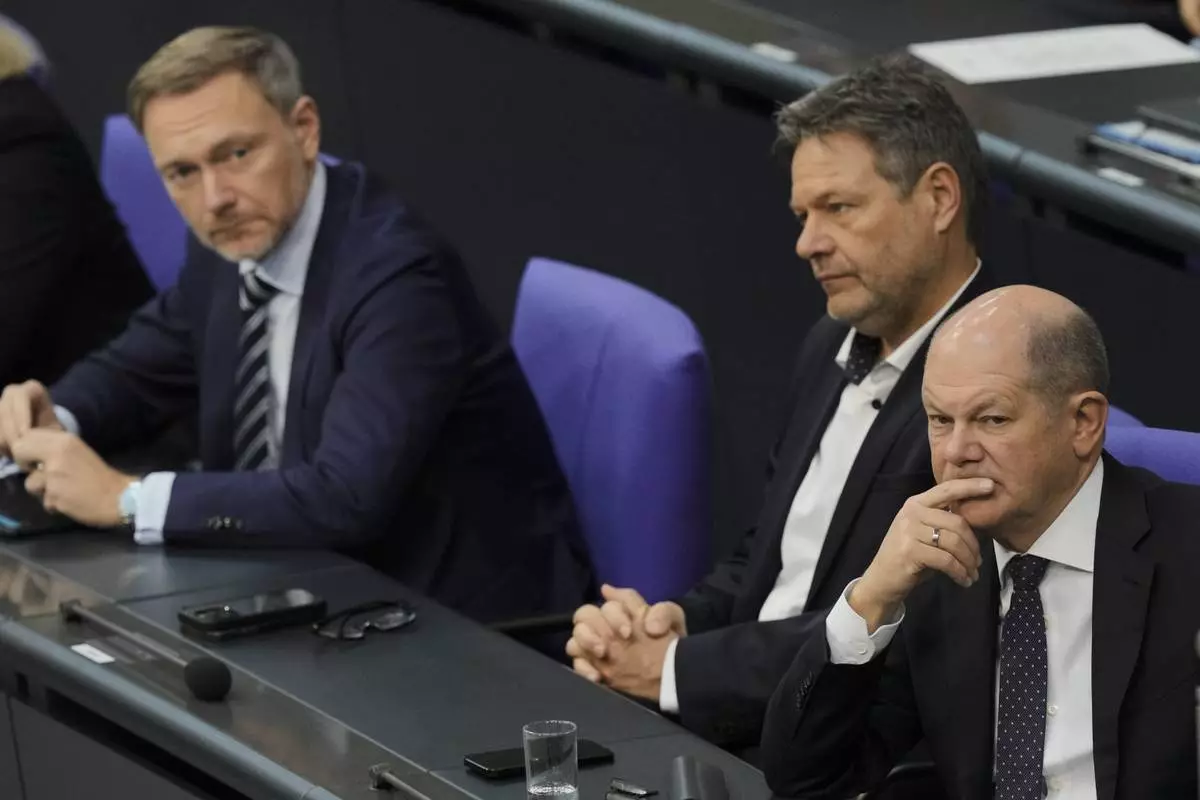
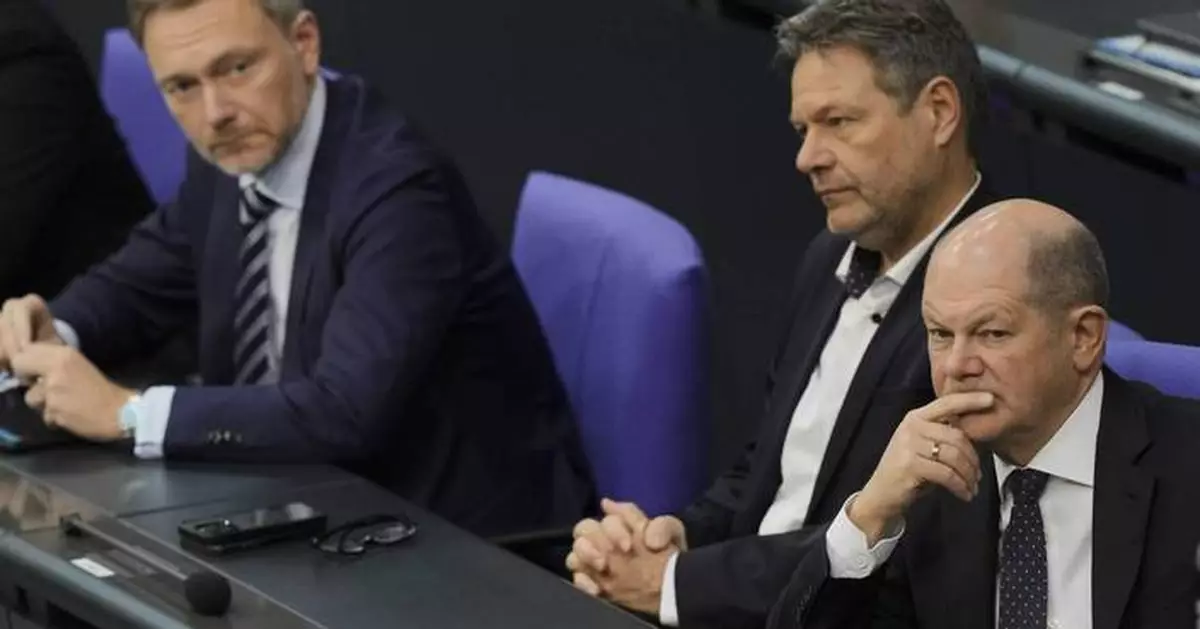
FILE - German Chancellor Olaf Scholz, from right, Economy and Climate Minister Robert Habeck and Finance Minister Christian Lindner listen to a debate about Germany's budget crisis at the parliament Bundestag in Berlin, Germany, Tuesday, Nov. 28, 2023. (AP Photo/Markus Schreiber, File)
FILE - German Chancellor Olaf Scholz, from right, Economy and Climate Minister Robert Habeck and Finance Minister Christian Lindner listen to a debate about Germany's budget crisis at the parliament Bundestag in Berlin, Germany, Tuesday, Nov. 28, 2023. (AP Photo/Markus Schreiber, File)

The NFL set a record for fewest punts per game in 2025, and wild-card weekend was filled with fourth-down fun and folly as punters were mostly spectators, especially Chicago's Tory Taylor, who never stepped off the sideline in the Bears' come-from-behind win over the Green Bay Packers.

In all, teams converted 15 of 29 fourth down attempts on wild-card weekend, when there were only 41 punts, nine of them Monday night in the Houston Texans' 30-6 rout of Aaron Rodgers and the Pittsburgh Steelers.

Bears first-year coach Ben Johnson was particularly aggressive, going for it a half-dozen times on fourth down Saturday night, including two backfires in the first half that led to a pair of Green Bay touchdowns and put the Bears in a 21-3 halftime hole.

Caleb Williams was intercepted on fourth-and-6 from the Packers 40-yard line, leading to Jordan Love's 18-yard touchdown throw, and Williams threw incomplete on fourth-and-5 from his own 32. That one led to Love's TD throw on fourth-and-goal from the Bears 2 that gave Green Bay an 18-point halftime cushion.

The Packers couldn't capitalize on another turnover on downs by Chicago just before halftime because Brandon McManus missed a 55-yard field goal on the final play after Williams threw incomplete deep on fourth-and-4 from the Green Bay 37.

When Prime Video's sideline reporter Kaylee Hartung asked the Bears' coach about his aggressive approach and going for it on fourth down multiple times on his own side of the field, Johnson replied, “Yeah, we want to maximize our possessions and we want to go for fourth-down plays."

Her follow-up was about how to slow down Green Bay's efficient offense.

“That's a big reason why we're being aggressive on offense, so that we can extend our drives and score points ourselves,” Johnson said. “It's a really good offense we're going against.”

Although the Bears would convert just twice on their six fourth downs — Green Bay was 3 for 3 on fourth down — that strategy paid off in the end. Williams threw a 27-yard pass to Rome Odunze to the Packers' 30-yard line, which led to the TD that pulled Chicago to 27-24 with 4:21 remaining.

Johnson said the game plan featured an aggressive fourth-down mentality, and "I think where it gets misconstrued is, there’s a lack of confidence in your defense when you do that. I think the opposite, I think it’s because I have confidence in our defense and their ability to stop teams in the red zone."

“I’m never going to apologize for being aggressive or doing things that might be a little unorthodox,” Johnson added, "if it’s what we deem is best for us to win a ballgame.”

Johnson was the Lions' offensive coordinator when Detroit blew a 17-point halftime lead and lost the NFC championship to San Francisco 34-31 after the 2023 season. In that game, Lions coach Dan Campbell went for it on fourth down twice in field-goal range but came up short, later saying he'd do it again if he could.

Those failures didn't curtail the Lions' aggressive fourth-down philosophy, one that Johnson took to Chicago when he was hired by the Bears a year ago.

He had plenty of company over the weekend as a trend from the regular season continued. There were just 3.55 punts per game per team this season and that figure fell in the first round of the playoffs with teams averaging just 3.41 punts per game.

The Panthers and Rams got the fun going Saturday when early fourth-down failures led to touchdowns by each team.

Trevor Lawrence thought he had the first down when the Jaguars went for it on fourth-and-2 from the Buffalo 9 only to see the review reveal his shin had hit the ground shy of the first-down marker, a fourth-down faux pas that proved pivotal in Jacksonville's 27-24 loss to the Bills.

The Bills twice went for it on fourth-and-1 deep in Jaguars territory. Josh Allen had a four-yard keeper on the first one and was carried nine yards on an astonishing tush push to the 1 that also led to a Buffalo touchdown.

The 49ers didn't attempt a single fourth-down conversion in their 23-19 win at Philadelphia, where the Eagles were 3-for-5 on fourth down.

The Patriots converted their only fourth-down try, on fourth-and-4 from the Chargers' 30, which led to a field goal. When the Chargers took a delay after failing to induce an offsides call and then punted from midfield, NBC analyst Cris Collinsworth said, “I think Jim Harbaugh's been watching the games this weekend.”

And when Steelers coach Mike Tomlin chose to take the three points with a 32-yard field goal try rather that chancing it on fourth-and-3 from the Houston 14 Monday night, ESPN analyst Troy Aikman commented: “We're in a time as we all know when a lot of offenses would be going for it. ... But points are going to be (at) a premium. You've got two defenses that are capable of dominating their opponent. Get 'em when you can.”

Well, points certainly were at a premium for Pittsburgh, which hung in there most of the night before the Texans' 23-0 fourth-quarter blitz in what might have been Rodgers' farewell game.

If so, Rodgers' final pass was a pick-6 by safety Calen Bullock, whose 50-yard interception return for a touchdown came on ... you guessed it, fourth down.

AP NFL: https://apnews.com/hub/NFL

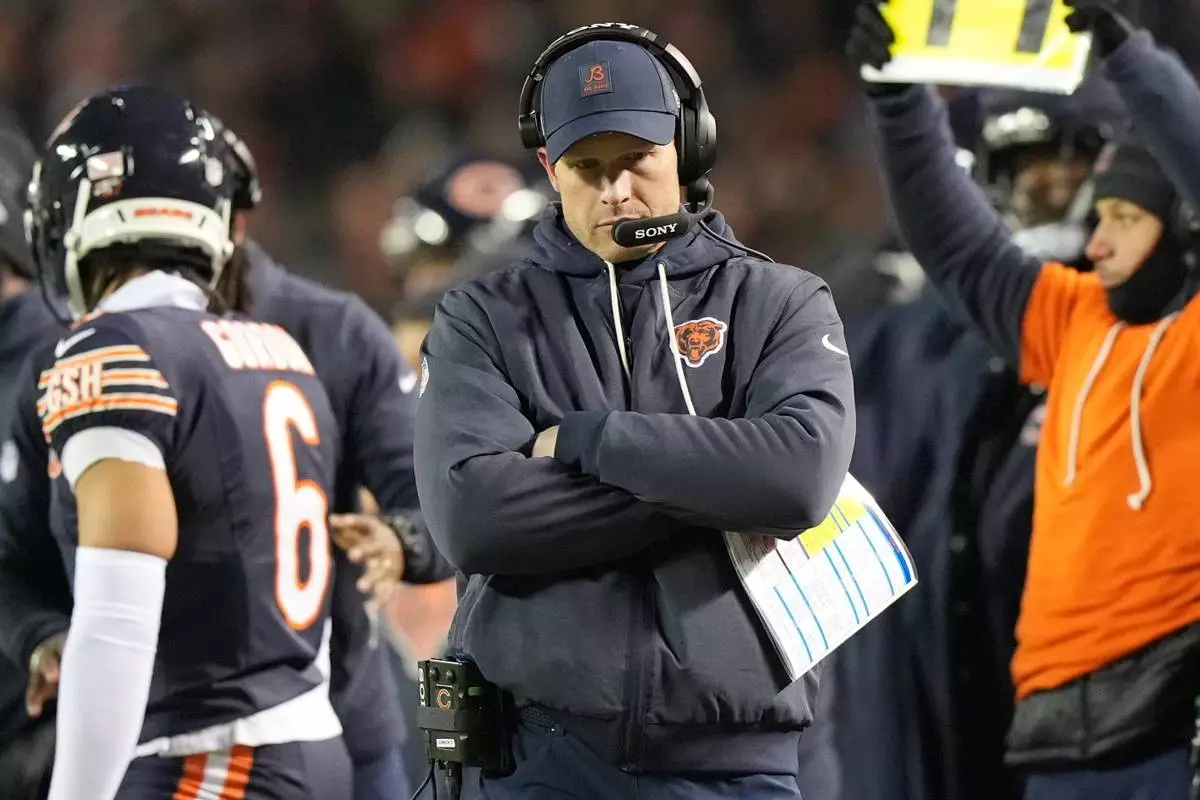
Chicago Bears head coach Ben Johnson reacts during the first half of an NFL wild-card playoff football game against the Green Bay Packers Saturday, Jan. 10, 2026, in Chicago. (AP Photo/Nam Huh)

Chicago Bears head coach Ben Johnson reacts during the first half of an NFL wild-card playoff football game against the Green Bay Packers Saturday, Jan. 10, 2026, in Chicago. (AP Photo/Nam Huh)

Recommended Articles