 |
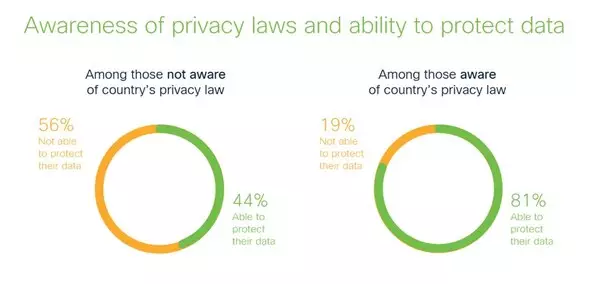
- The 2024 Cisco Consumer Privacy Survey* reveals most consumers (53%) are now aware of privacy laws, and informed consumers feel significantly more confident about protecting their data (81% vs. 44%).
- 63% of consumers believe AI can be useful in improving their lives, and 59% say strong privacy laws make them more comfortable sharing information in AI applications.
- 30% of Generative AI users enter personal or confidential information into these tools despite 84% saying they are concerned about data entered in GenAI going public.
SAN JOSE, Calif., Oct. 30, 2024 /PRNewswire/ -- Today, Cisco (NASDAQ: CSCO) released its 2024 Consumer Privacy Survey, an annual global review of consumer perception and behavior regarding data privacy. This year's survey highlights the critical role of privacy rights awareness in fostering consumer trust and confidence in emerging technologies like Artificial Intelligence (AI).
Awareness of privacy laws enhances consumer confidence in AI
Consumer awareness is on the rise. This year, 53% report being aware of their national privacy laws, a 17-percentage point increase compared to 2019. Informed consumers are also much more likely to feel their data is protected (81%) compared to those who are unaware (44%).
"Our survey highlights the importance of privacy awareness in building consumer trust in brands and AI technologies," says Harvey Jang, Cisco Vice President and Chief Privacy Officer. "Nearly 60% of consumers aware of privacy laws are comfortable using AI. Broadening awareness and educating consumers about their privacy rights will empower them to make informed decisions and foster greater trust in emerging technologies."
The opportunities and challenges of Generative AI
The survey reveals that 63% believe AI can be useful in improving their lives. The use of Generative AI (GenAI) has nearly doubled, with 23% of respondents using it regularly, up from 12% last year. However, 44% of surveyed consumers remain unaware of GenAI. While users say they are gaining significant value from GenAI supporting content creation work, they are concerned about safety, potential misuse and societal risks.
"AI's growing influence in our daily lives brings attention to the need for its responsible and safe use," says Dev Stahlkopf, Cisco's Chief Legal Officer and Executive Vice President. "78% of surveyed consumers feel that it is the responsibility of businesses to employ AI ethically, which underscores the vital relationship between Responsible AI and consumer trust."
Focusing on privacy, 30% of GenAI users say they enter personal or confidential information, including financial and health details, into GenAI tools. This is despite 84% being concerned about that data going public.
Young adults take action to protect privacy, seniors fall behind
Privacy and data protection has evolved from relative obscurity to a customer requirement with more than 75% of consumers saying they won't purchase from an organization they don't trust with their data. This translates into concrete actions as more consumers are becoming "Privacy Active," particularly younger ones. To safeguard their privacy, 49% of consumers aged 25-34 have switched companies or providers over their data policies or data-sharing practices, compared to just 18% of those aged 75+.
The survey found that consumers aged 25-34 are also most aware of their privacy rights (64% vs. 33% of those aged 65+). It also shows a significant increase (36% vs. 28% last year) in how consumers exercise their right to access, correct, delete or transfer their personal data via Data Subject Access Requests (DSARs). Once more, younger consumers lead the way, with 46% of them taking these actions, compared to only 16% of those aged 65+.
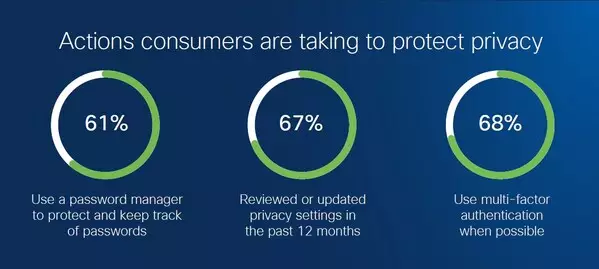
In addition, consumers are leveraging security tools to safeguard their data. In the 12 months prior to the survey, 67% reviewed or updated their privacy settings in apps or platforms. 68% say they use multi-factor authentication, and 61% use a password manager to protect and keep track of their passwords.
"Data is an asset we all must actively work to protect," says Anthony Grieco, Cisco Senior Vice President and Chief Security and Trust Officer. "From using multi-factor authentication to making sure that users know very clearly and easily who can access information as it is shared, we are encouraged by respondents taking action to protect their personal information."
Consumers support strong privacy protections and favor more consistent rules
A significant majority (70%) of all consumers surveyed believe that privacy laws have a positive impact, with only 5% perceiving a negative impact. They increasingly favor privacy protections, with 77% of respondents supporting similar rules across countries and regions to ensure baseline privacy protections. In the US, 81% of respondents favor a US Federal Privacy law.
* | The Cisco 2024 Consumer Privacy Survey is an annual global review of consumers' perceptions and behaviors on data privacy. The 6th edition of this research surveyed anonymously 2600 consumers in Australia, Brazil, China, France, Germany, India, Italy, Japan, Mexico, Spain, UK, US. |
Additional Materials
About Cisco
Cisco (NASDAQ: CSCO) is the worldwide technology leader that securely connects everything to make anything possible. Our purpose is to power an inclusive future for all by helping our customers reimagine their applications, power hybrid work, secure their enterprise, transform their infrastructure, and meet their sustainability goals. Discover more on The Newsroom and follow us on X at @Cisco.
Cisco and the Cisco logo are trademarks or registered trademarks of Cisco and/or its affiliates in the U.S. and other countries. A listing of Cisco's trademarks can be found at www.cisco.com/go/trademarks. Third-party trademarks mentioned are the property of their respective owners. The use of the word partner does not imply a partnership relationship between Cisco and any other company.
- The 2024 Cisco Consumer Privacy Survey* reveals most consumers (53%) are now aware of privacy laws, and informed consumers feel significantly more confident about protecting their data (81% vs. 44%).
- 63% of consumers believe AI can be useful in improving their lives, and 59% say strong privacy laws make them more comfortable sharing information in AI applications.
- 30% of Generative AI users enter personal or confidential information into these tools despite 84% saying they are concerned about data entered in GenAI going public.
SAN JOSE, Calif., Oct. 30, 2024 /PRNewswire/ -- Today, Cisco (NASDAQ: CSCO) released its 2024 Consumer Privacy Survey, an annual global review of consumer perception and behavior regarding data privacy. This year's survey highlights the critical role of privacy rights awareness in fostering consumer trust and confidence in emerging technologies like Artificial Intelligence (AI).
Awareness of privacy laws enhances consumer confidence in AI
Consumer awareness is on the rise. This year, 53% report being aware of their national privacy laws, a 17-percentage point increase compared to 2019. Informed consumers are also much more likely to feel their data is protected (81%) compared to those who are unaware (44%).
"Our survey highlights the importance of privacy awareness in building consumer trust in brands and AI technologies," says Harvey Jang, Cisco Vice President and Chief Privacy Officer. "Nearly 60% of consumers aware of privacy laws are comfortable using AI. Broadening awareness and educating consumers about their privacy rights will empower them to make informed decisions and foster greater trust in emerging technologies."
The opportunities and challenges of Generative AI
The survey reveals that 63% believe AI can be useful in improving their lives. The use of Generative AI (GenAI) has nearly doubled, with 23% of respondents using it regularly, up from 12% last year. However, 44% of surveyed consumers remain unaware of GenAI. While users say they are gaining significant value from GenAI supporting content creation work, they are concerned about safety, potential misuse and societal risks.
"AI's growing influence in our daily lives brings attention to the need for its responsible and safe use," says Dev Stahlkopf, Cisco's Chief Legal Officer and Executive Vice President. "78% of surveyed consumers feel that it is the responsibility of businesses to employ AI ethically, which underscores the vital relationship between Responsible AI and consumer trust."
Focusing on privacy, 30% of GenAI users say they enter personal or confidential information, including financial and health details, into GenAI tools. This is despite 84% being concerned about that data going public.
Young adults take action to protect privacy, seniors fall behind
Privacy and data protection has evolved from relative obscurity to a customer requirement with more than 75% of consumers saying they won't purchase from an organization they don't trust with their data. This translates into concrete actions as more consumers are becoming "Privacy Active," particularly younger ones. To safeguard their privacy, 49% of consumers aged 25-34 have switched companies or providers over their data policies or data-sharing practices, compared to just 18% of those aged 75+.
The survey found that consumers aged 25-34 are also most aware of their privacy rights (64% vs. 33% of those aged 65+). It also shows a significant increase (36% vs. 28% last year) in how consumers exercise their right to access, correct, delete or transfer their personal data via Data Subject Access Requests (DSARs). Once more, younger consumers lead the way, with 46% of them taking these actions, compared to only 16% of those aged 65+.
In addition, consumers are leveraging security tools to safeguard their data. In the 12 months prior to the survey, 67% reviewed or updated their privacy settings in apps or platforms. 68% say they use multi-factor authentication, and 61% use a password manager to protect and keep track of their passwords.
"Data is an asset we all must actively work to protect," says Anthony Grieco, Cisco Senior Vice President and Chief Security and Trust Officer. "From using multi-factor authentication to making sure that users know very clearly and easily who can access information as it is shared, we are encouraged by respondents taking action to protect their personal information."
Consumers support strong privacy protections and favor more consistent rules
A significant majority (70%) of all consumers surveyed believe that privacy laws have a positive impact, with only 5% perceiving a negative impact. They increasingly favor privacy protections, with 77% of respondents supporting similar rules across countries and regions to ensure baseline privacy protections. In the US, 81% of respondents favor a US Federal Privacy law.
*
The Cisco 2024 Consumer Privacy Survey is an annual global review of consumers' perceptions and behaviors on data privacy. The 6th edition of this research surveyed anonymously 2600 consumers in Australia, Brazil, China, France, Germany, India, Italy, Japan, Mexico, Spain, UK, US.
Additional Materials
About Cisco
Cisco (NASDAQ: CSCO) is the worldwide technology leader that securely connects everything to make anything possible. Our purpose is to power an inclusive future for all by helping our customers reimagine their applications, power hybrid work, secure their enterprise, transform their infrastructure, and meet their sustainability goals. Discover more on The Newsroom and follow us on X at @Cisco.
Cisco and the Cisco logo are trademarks or registered trademarks of Cisco and/or its affiliates in the U.S. and other countries. A listing of Cisco's trademarks can be found at www.cisco.com/go/trademarks. Third-party trademarks mentioned are the property of their respective owners. The use of the word partner does not imply a partnership relationship between Cisco and any other company.
** The press release content is from PR Newswire. Bastille Post is not involved in its creation. **
New Cisco Survey Shows Strong Relationship Between Privacy Awareness and Trust in AI
New Cisco Survey Shows Strong Relationship Between Privacy Awareness and Trust in AI
New Cisco Survey Shows Strong Relationship Between Privacy Awareness and Trust in AI
SAN FRANCISCO, Feb. 9, 2026 /PRNewswire/ -- On February 8, Dreame Wet Dry Vacuum announced a high-profile collaboration with NBC, one of the three major U.S. broadcast television networks, securing its debut on U.S. national prime-time television. The brand's 30-second commercial will air on Game Day, during Championship Sunday coverage, placing Dreame wet dry vacuum on one of the most-watched live broadcast stages in the United States and reaching tens of millions of viewers nationwide through NBC's broadcast and affiliate network.
For Dreame, the campaign represents a key step in introducing its wet dry vacuum category to the American mainstream. By appearing during a premium live sports broadcast, the technology-driven brand is showcasing how intelligent cleaning innovation can deliver a more efficient approach to everyday floor care.
The commercial features Aero Pro, one of Dreame's latest wet & dry vacuum models introduced to the U.S. market following its debut at CES 2026. Designed as an all-in-one solution, Aero Pro vacuums and mops in a single pass, handling both wet spills and dry debris. Its ultra-slim 3.88-inch profile and 180-degree lie-flat design enable easy cleaning under sofas and beds, while a dual-scraper system helps reduce hair tangling and maintain streak-free results.
During CES, NBA legend and youngest MVP in league history Derrick Rose experienced Aero Pro firsthand, highlighting its cleaning performance and sleek design.
Beyond broadcast exposure, Dreame continues to deepen its presence in the U.S. innovation ecosystem. Following CES, the brand hosted its global innovation launch event, "The Future of Smart Living," at Stanford University in Silicon Valley, where it showcased its latest advancements in intelligent cleaning technology alongside initiatives supporting children's health and well-being.
Today, Dreame operates in more than 120 countries and regions worldwide. Dreame wet dry vacuum holds the No.1 market share in 17 countries, and has filed over 1,700 global patent applications. As the brand expands its global footprint, it remains focused on translating advanced technology into practical solutions for everyday cleaning scenarios.
To coincide with the Game Day campaign, Dreame is offering a limited-time promotion for U.S. consumers. Consumers can receive a discount by using the code GAMEDAY10 on Dreame's U.S. website between February 1 and February 28, with availability subject to terms and exclusions.
About Dreame Technology
Established in 2017, Dreame Technology is a global leader in high-end consumer electronics and intelligent manufacturing with the vision to empower lives through technology. Follow us on Facebook, Instagram, TikTok and Twitter. For more information, please visit https://www.dreametech.com/.
** The press release content is from PR Newswire. Bastille Post is not involved in its creation. **

Dreame Wet Dry Vacuum Makes Its U.S. Prime-Time Debut on Game Day with NBC