The Dongfeng landing site in north China's Inner Mongolia Autonomous Region has prepared well for the return of the Shenzhou-18 astronauts with various advanced equipment and technologies, according to the Jiuquan Satellite Launch Center.
The return capsule of the Shenzhou-18 manned spaceship, carrying three astronauts, is scheduled to touch down on Earth in the early morning on Nov. 4.
The landing marks the second occasion that the Dongfeng landing site receives astronauts during nighttime conditions. To enhance safety, efficiency and reliability for this search and rescue mission, various systems at the landing site have undergone innovation, with significant upgrades made to both hardware and software.
The landing site observation team is performing final inspections and adjustments on several small unmanned optical measurement and control devices set up at the site.
Acquiring clear and stable image data in a timely manner is crucial for the swift search and rescue of astronauts before the return capsule's landing, and the Shenzhou-18 spacecraft's return to the Dongfeng landing site during nighttime presents a significant challenge for the optical equipment.
"Given that Shenzhou-18 will return at night, we have prioritized the use of infrared thermal imagers for capturing images. To ensure the highest image quality possible, we have conducted technical research on infrared image processing, yielding good results. In addition, we have employed in-depth learning technology to enhance our target recognition methods, significantly boosting the stability and reliability of target tracking," said Lu Shengwang, a member of the Shenzhou-18 landing site survey team.
Searching for and locating targets at night is more challenging than during the day, and ground teams face greater difficulties in reaching the landing site amid darkness. The Gobi Desert's uneven terrain, dust and debris stirred up by vehicles, as well as fallen tree branches and barbed wire that can cause tire blowouts, constitute significant challenges to the ground teams' search efforts.
To ensure a safe and efficient search and rescue operation, the ground team's vehicles have received upgrades to their lighting systems. New equipment, including warning lights to maintain safe distances between vehicles, has been installed to enhance the safety, efficiency and reliability of the ground search.
"This is the lighting equipment we set up at the landing site. We have installed four 400-kilowatt square lights on it. The pole can be elevated to 10 meters, ensuring that the area is illuminated as brightly as during the day. We also have a complementary lighting source, allowing us to perform various tasks with ease," said Sun Liwen, leader of the search and rescue team of the Jiuquan Satellite Launch Center.
The Dongfeng landing site has successfully carried out six search and rescue missions for Shenzhou spacecraft. For the Shenzhou-18 mission, the landing site has upgraded its communication equipment, refined contingency plans, and conducted multiple rounds of specialized night training and coordinated drills.
"Our integrated communication vehicle has undergone upgrades to its satellite antenna system and the command and dispatch vehicle has been thoroughly optimized to ensure that image transmission is now more stable and efficient," said Wang Guoliang, communications operator of the space search and rescue team of the Jiuquan Satellite Launch Center.
The three Shenzhou-18 astronauts, Ye Guangfu, Li Cong and Li Guangsu, were sent into space on April 25. So far, the crew members have completed all preparations before leaving the Tiangong Space Station.
China launched the Shenzhou-19 crewed spaceship on Wednesday, sending three astronauts to its orbiting space station for a six-month mission.
The Shenzhou-19 and Shenzhou-18 crew members met in the Tiangong space station, starting a new round of in-orbit crew handover.
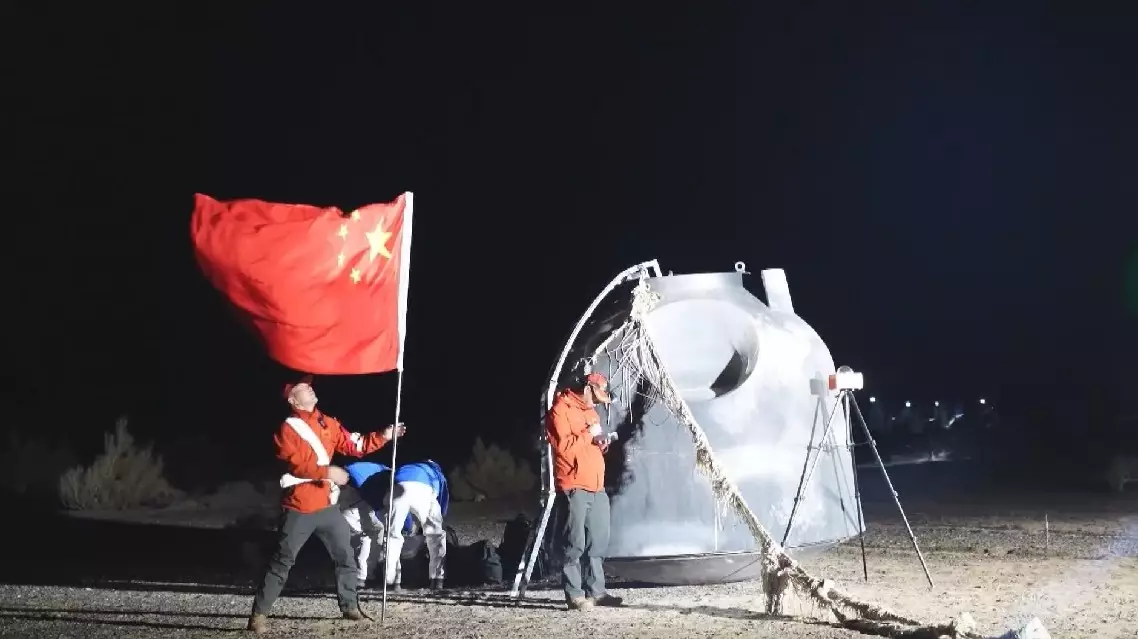
China's Dongfeng landing site prepared for Shenzhou-18 astronauts return