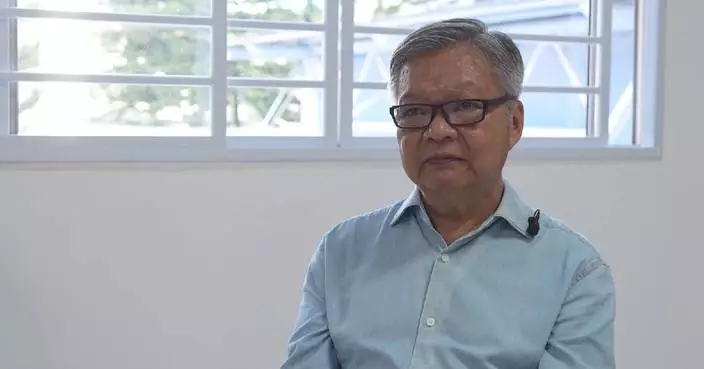
Nobel Prize in Physics laureate Prof. Samuel Ting has shared his story of discovering the J/psi meson, a subatomic particle that sheds new light on the theory that there existed a fourth quark, with one in a billion odds.
Ting, who discovered the particle in 1974 and received the Nobel Prize two years later, shared his story in an interview with China Media Group while attending a symposium commemorating the 50th anniversary of the discovery of the J/psi meson in Beijing on Oct. 20.
The finding marked "a pivotal moment" in the understanding of the subatomic world, which was referred to "November Revolution of the Particle Physics", said the Institute of High Energy Physics of the Chinese Academy of Sciences, host of the symposium, in a statement.
"[The experiment] was really difficult. The experimental equipment we needed should have an accuracy of as high as one part per billion. It is like, if it rains in Beijing, and there is one red raindrop among a billion fell in one second, we need to find it out. This was widely considered as impossible. Some laboratories that had particle accelerators in Europe and the United States refused to do the experiment. Finally, it was accepted by the Brookhaven National Laboratory in the United States," said Ting.
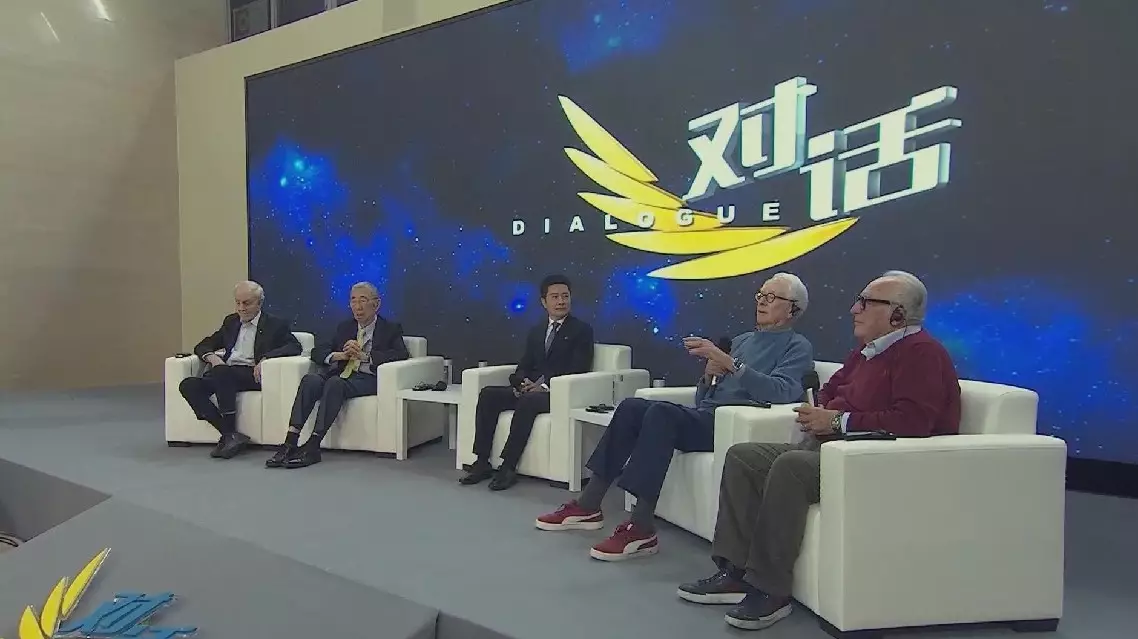
Also speaking at the symposium, Ting's friends recounted how they reacted to Ting's extraordinary finding when hearing about it.
"Was I shocked. I was wakened out of a deep sleep when Doctor Ting phoned me and said I should come to his office. He did not explain why. So, I got dressed, and I got into my car, and I drove to MIT (Massachusetts Institute of Technology) and found his office. He explained to me what he had done and showed me a picture of his experimental results. And I was absolutely flabbergasted. It was something extraordinary, very difficult to understand, and I think I said to him 'please give me a moment to think about this," said Sheldon Glashow a friend of Ting and a winner of Nobel Prize in Physics in 1979.
"I was in Italy at the time, so, the thing was not so instantaneous as Shelly, but I must say that the particle came out with some surprising qualities," said Luciano Maiani, former director-general of the European Organization for Nuclear Research.

Nobel prize laureate shares story of discovering J/psi meson with one in a billion odds
Nobel prize laureate shares story of discovering J/psi meson with one in a billion odds