Chinese learning in Peru has taken off over the years, as the flourishing economic and people-to-people exchanges between the two sides have prompted a rise in language learning demand.
The Confucius Institute, started in Peru 15 years ago, has played a key role in this trend. So far, more than 1,200 students have graduated in translation and interpreting from the training center, while 14,000 have taken up Chinese language courses.
For many young Peruvians, learning Chinese is not an easy task.
"If it is difficult, I feel that it's mostly due to learning the characters, because it is very different from our alphabet. It's totally different," said Alejandra Herrera, a Chinese language course student.
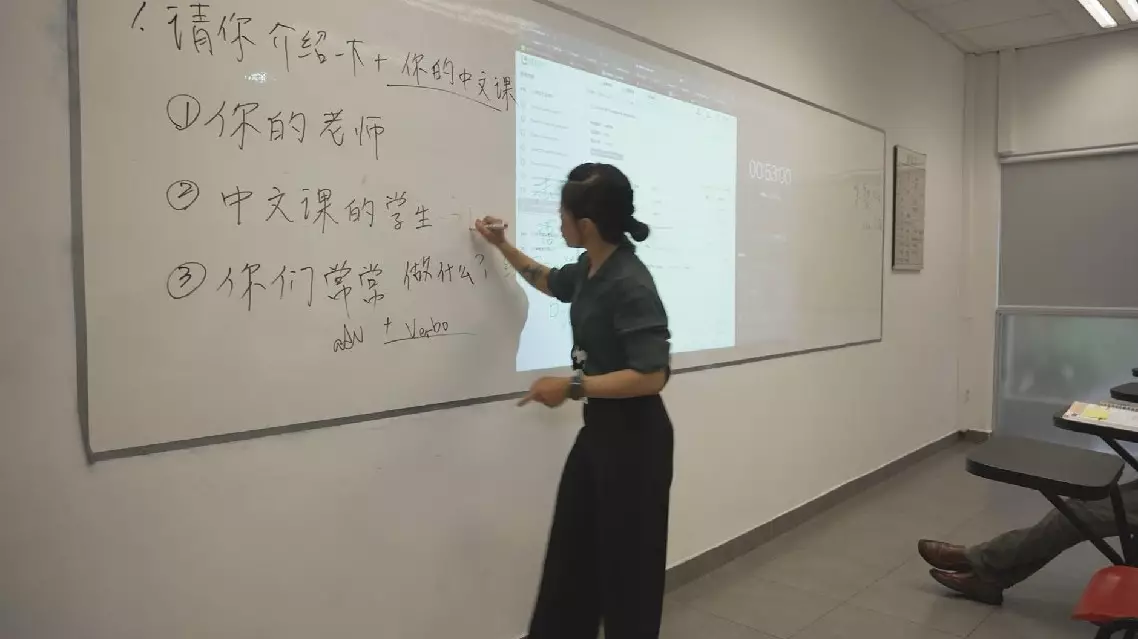
Rather than an alphabet, Chinese has characters. Teachers at the Confucius Institute are finding ways to encourage their students to overcome this difficulty.
"People from Peru and other South American countries have a natural artistic talent, so we host calligraphy competitions and workshops. As a result, students don't see Chinese characters as a problem; they see them as a way to showcase their talent," said Zhu Juang, a Chinese teacher at the Confucius Institute in Peru.
Some students at the training center are majoring in international business. They say they want to learn Chinese because the language is becoming increasingly important for young professionals, especially as Peru's commercial ties with China continue to expand.
"For business, I have seen that it is very important to know Chinese and English more than anything else, in case you go on a business trip or have contact with a person in a company who also knows Chinese. So, knowing Chinese is important," said Mayre Curo, one of the Chinese language students, who is also studying international business.
"Especially with this big project that is starting here in Chancay, we have to be able to communicate with them. It's going to open a lot of opportunities for us," said another language student Daniel Carrascal, who is also an English teacher.
Some students are learning Chinese because they are curious about the language and culture.
"I think that Chinese culture and Asian culture in general are very present. In my life, for example, here in Peru, we have Chinatown," said language student Allison Santa Cruz.
Peru will host the Asia-Pacific Economic Cooperation (APEC) meetings from Nov. 10 to Nov. 16 under the theme of "Empower, Include, Grow."
Patricia Perez-Albela, academic coordinator of the Confucius Institute in Peru, believes it will be a good opportunity for Peru to forge closer ties with Asian countries, and she is expecting to see a big growth in the number of people learning Chinese.
"Every year there is a margin of growth, and we expect that next year in 2025, the growth will be at 15 percent, or possibly more. There is increasing interest from different groups; not only young people but also older people," she said.
Chinese learning gains popularity in Peru as bilateral ties deepen