China has always been a crucial partner for UNESCO, and the organization is currently promoting further cooperation with China in science, education, culture and other fields, according to UNESCO's East Asia director Shahbaz Khan.
In an interview with China Media Group (CMG), Khan stressed the importance of enhancing understanding of different civilizations and respecting the diversity of world cultures today.
"Climate change is an existential threat to humanity, and of course, wars and geopolitical challenges still remain, so the GCI (Global Civilization Initiative) is more important than ever before. We need intercultural dialogue. If we talk to each other, we can get over many of these differences. And if we understand each other, the civilizations, there will be a better future for everyone. And we can create opportunities for sustainable development," he said.
Khan noted China's long tradition of innovation, from paper-making to AI, is guided by its culture, and its use of technology in heritage conservation offers valuable lessons for developing countries.
"Coming from a long time with the tradition of innovation, the tradition of respecting knowledge and bringing science and technology, like, for example, the paper-making in China or the printing in China, all the way now to artificial intelligence - they are also guided by the culture of China. China is one of the, I would say, is the largest developing country," said Khan.
"But China is also at the cutting edge of technologies. China has brought, strongly, science and technology into conservation. So, for example, the use of artificial intelligence and 3D modeling, all [of the] Mogao caves, you can see it on your computer in an amazing way. Also linking with the remote sensing technologies and nature conservation. And we have such great examples already from China, which can be useful for the developing countries around the world," said Khan.
Khan said that practical cooperation between China and UNESCO in recent years has given rise to some important new initiatives.
From jointly establishing scholarship programs to help young people, especially those from Global South countries, to study agriculture and cutting-edge technologies in China, to building platforms through Chinese research institutions to protect cultural heritage using science and technology, Khan said China has always been a vital partner for UNESCO.
"During the visit of our director-general [Khaled El-Enany] last month, we had several high level interactions which will promote jointly education, culture, as well as science and technology. So there are already great examples like the new institute in Shanghai (UNESCO International Institute for STEM Education), which is a very major investment for the world by China," he said.
"UNESCO is supporting the work of China by linking closely with China. It brings fruitful results for everyone around the world, especially for the developing countries, the people who need more help with education, the people who need help with conservation of their nature, conservation of their heritage and also bringing technologies where they are needed, getting over digital divides and helping with the capacity building in STEM education, in AI. So there would be a lot of further follow-ups," said Khan.
The institute was established in Shanghai in September, 2025. It aims to create a world-class research and cooperation platform for fostering students' innovation, problem-solving skills and social responsibility in science, technology, engineering and mathematics. It is also the first Category I institute established by UNESCO in the Asia-Pacific region.
A series of high-level cultural events have also been taking place recently, serving as examples of civilization dialogue.
The International Day for Dialogue Among Civilizations opened on Wednesday in New York, the third World Conference of Sinologists hosted by China took place in Dunhuang City, northwest China's Gansu Province from June 2 to 4, and the second World Conference of Classics co-hosted with Greece was held in Athens from Tuesday to Wednesday.
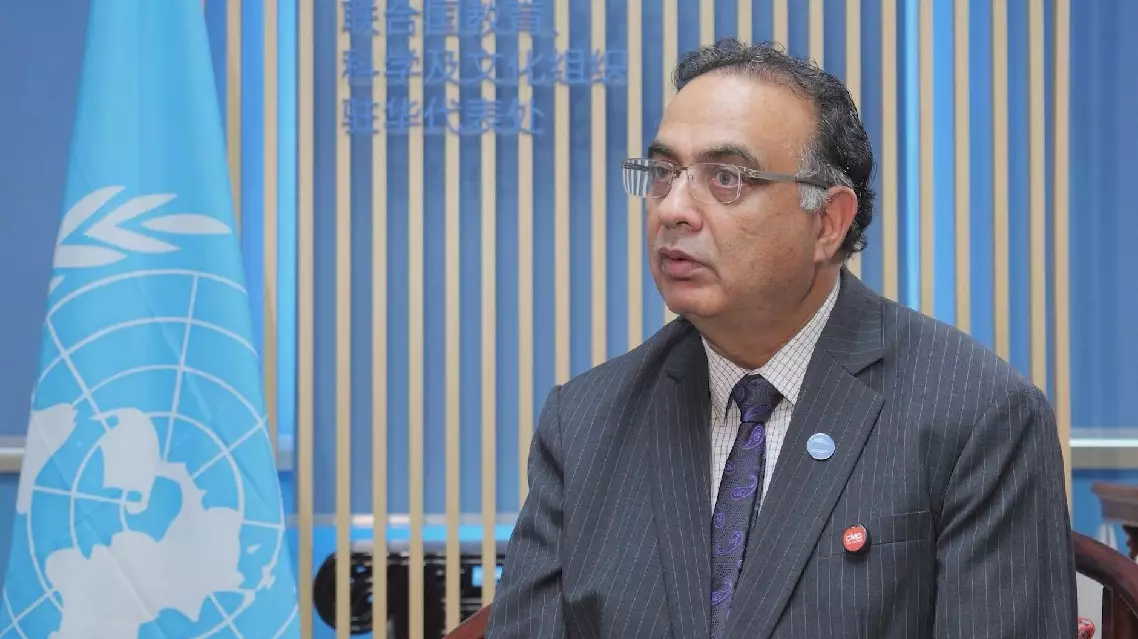
UNESCO official hails China as vital partner in development