Skip to Content Facebook Feature Image

Former UNGA president calls looks to multipolarity to address overlapping challenges

China

China

China

Former UNGA president calls looks to multipolarity to address overlapping challenges

2024-11-12 21:06 Last Updated At:11-13 00:27

A former United Nations General Assembly (UNGA) president has called on all countries to unite together to address a range of interconnected, human-created challenges.

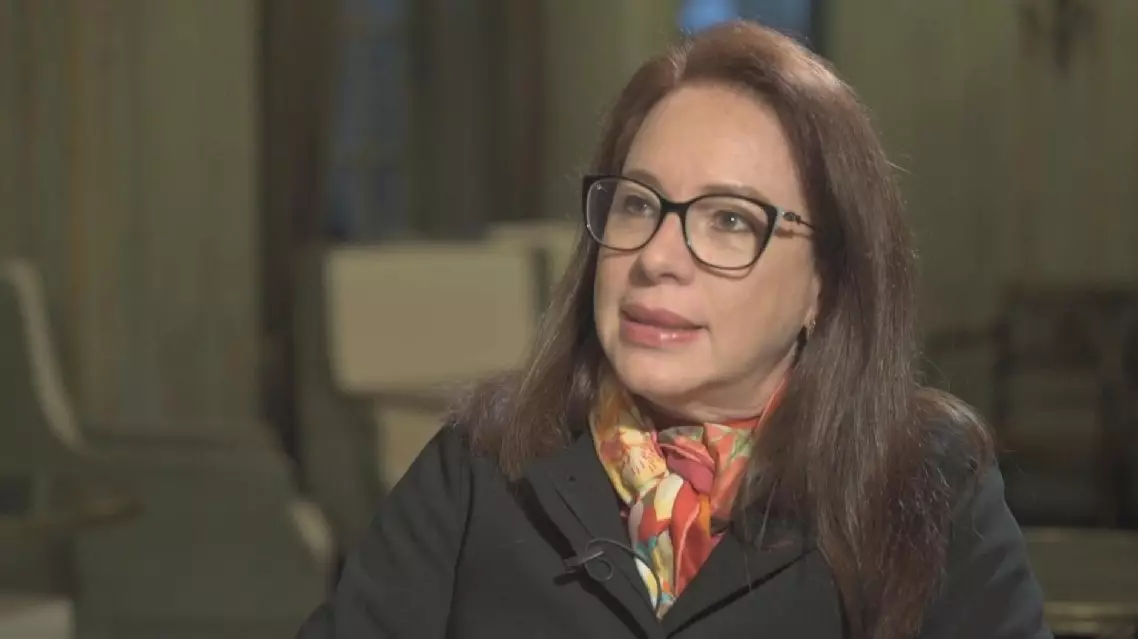
Maria Fernanda Espinosa was the president of the 73rd session of the UNGA and former Foreign Minister of Ecuador. With over three decades of taking on roles in academia, NGOs, international organizations and government, she has gained a gamut of expertise in the fields of international relations, peace and security, sustainable development and climate change.

She shared her insights on the current challenges that face humanity and international cooperation in a recent interview with China Global Television Network on the sidelines of the two-day 7th Paris Peace Forum which opened on Monday.

"I would say that the world is full of what they're called multiple and interconnected crises. Crisis on the security front. Crisis on the economic front because of looming inequalities. Crisis on the nature and environment front we are experiencing, what has been called the extinction crisis. And the climate crisis. I think that as citizens, as former public servants and diplomats, we have the responsibility to do something about the things of that we don't like. But all these are human creations. Therefore they have human solutions," she said.

On the UN's evolving role, Espinosa stressed that the international body should be lauded for its accomplishments while pressing forward to form a fairer and more effective institution.

"The main mandate of the UN is keeping the world safe, free of wars, and of course, a pillar on development and on human rights. These are the three pillars 80 years ago, and I think the context has changed, geopolitics has changed, the challenges ahead of us have changed. And I think that the UN is an organization that has done a lot of good but needs to be retooled," she said.

The lifelong diplomat stressed that today's world is in urgent need of international cooperation and solidarity.

"I think the need for international cooperation, the need for better diplomacy, the need for solidarity, the need for really building a human community is more needed than ever. We learned that the hard way with COVID-19. We understood that we are fragile, vulnerable, interdependent. The same thing goes on access to technology, on artificial intelligence, on the service economy that is so important today, when you look at the geopolitics of where are the raw materials that are fundamental for the future," Espinosa said.

Despite the array of challenges, the former UNGA president said that shifts away from concentrated global power give her hope for the future.

"What we see is a multipolar world, a polycentric world, some call it that way, emerging and shaping. We saw it during the BRICS summit recently, and we are not leaving a unipolar, bipolar world anymore. We are living in a world that has many powers playing in the same camp in a way. We see the emerging economies and the middle income countries, also. So, I think that the geopolitics and the geography has changed, and I think institutions have to adapt to these changes. We have to understand leadership in a different way. And I think that all these new and emerging powers have a role to play," she said.
Former UNGA president calls looks to multipolarity to address overlapping challenges
Former UNGA president calls looks to multipolarity to address overlapping challenges
China's push toward a greener future is once again in the spotlight at this year's annual political "two sessions", as lawmakers are reviewing a draft ecological environment code, a significant step toward establishing a comprehensive legal framework for ecological protection.

The draft code was submitted on March 5 to the ongoing fourth session of the 14th National People's Congress (NPC), China's top legislature, for deliberation.

Once adopted, it will become China's second formal statutory code, after the Civil Code, which was adopted in 2020.

The rule of law has been continuously strengthened to support the country's green progress. China already has more than 30 laws related to environmental protection, along with over 100 sets of administrative regulations and more than 1,000 sets of local rules.

The latest legislative move comes amid China's historic gains in ecological conservation over the past decade or so. Championing green development, the country has recorded the world's fastest growth in forest resources and afforestation, led globally in renewable energy development, and achieved one of the fastest national reductions in energy intensity worldwide.

The 1,242-article draft has five chapters, covering areas including pollution control, ecological protection, and green and low-carbon development.

Scholars involved in drafting the legislation say the code goes beyond broad legal principles. It is also designed to address environmental issues that affect people's daily lives.

"Electric vehicles are becoming very common in China. My family has one. We all think it environment-friendly. But have you ever thought about this question: how do we deal with the first generation of EV batteries after they expire a few years later? The same goes for wind turbine blades and solar panels," said Ding Lin, assistant professor of the Renmin University of China.

China's environmental progress has drawn global attention in recent years, from improving air quality to expanding renewable energy. Yet amid geopolitical tensions and economic uncertainty, some observers have questioned whether the country will maintain the same pace of green transition.

"Last year during the COP30, even some friends who are very familiar with China asked me whether China will continue its green development path. I told them we have gradually worked out new policies. We have a very clear direction and goal. In a world full of uncertainties, we are providing the most certainty," said Wang Yi, an NPC deputy from east China's Zhejiang Province and professor of the Chinese Academy of Sciences.

In a country pursuing modernization, taking the time to codify environmental laws sends a clear message: economic growth and environmental protection are not a trade-off to be managed, but a commitment to be upheld. For China, a beautiful environment is not a luxury for the future, it is a right for the present, and a responsibility to the next generation.

"This code reflects China's vision of harmonious coexistence between humanity and nature. It shows how development and environmental protection can move forward together," said Lyu Zhongmei, vice chair of the NPC Environmental Protection and Resources Conservation Committee.

China will accelerate the green transition across the board and cut carbon dioxide emissions per unit of the GDP by a total of 17 percent in the 2026-2030 period, according to a draft outline of the 15th Five-Year Plan (2026-30) for national economic and social development submitted to the NPC for deliberation on March 5.

Chinese lawmakers review draft ecological environment code in major green legislative push

Chinese lawmakers review draft ecological environment code in major green legislative push

Recommended Articles