China's large unmanned combat vessel, JARI-USV-A, also known as "Orca," made its global debut on Tuesday at the ongoing 15th China International Aviation and Aerospace Exhibition, also known as Airshow China, in Zhuhai, a coastal city of south China's Guangdong Province.
This 58-meter, 500-tonne stealth USV boasts a 4,000-nautical-mile range and capabilities for long-range strikes, air defense, anti-missile, and anti-submarine warfare. With a trimaran hull and hybrid diesel-electric dual-mode propulsion, the "Orca" can operate independently or in coordination with naval fleets for extended-range missions.
"We can say the vessel has strong detection capabilities in the air, above and below water. It can carry different loads according to different tasks. Because it adopts a special design, it is relatively stable in the sea to facilitate the take-off and landing of unmanned aerial vehicles. It is also one of the few unmanned vessels with a relatively large displacement in the world. Since it can automatically navigate and perform tasks, it may become a powerful weapon for our coastal defense forces or naval forces to protect the safety of our coastline and related maritime economic zones in the future," said military expert Fu Qianshao.
At the same time, a number of star exhibits, including the first lunar soil samples brought back from the far side of the moon and the scaled model of China's Haoloong space cargo shuttle are also making their debut at the air show, which will last through Nov 17.
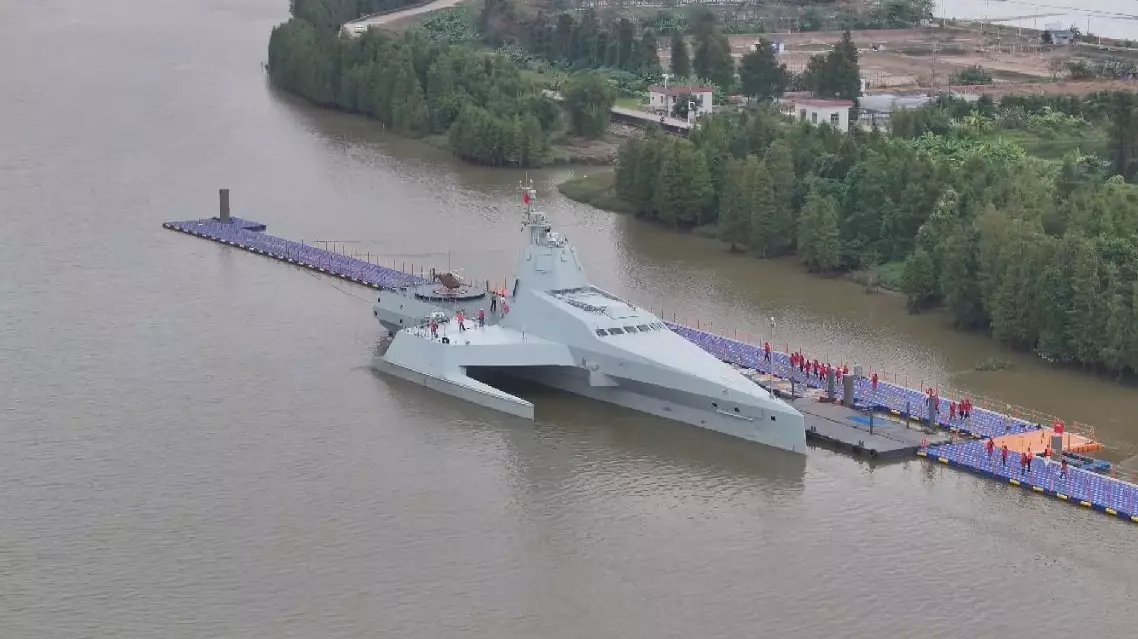
China's large unmanned combat vessel makes global debut at airshow
Displaced Palestinians in the Gaza Strip are manually removing rubble using basic tools, in the absence of heavy machinery and international reconstruction assistance.
Seven months into a fragile ceasefire, large-scale reconstruction remains largely stalled in Gaza, with Israeli restrictions on construction materials and unresolved political disputes deemed as key obstacles.
Many families in the enclave say they can no longer wait for rebuilding plans to begin.
Mohammad Adel, who lost his seven-story home in Khan Younis during the war, has been living with his family under difficult displacement conditions in the crowded tents of Al Mawasi for more than two years.
Unable to wait any longer, Adel decided to begin clearing the rubble of his home by hand.
"We see that there will be no reconstruction for Gaza and the closure is very strict on us. Waiting for reconstruction will take a very long time, so we started working and removing the rubble with our own hands. As you can see, this will cost us money, but we are trying to prepare the place so we can live in it," he said.
For some unemployed workers, clearing debris has become a temporary source of income amid the economic collapse caused by the war.
"Today, financial means have become nonexistent. Before the war, I had a chicken farm, but my work stopped because of the war. So I searched for another job that could provide me with an income, and I have no choice except this extremely exhausting work," said Abdullah Al Bayouk, a worker.
Palestinian officials warn that the continued delay in reconstruction is forcing thousands of displaced families to remain inside tents or unsafe damaged buildings, under worsening humanitarian conditions.
"Over 400,000 residential buildings have been either totally destroyed or rendered uninhabitable, along with more than 60 million tons of rubble. And 3,000 more housing units are at risk of collapse, yet people are still living inside them," said Mohannad Abboud, director of reconstruction of the Palestinian Ministry of Public Works.
A recent UN report showed that rebuilding Gaza and clearing the debris will require more than 71 billion U.S. dollars over the next decade. The rubble is estimated to cover around 78 percent of buildings across the strip.
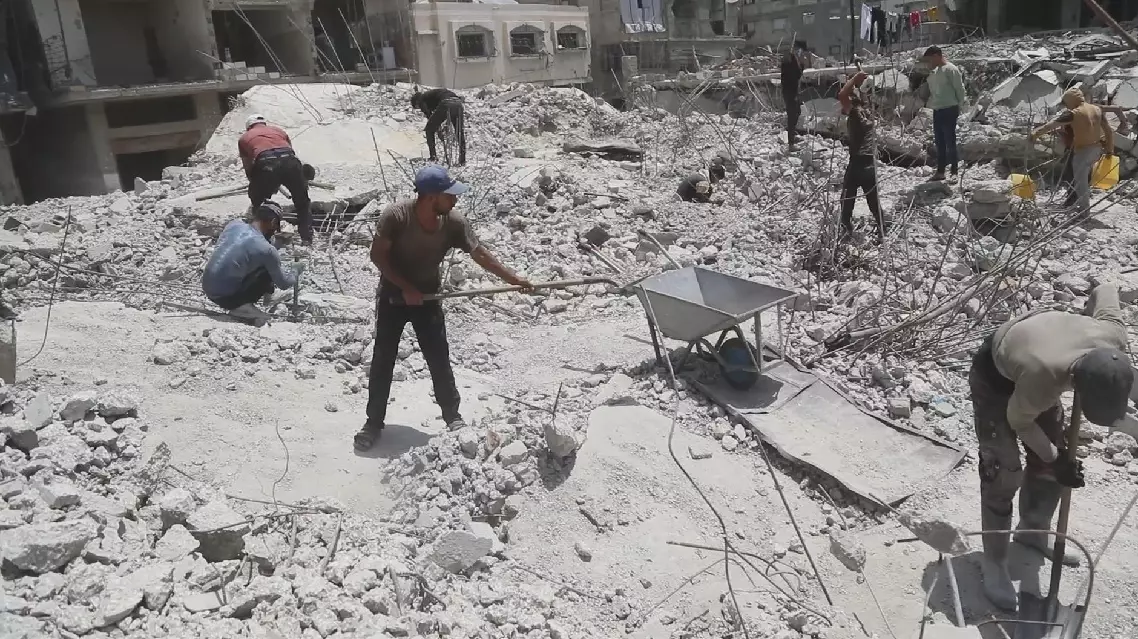
Gaza residents clear rubble by hand as large-scale reconstruction stalls
Gaza residents clear rubble by hand as large-scale reconstruction stalls