WASHINGTON (AP) — Republicans have elected South Dakota Sen. John Thune as the next Senate majority leader, completing a momentous shift in their leadership that elevates a top deputy of Mitch McConnell into a key position as President-elect Donald Trump returns to the White House.
Thune, 63, is in his fourth Senate term and has promised to work closely with Trump, despite differences the two have had over the years, and will be a crucial part of the incoming president’s efforts to push through his policy agenda.
Thune beat out two other competitors, Sens. John Cornyn and Rick Scott, by gaining majority support from GOP senators in two rounds of secret ballots behind closed doors. Scott was eliminated on the first round and the final vote between Thune and Cornyn was 29-24, according to several people who requested anonymity to discuss the private meeting.
Republicans are replacing McConnell, the longest serving Senate party leader, as they prepare to take majority control of the Senate with the 53 seats they won in last week’s elections. It was the first competitive election for Republican leader in three decades and Senate Republicans' first regime change since McConnell became GOP leader in 2007.
Thune's election represents a major shift in the upper chamber's GOP conference as many senators have been eager to move on from McConnell's long and powerful reign. But it will also be a complicated test for Thune as he will have to manage a conference that is often divided over policy, navigate Trump's demands of the legislative branch and secure policy wins for the president as he begins his second term.
Speaking to reporters immediately after he was elected, Thune said that it is a “new day in the United States Senate.” He said his majority will work to toughen border security laws, lower energy costs and overturn regulations they see as burdensome.
“We are excited to reclaim the majority and to get to work with our colleagues in the House to enact President Trump’s agenda,” Thune said.
As the candidates tried to win over individual senators, all of their pitches centered around how close they would be to Trump. That was a more difficult task for Cornyn and Thune, who broke publicly with Trump over his effort to overturn the results of the 2020 presidential election and the Jan. 6, 2021 attack on the Capitol by Trump's supporters. At the time, Thune called Trump's actions “inexcusable.”
In recent months, Thune has worked to smooth over that relationship, visiting Trump in his Florida home and consulting with him on how to implement the incoming president’s agenda. Thune told The Associated Press over the summer that he views their potential relationship as a professional one. If they both won their elections, Thune said then, “we’ve got a job to do.”
As he made his case, Thune has made clear that he will listen to Trump's demands. When Trump posted on X Sunday that the new leader “must agree” to allow him to appoint Cabinet members and others when the Senate is on recess, avoiding confirmation votes, Thune quickly responded in a statement that the Senate must “quickly and decisively” act to get nominees in place and that “all options are on the table to make that happen, including recess appointments.”
Speaking to reporters after he was elected, Thune noted that “the Senate has an advise and consent rule in the Constitution" but that they will do everything they can to get his nominees in place.
“How that happens remains to be seen,” Thune said.
Thune’s win is all the more extraordinary because of his 2004 election to the Senate – defeating then-Senate Majority Leader Tom Daschle after arguing during the campaign that Daschle had lost his South Dakota roots during his years in Democratic leadership. Twenty years later, Thune will become majority leader himself.
Well liked and a respected communicator, Thune has been perceived as a front-runner for much of the year. Like McConnell, he hails from the Republican Party’s more traditional wing.
He is a former chairman of the Senate Commerce Committee and has held the Republican whip position — no. 2 in party leadership — since 2019. He took over for McConnell for several weeks last year when he was on a medical leave, a move that was widely seen as an audition of sorts as speculation surrounded McConnell's future.
As he geared up to run for leader, Thune spent much of the year campaigning for his colleagues. According to his aides, he raised more than $31 million to elect Senate Republicans this cycle, including a $4 million transfer from his own campaign accounts to the Senate’s main campaign arm.
The election was difficult for many in the conference who saw Thune and Cornyn as similar choices. They are alike on policy, voting generally in step with the conference but working with Democrats at times. Cornyn is a longtime member of the Senate Judiciary Committee who took a leading role on bipartisan gun legislation two years ago.
But the two differed on whether the leader should be term limited — a key demand from some in the conservative wing. Cornyn pushed for limits, while Thune did not.
Scott, the former governor of Florida, was elected to the Senate in 2018 and quickly positioned himself as a foil to McConnell, running against him for leader in 2022 and aligning with Utah Sen. Mike Lee and others who have been highly critical of the current leadership.
As Thune and Cornyn wooed their colleagues one by one all year, Scott was tied up in his own reelection race. He handily defeated Democrat Debbie Mucarsel-Powell by more than 10 points.
In the week since the election, Scott aggressively stepped up his campaign for GOP leader, campaigning publicly as the candidate closest to Trump and winning endorsements from people who are close to the former and future president, such as billionaire Elon Musk. But some questioned whether that strategy might backfire.
South Dakota Sen. Mike Rounds, Thune's home state colleague, said that he prefers the way that Thune and Cornyn have “handled it one-on-one with everybody,” but that he had talked to Scott as well. “We’ve got three qualified individuals,” he said ahead of the race.
Still, both Thune and Cornyn adopted some of Scott's ideas as they worked to win over voters. Thune told the conference in a candidate forum Tuesday evening that he would allow more amendments on the floor and improve communication from McConnell's regime, addressing frequent complaints from that wing of the conference.
McConnell did not say who he was supporting, but said after the vote that Thune’s victory was a “clear endorsement of a consummate leader.”
“The American people elected Republicans to restore stability and order after four years of Washington Democrats’ failure," McConnell said. "John Thune will take the reins with a tremendous opportunity to lead this transformation, and Senate Republicans stand behind him, ready to get to work.”
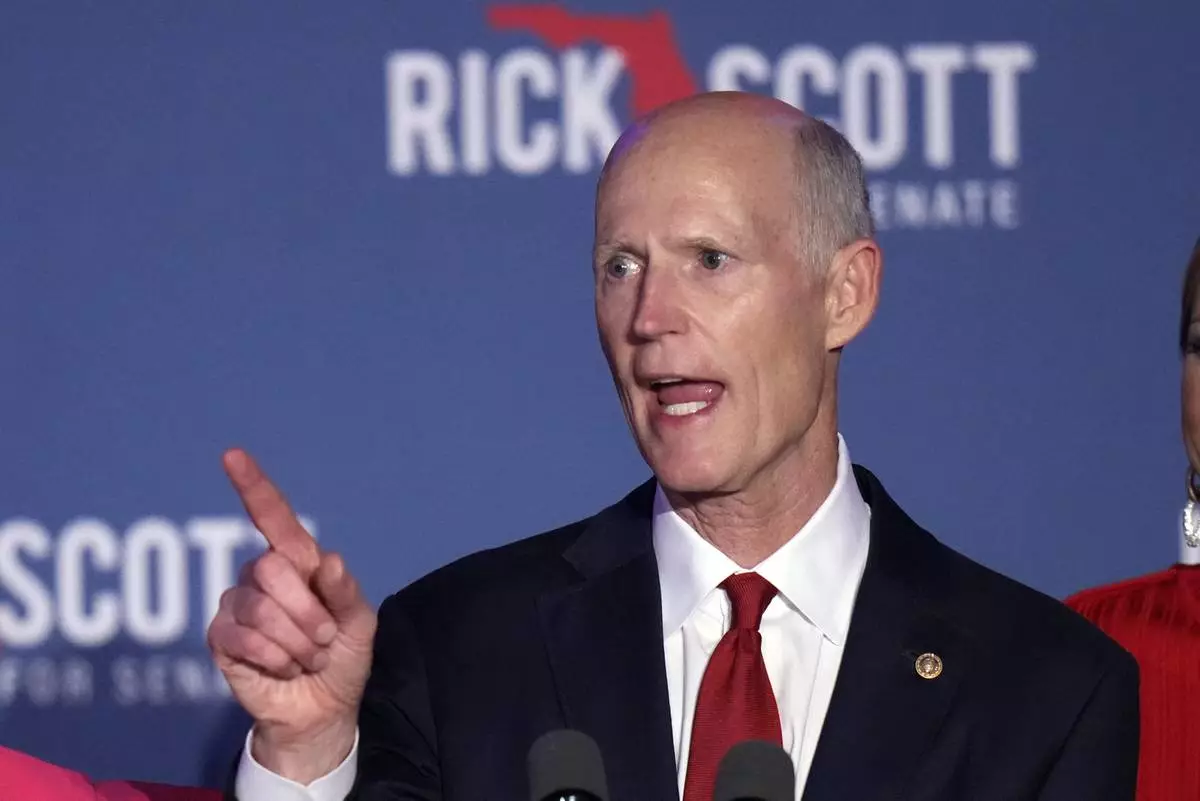
Sen. Rick Scott, R-Fla., speaks at a campaign watch party on election night Tuesday, Nov. 5, 2024, in Bonita Springs, Fla. (AP Photo/Chris O'Meara)
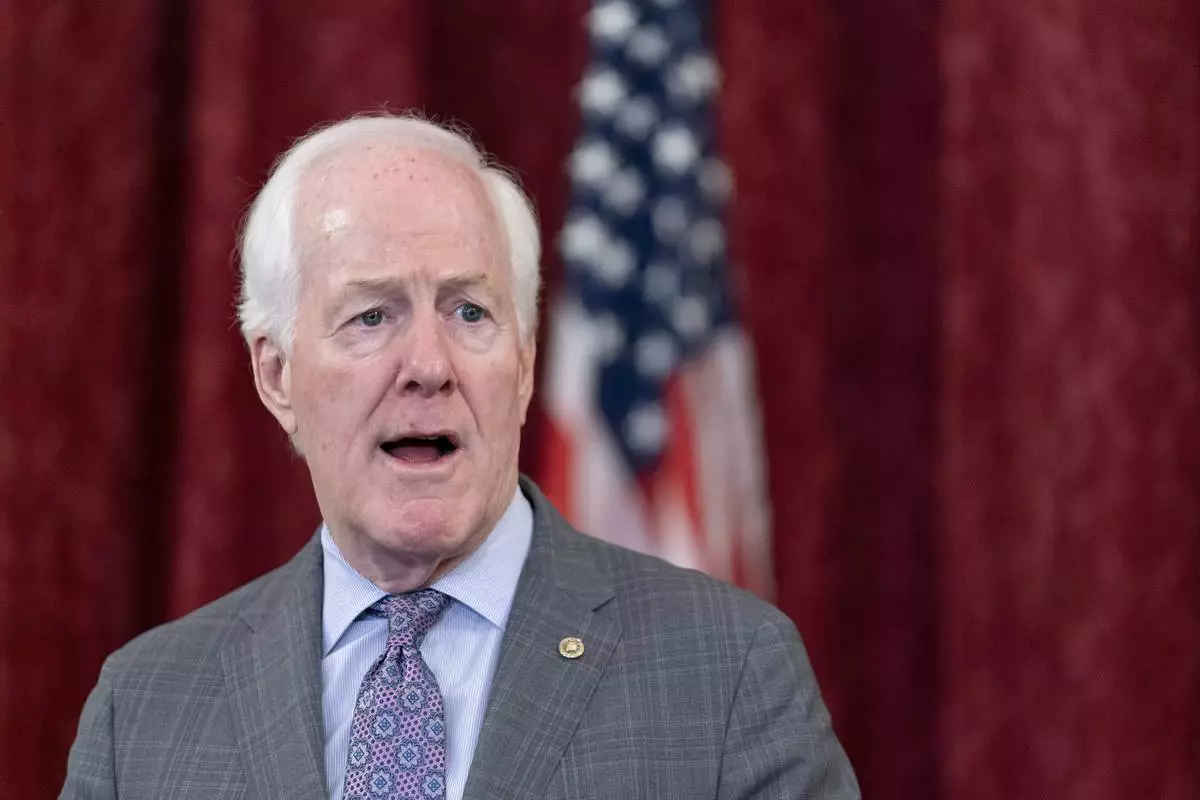
FILE - Sen. John Cornyn, R-Texas, speaks to media, Oct. 18, 2023, on Capitol Hill in Washington. (AP Photo/Stephanie Scarbrough, File)
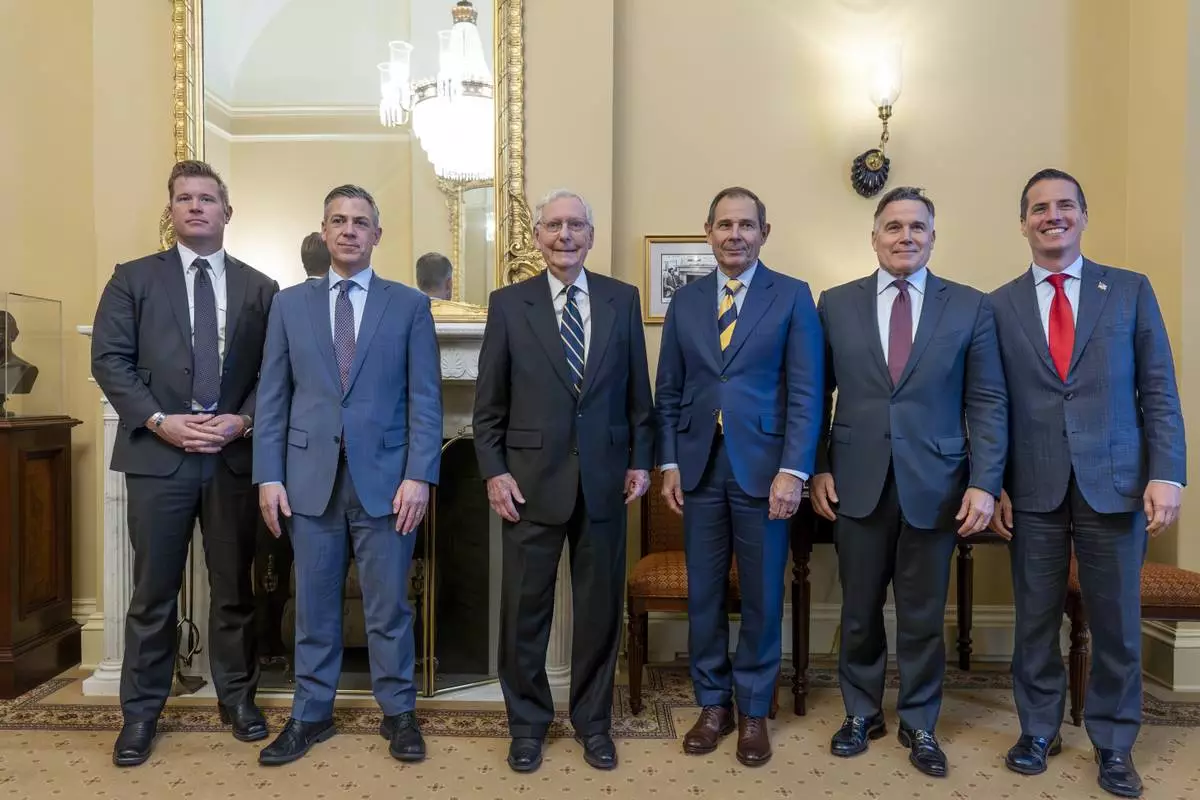
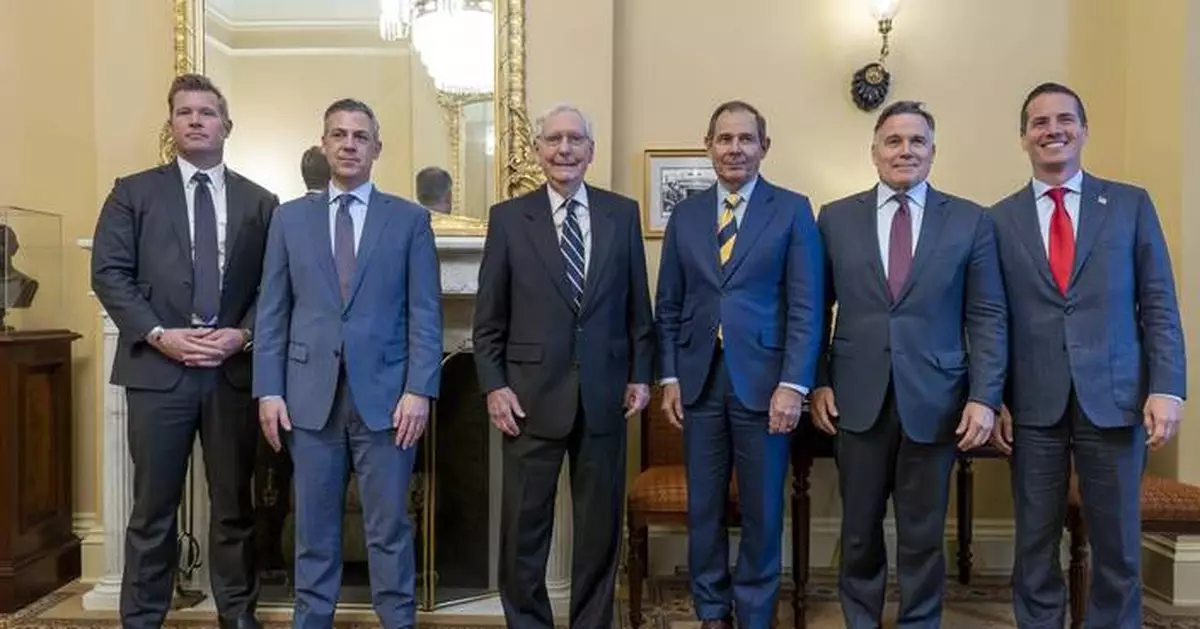
Senate Minority Leader Mitch McConnell, R-Ky., center, welcomes incoming Republican senators in his office at the Capitol in Washington, Tuesday, Nov. 12, 2024. From left are, Sen.-elect Tim Sheehy, R-Mont., Sen.-elect Jim Banks, R-Ind., Sen. Mitch McConnell, R-Ky., Sen.-elect John Curtis, R-Utah, Sen.-elect David McCormick, R-Pa., and Sen.-elect Bernie Moreno, R-Ohio. (AP Photo/J. Scott Applewhite)
WASHINGTON (AP) — The Trump administration's criminal investigation of Federal Reserve Chair Jerome Powell appeared on Monday to be emboldening defenders of the U.S. central bank, who pushed back against President Donald Trump’s efforts to exert more control over the Fed.
The backlash reflected the overarching stakes in determining the balance of power within the federal government and the path of the U.S. economy at a time of uncertainty about inflation and a slowing job market. This has created a sense among some Republican lawmakers and leading economists that the Trump administration had overstepped the Fed's independence by sending subpoenas.
The criminal investigation — a first for a sitting Fed chair — sparked an unusually robust response from Powell and a full-throated defense from three former Fed chairs, a group of top economic officials and even Republican senators tasked with voting on Trump's eventual pick to replace Powell as Fed chair when his term expires in May.
White House press secretary Karoline Leavitt told reporters that Trump did not direct his Justice Department to investigate Powell, who has proven to be a foil for Trump by insisting on setting the Fed's benchmark interest rates based on the data instead of the president's wishes.
“One thing for sure, the president’s made it quite clear, is Jerome Powell is bad at his job,” Leavitt said. “As for whether or not Jerome Powell is a criminal, that’s an answer the Department of Justice is going to have to find out.”
The investigation demonstrates the lengths the Trump administration is willing to go to try to assert control over the Fed, an independent agency that the president believes should follow his claims that inflationary pressures have faded enough for drastic rate cuts to occur. Trump has repeatedly used investigations — which might or might not lead to an actual indictment — to attack his political rivals.
The risks go far beyond Washington infighting to whether people can find work or afford their groceries. If the Fed errs in setting rates, inflation could surge or job losses could mount. Trump maintains that an economic boom is occurring and rates should be cut to pump more money into the economy, while Powell has taken a more cautious approach in the wake of Trump's tariffs.
Several Republican senators have condemned the Department of Justice's subpoenas of the Fed, which Powell revealed Sunday and characterized as “pretexts” to pressure him to sharply cut interest rates. Powell also said the Justice Department has threatened criminal indictments over his June testimony to Congress about the cost and design elements of a $2.5 billion building renovation that includes the Fed's headquarters.
“After speaking with Chair Powell this morning, it’s clear the administration’s investigation is nothing more than an attempt at coercion,” said Sen. Lisa Murkowski, R-Alaska, on Monday.
Jeanine Pirro, U.S. attorney for the District of Columbia, said on social media that the Fed “ignored” her office’s outreach to discuss the renovation cost overruns, “necessitating the use of legal process — which is not a threat.”
“The word ‘indictment’ has come out of Mr. Powell’s mouth, no one else’s,” Pirro posted on X, although the subpoenas and the White House’s own statement about determining Powell's criminality would suggest the risk of an indictment.
A bipartisan group of former Fed chairs and top economists on Monday called the Trump administration's investigation “an unprecedented attempt to use prosecutorial attacks" to undermine the Fed's independence, stressing that central banks controlled by political leaders tend to produce higher inflation and lower growth.
“I think this is ham-handed, counter-productive, and going to set back the president’s cause,” said Jason Furman, an economist at Harvard and former top adviser to President Barack Obama. The investigation could also unify the Fed’s interest-rate setting committee in support of Powell, and means “the next Fed chair will be under more pressure to prove their independence.”
The subpoenas apply to Powell's statements before a congressional committee about the renovation of Fed buildings, including its marble-clad headquarters in Washington. They come at an unusual moment when Trump was teasing the likelihood of announcing his nominee this month to succeed Powell as the Fed chair and could possibly be self-defeating for the nomination process.
While Powell's term as chair ends in four months, he has a separate term as a Fed governor until January 2028, meaning that he could remain on the board. If Powell stays on the board, Trump could be blocked from appointing an outside candidate of his choice to be the chair.
Powell quickly found a growing number of defenders among Republicans in the Senate, who will have the choice of whether to confirm Trump's planned pick for Fed chair.
Sen. Thom Tillis, a North Carolina Republican and member of the Senate Banking panel, said late Sunday that he would oppose any of the Trump administration’s Fed nominees until the investigation is "resolved."
“If there were any remaining doubt whether advisers within the Trump Administration are actively pushing to end the independence of the Federal Reserve, there should now be none,” Tillis said.
Sen. Dave McCormick, R-Pa., said the Fed may have wasted public dollars with its renovation, but he said, “I do not think Chairman Powell is guilty of criminal activity.”
Senate Majority Leader John Thune offered a brief but stern response Monday about the tariffs as he arrived at the U.S. Capitol, suggesting that the administration needed “serious” evidence of wrongdoing to take such a significant step.
“I haven’t seen the case or whatever the allegations or charges are, but I would say they better, they better be real and they better be serious,” said Thune, a Republican representing South Dakota.
If Powell stays on the board after his term as chair ends, the Trump administration would be deprived of the chance to fill another seat that would give the administration a majority on the seven-member board. That majority could then enact significant reforms at the Fed and even block the appointment of presidents at the Fed's 12 regional banks.
“They could do a lot of reorganizing and reforms” without having to pass new legislation, said Mark Spindel, chief investment officer at Potomac River Capital and author of a book on Fed independence. “That seat is very valuable.”
Powell has declined at several press conferences to answer questions about his plans to stay or leave the board.
Scott Alvarez, former general counsel at the Fed, says the investigation is intended to intimidate Powell from staying on the board. The probe is occurring now “to say to Chair Powell, ’We’ll use every mechanism that the administration has to make your life miserable unless you leave the Board in May,'" Alvarez said.
Asked on Monday by reporters if Powell planned to remain a Fed governor, Kevin Hassett, director of the White House National Economic Council and a leading candidate to become Fed chair, said he was unaware of Powell’s plans.
“I’ve not talked to Jay about that,” Hassett said.
A bipartisan group of former Fed chairs and top economists said in their Monday letter that the administration’s legal actions and the possible loss of Fed independence could hurt the broader economy.
“This is how monetary policy is made in emerging markets with weak institutions, with highly negative consequences for inflation and the functioning of their economies more broadly,” the statement said.
The statement was signed by former Fed chairs Ben Bernanke, Janet Yellen, and Alan Greenspan, as well as former Treasury Secretaries Henry Paulson and Robert Rubin.
Still, Trump's pressure campaign had been building for some time, with him relentlessly criticizing and belittling Powell.
He even appeared to preview the shocking news of the subpoenas at a Dec. 29 news conference by saying he would bring a lawsuit against Powell over the renovation costs.
“He’s just a very incompetent man,” Trump said. “But we’re going to probably bring a lawsuit against him.”
__
AP writers Lisa Mascaro and Joey Cappelletti contributed to this report.
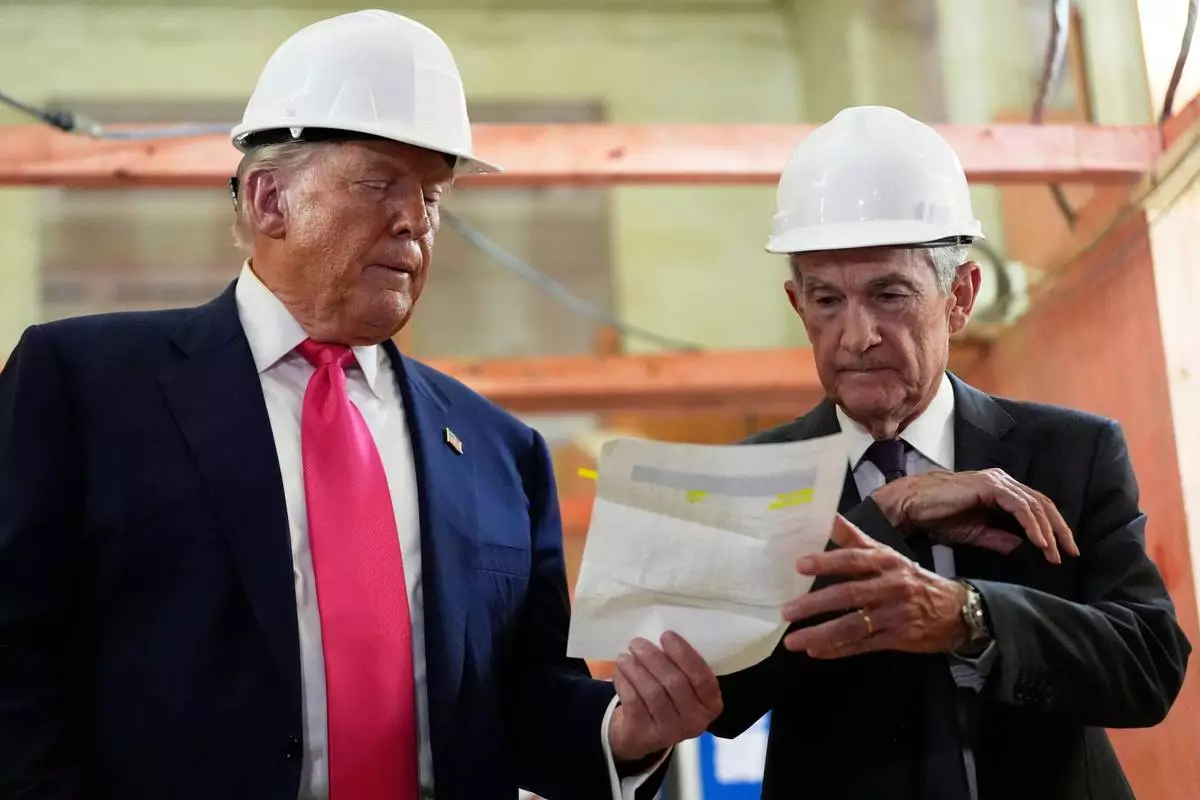
FILE - Federal Reserve Chairman Jerome Powell, right, and President Donald Trump look over a document of cost figures during a visit to the Federal Reserve, July 24, 2025, in Washington. (AP Photo/Julia Demaree Nikhinson, File)