SAN MATEO, Calif. & BASEL, Switzerland--(BUSINESS WIRE)--Nov 14, 2024--
BeiGene, Ltd. (NASDAQ: BGNE; HKEX: 06160; SSE: 688235), a global oncology company, today announced its intent to change the Company’s name to BeOne Medicines Ltd., confirming its commitment to develop innovative medicines to eliminate cancer by partnering with the global community to serve as many patients as possible.
This press release features multimedia. View the full release here: https://www.businesswire.com/news/home/20241114671168/en/
“Cancer, a leading cause of death worldwide, exacts an immense toll on individuals, families, and communities. No person, family, scientist, clinician, hospital, policy maker, company or country can or should face this devastating disease alone. We all must work together to win, which is why we are committed to playing a critical role and unifying the global community in the fight against cancer. Our focus is to not only bring innovative medicines to as many people as possible, but also to identify and address the challenges that impede access, making treatments more accessible and affordable,” said John V. Oyler, Co-Founder, Chairman and CEO at BeiGene. “We have already helped more than 1.4 million patients, and with one of the most prolific oncology pipelines, this year we will bring more than 10 new potential medicines into the clinic. I look forward to our next chapter of growth as BeOne.”
About Our Brand Evolution: BeOne Medicines
The proposed new name and logo illustrates our focus on coming together against cancer. Key attributes of the new logo design include:
The new name is part of a broader strategic growth plan that has enabled the Company’s global oncology leadership since its inception in 2010. The Company recently reported $1 billion in quarterly total revenue driven by strong growth in product revenue in the U.S. and Europe. To support its expansive clinical portfolio and global growth, the Company opened its $800 million flagship clinical R&D and manufacturing facility at the Princeton West Innovation Campus in Hopewell, N.J. in July. Once the name is approved by shareholders, the company’s stock ticker on Nasdaq will change to “ONC”.
The Company’s nearly 11,000 colleagues have advanced more than 20 molecules into the clinic and secured regulatory approvals across five continents, and its unique global clinical team comprised of more than 1,800 colleagues conducts clinical trials across Europe, North and South America, Australia, and Asia in more than 45 countries. Its portfolio strategy emphasizes rapid generation of early-stage clinical proof-of-concept data enabled by its speed- and cost-advantaged (“Fast to Proof of Concept”) approach to global clinical operations. The Company has solidified its leadership in hematology with BRUKINSA ® (zanubrutinib), which has the broadest label of any BTK inhibitor and, in the U.S., is the leader in new patient starts in both frontline and relapsed/refractory chronic lymphocytic leukemia in addition to all other approved B-cell malignancies. The Company is advancing this impactful therapy, which is approved in more than 70 markets, as the cornerstone of its hematology franchise as a monotherapy and as a backbone for potential best-in-class combinations with late-stage BCL2 inhibitor sonrotoclax and BTK degrader BGB-16673. In addition, the Company is focused on growing its leadership in solid tumors with its PD-1 inhibitor TEVIMBRA ® (tislelizumab) and by advancing potential best-in-class assets for breast, lung and gastrointestinal cancers across several modalities, including antibody drug conjugates, multi-specific antibodies, targeted protein degraders, and small molecule inhibitors.
About BeiGene
BeiGene, which plans to change its name to BeOne Medicines, is a global oncology company that is discovering and developing innovative treatments that are more affordable and accessible to cancer patients worldwide. With a broad portfolio, we are expediting development of our diverse pipeline of novel therapeutics through our internal capabilities and collaborations. We are committed to radically improving access to medicines for far more patients who need them. Our growing global team of nearly 11,000 colleagues spans five continents. To learn more about BeiGene, please visit www.beigene.com and follow us on LinkedIn, X (formerly known as Twitter), Facebook and Instagram.
Forward-Looking Statements
This press release contains forward-looking statements within the meaning of the Private Securities Litigation Reform Act of 1995 and other federal securities laws, including statements regarding BeiGene’s ability to develop innovative medicines and partner with the global community; BeiGene’s ability to make treatments more accessible and affordable; the future growth of the Company; and BeiGene’s plans, commitments, aspirations and goals under the caption “About BeiGene”. Actual results may differ materially from those indicated in the forward-looking statements as a result of various important factors, including BeiGene’s ability to demonstrate the efficacy and safety of its drug candidates; the clinical results for its drug candidates, which may not support further development or marketing approval; actions of regulatory agencies, which may affect the initiation, timing and progress of clinical trials and marketing approval; BeiGene’s ability to achieve commercial success for its marketed medicines and drug candidates, if approved; BeiGene's ability to obtain and maintain protection of intellectual property for its medicines and technology; BeiGene’s reliance on third parties to conduct drug development, manufacturing, commercialization, and other services; BeiGene’s limited experience in obtaining regulatory approvals and commercializing pharmaceutical products; BeiGene’s ability to obtain additional funding for operations and to complete the development of its drug candidates and achieve and maintain profitability; and those risks more fully discussed in the section entitled “Risk Factors” in BeiGene’s most recent quarterly report on Form 10-Q, as well as discussions of potential risks, uncertainties, and other important factors in BeiGene’s subsequent filings with the U.S. Securities and Exchange Commission. All information in this press release is as of the date of this press release, and BeiGene undertakes no duty to update such information unless required by law.
To access BeiGene media resources, please visit our News & Media site.

(Graphic: Business Wire)
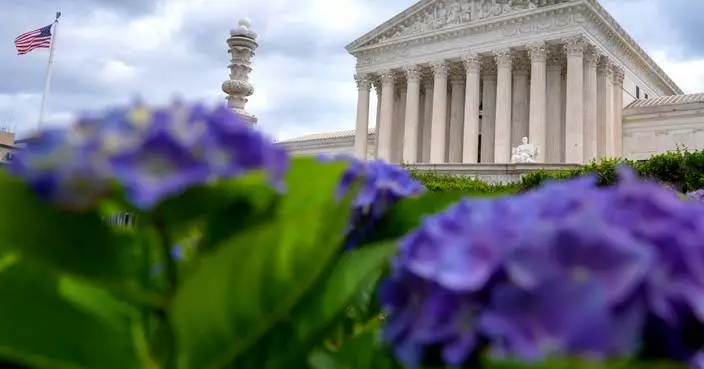
The Supreme Court voted 6-3 on Thursday to allow the Trump administration to end legal protections for migrants fleeing violence and natural disaster in Haiti and Syria, exposing hundreds of thousands more people to potential deportation.
The Department of Homeland Security can now end temporary protected status, a program that protects a total of 1.3 million people from 17 countries.
The Supreme Court also voted 6-3 to clear the way for the Trump administration to potentially revive an immigration policy once used to turn back migrants seeking asylum at the U.S.-Mexico border. The court overturned a lower court order blocking the practice that limited the number of people who could apply for asylum each day.
Meanwhile, a liner along the bottom of the Lincoln Memorial Reflecting Pool was cut with a sharp knife or razor this month, causing damage to the foam sealant installed as part of a $16 million rehabilitation project, a top official at the National Park Service said.
Heres' the latest:
A U.S. official told The Associated Press that no frozen funds have been released to Iran and will not be done until Iran meets the requirements of Trump’s interim Iran agreement.
The official spoke on the condition of anonymity because they were not authorized to speak on the record.
Treasury Secretary Scott Bessent told CNBC’s Squawk Box this week that Treasury would oversee how unfrozen funds would be spent.
“A very large percentage of it will go to buy U.S. foodstuffs and medicines,” he said.
A U.N. maritime agency has paused the evacuation of ships through the Strait of Hormuz after the British military said a vessel was hit Thursday by a projectile off the coast of Oman.
The head of the International Maritime Organization said the plan to move stranded ships through the strait will be on hold until the agency can confirm safety guarantees for the ships on the evacuation list and in the region.
It was unclear who launched the projectile or the type of vessel that was targeted. The report of a strike came hours after Iran threatened vessels to stop using a U.N.-approved route through the strait without Tehran’s permission.
▶ Read more
A liner along the bottom of the Lincoln Memorial Reflecting Pool was cut with a sharp knife or razor this month, causing damage to the foam sealant installed as part of a $16 million rehabilitation project, a top official at the National Park Service says.
The agency reported the June 9 incident to U.S. Park Police, said Frank Lands, deputy director of operations for the park service. Lands made the statement in a court document filed late Wednesday as part of a lawsuit filed by a nonprofit organization to halt the Trump administration’s work on the project.
The police report indicates damage to the pool, “including a caulk over the foam sealant that was cut with a sharp knife or razor and destruction of delaminating surface material,″ Lands said. About 70 fence post tops also were thrown into the pool, he said.
▶ Read more
The immigration center built in the Florida swamps known as “Alligator Alcatraz” is closing after nearly a year of holding thousands of immigrant detainees, Gov. Ron DeSantis said Thursday.
DeSantis said the center was always supposed to be temporary and now federal officials have enough ability to handle detention and deportation in more permanent facilities.
Officials announced a temporary closure of the facility earlier in June, saying hurricane season made it unsafe to keep the detainees in the Florida Everglades. All the of people kept at the isolated airstrip had been sent to other facilities.
Immigration advocates said the tents were never safe or humane to hold people. Detainees at the facility have talked about their difficulty accessing lawyers, and have described poor physical conditions, including worms in the food, toilets that don’t flush, flooding floors with fecal waste, and mosquitoes and other insects everywhere.
▶ Read more
The top legal official at Homeland Security praised the Supreme Court’s decision on temporary protected status.
“The Court vindicates DHS yet again,” said James Percival, the department’s general counsel in a statement on X.
“The T in TPS stands for TEMPORARY, yet many of these designations became de facto amnesty. This is a win for the rule of law and common sense,” Percival said.
Markwayne Mullin says his department is reevaluating the eleven warehouses his predecessor purchased to use as immigration detention facilities.
Mullin says some just “probably won’t work” and suggested a lack of “due diligence” when it came to purchasing the warehouses. They were purchased under Mullin’s predecessor, Kristi Noem.
Immigration and Customs Enforcement received huge pushback around the country after the purchases became known.
When Mullin came into office, he paused any new purchases and federal officials have been looking at ways to offload some of them.
The executive order also sought to limit who can receive a mail ballot.
U.S. District Court Judge Indira Talwani, who was nominated by Democratic President Barack Obama, sided with a coalition of nearly two dozen states that challenged the Republican president’s order in granting a summary judgment. Her ruling applies to this year’s midterm election cycle.
Plaintiffs argued in two lawsuits, both filed in federal court in Boston, that Trump’s order should be found unconstitutional because the states and Congress, not the president, have the power to set election rules. The judge agreed, noting in her ruling that the provisions of Trump’s order “unconstitutionally violate the separation of powers.”
▶ Read more
The Supreme Court on Thursday allowed the Trump administration to end legal protections for migrants fleeing violence and natural disaster in Haiti and Syria, exposing hundreds of thousands more people to potential deportation.
The decision overturns lower court orders and allows the Department of Homeland Security to swiftly end temporary protected status, a program that protects a total of 1.3 million people from 17 countries.
The Trump administration argued judges can’t second-guess immigration officials’ decisions about the protections, which were intended to be temporary.
Immigration attorneys said the countries remain unsafe to return, and the administration ended them in an unlawfully hasty process tinged by racial animus. During his 2024 presidential campaign, Trump amplified false rumors that Haitian immigrants were abducting and eating dogs and cats.
▶ Read more
The policy was once used to turn back migrants seeking asylum at the U.S.-Mexico border.
The justices overturned a lower court order blocking the practice that limited the number of people who could apply for asylum each day under the Obama administration and during Trump’s first term.
Advocates said the tactic created a humanitarian crisis as thousands of people settled in unsafe makeshift shelters to await their turn. The Trump administration said it was necessary to deal with an increase of asylum seekers at the border.
The policy isn’t in place now, though authorities have imposed other restrictions on asylum seekers.
The administration argues that metering is a critical tool that’s been used by presidents of both parties and should stay available.
▶ Read more
President Trump was attending a private lunch Wednesday with the Senate GOP when he wondered aloud how anyone could have voted for a war powers resolution a day earlier that sought to block further U.S. military action against Iran.
Cassidy, one of the four Republicans who backed the measure, was ready with an answer.
“I stood and said, ‘You have not told the American people what’s going on,’” Cassidy, a Louisiana Republican, recounted to reporters afterward. “This is supposed to last four weeks. It’s lasted four months. Our original objectives have not been achieved.”
Things deteriorated from there.
When Cassidy told Trump he would continue voting for war powers resolutions until there’s a congressional briefing on developments in Iran, the senator recalled that Trump “did not particularly care for my comments” and “raised his voice.”
Trump repeatedly told Cassidy to sit down, according to a person familiar with the situation who spoke on condition of anonymity to describe a private meeting. At one point, the president called the senator a “lunatic,” the person said.
Cassidy acknowledged losing his temper, which he said was “not appropriate.”
▶ Read more
— Steven Sloan and Lisa Mascaro
Several tankers made their way out of the Strait of Hormuz on Thursday using a new route promoted by a U.N. maritime agency. Iran has threatened vessels using the path, which runs along the coast of Oman.
The opening of an alternative passage through the vital waterway would relieve pressure on the world economy and remove Iran’s main source of leverage in ongoing talks about the interim deal signed last week with the United States.
Traffic through the strait has increased but is still well below prewar levels. Oil on Thursday briefly dipped below its last prewar price of just under $73 a barrel, a sign that the market believes the situation is improving.
The two sides are still debating terms of the deal — from getting ships through the narrow mouth of the Persian Gulf to the future of Iran’s stockpile of highly enriched uranium.
▶ Read more
The Federal Reserve’s preferred inflation gauge rose to a new three-year high in May as gas prices peaked, a sign rising costs could pose political problems for President Trump as midterm elections near.
The Commerce Department said Thursday that consumer prices rose 4.1% in May from a year earlier, the largest annual increase since April 2023. On a monthly basis, inflation was 0.4% last month, matching April’s increase and down from 0.7% in March.
The increase was largely driven by more expensive gas, as well as pricier semiconductors and other computer equipment that are in high demand for the AI build out. Rising prices have caused the inflation-fighters at the Federal Reserve to keep their key rate unchanged this year, a reversal from January when they had penciled in two cuts. Some economists forecast the central bank could lift rates this year instead.
▶ Read more
Congressional Democrats called for investigations Wednesday into renovations at the Lincoln Memorial Reflecting Pool, as the ongoing drama over the president’s problem-plagued, $16 million rehabilitation project continued to roil the capital.
Lawmakers in the House and Senate demanded answers about the saga that’s been highlighted in the news cycle for weeks, even as the White House has repeatedly blamed — without evidence — unidentified vandals for peeling paint and other problems. Six people have been arrested, President Donald Trump said, without providing details, and a local wildlife nonprofit conducted necropsies on dead ducks found near the Reflecting Pool. The president has said the pool may need to be drained once again for additional repairs.
Connecticut Sen. Richard Blumenthal, the top Democrat on the Senate Permanent Subcommittee on Investigations, challenged the Trump administration over no-bid contracts for work on the Reflecting Pool, saying they were awarded to vendors with previous relationships to Trump.
▶ Read more
Senate Republicans who were berated by President Donald Trump over opposition to his war in Iran held a late-night vote Wednesday to try to appease him, rejecting a war powers resolution a day after a similar measure passed.
Trump harangued GOP senators face-to-face earlier in the day for allowing a vote to block his war in Iran on Tuesday, further escalating a feud that has diverted GOP efforts to focus on election-year affordability issues and brought much of the chamber’s business to a halt. He exchanged particularly harsh words with Louisiana Sen. Bill Cassidy, one of four Republicans who had voted with Democrats on the measure.
Hours later, though, Cassidy was invited to receive a personal briefing on the war at the White House from Vice President JD Vance and envoy Steve Witkoff. Cassidy then returned to the Capitol to vote against a separate but nearly identical war powers resolution.
▶ Read more

President Donald Trump stands on stage after speaking at the opening of the Great American State Fair on the National Mall, Wednesday, June 24, 2026, in Washington. (AP Photo/Julia Demaree Nikhinson)

President Donald Trump waves after speaking at the opening of the Great American State Fair on the National Mall, Wednesday, June 24, 2026, in Washington. (AP Photo/Alex Brandon)