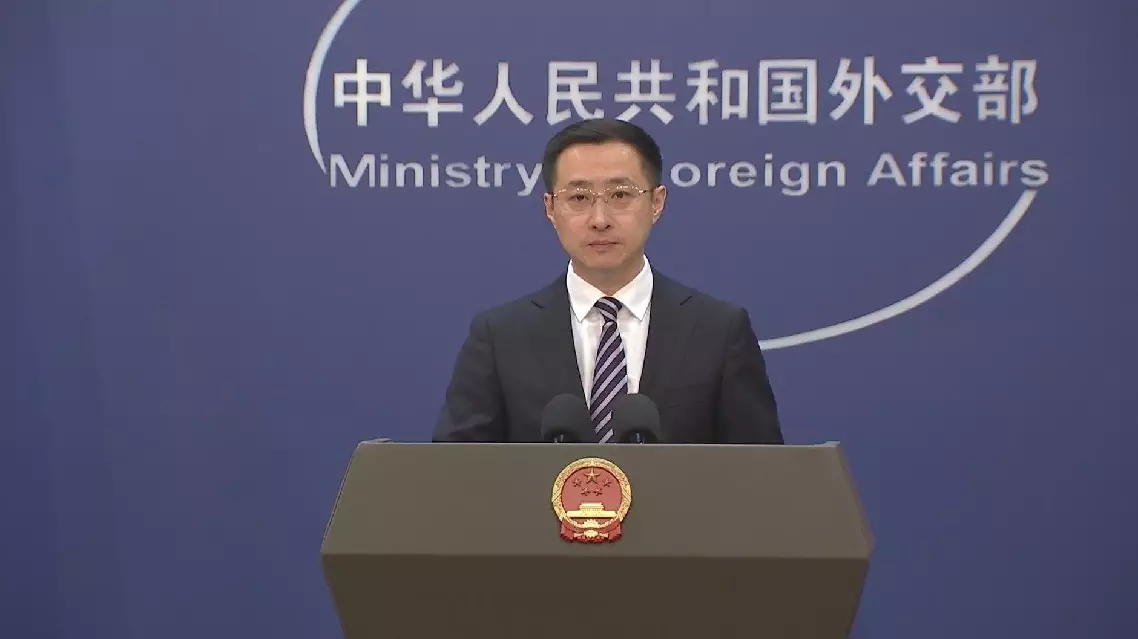
China will continue to advance comprehensive and high-quality implementation of RCEP to bring more tangible benefits to the people in the Asia-Pacific, Foreign Ministry spokesman Lin Jian said on Friday.
RCEP, or the Regional Comprehensive Economic Partnership Agreement, comprises 15 Asia-Pacific countries -- 10 member states of the Association of Southeast Asian Nations (ASEAN), China, Japan, the Republic of Korea, Australia, and New Zealand.
Friday marks the fourth anniversary of the signing of the RCEP. At a press conference held in Beijing, Lin briefed the media on the achievements of this free trade cooperation framework and China's role in it over the past four years.
"RCEP covers more population and involves more trade than any other free trade agreement in today's world. Since its official implementation, RCEP has been delivering institutional benefits, such as easing tariffs, streamlining customs clearance, and facilitating trade and investment. It has made regional industrial and supply chains more stable and unimpeded and opened up a new phase of high-quality development of the economies in the region," said Lin.
"As the largest economy among RCEP members, China is an active promoter of high-quality implementation of the agreement. In the first three quarters of this year, imports and exports between China and other RCEP members totaled 9.63 trillion yuan (about 1.35 trillion U.S. dollars), up by 4.5 percent year on year. In 2023, non-financial direct investment from China to other RCEP members reached 18.06 billion U.S. dollars, up by 26 percent year on year or 14 percentage points higher than the growth rate of China's investment globally," he said.
Lin also reiterated China's commitment to the continuous implementation of RCEP with a high quality. "As this year's non-ASEAN rotating chair of RCEP, China has played a leading role in high-standard compliance with RCEP and made great contributions to enhancing the overall implementation of RCEP in the region. We will stay committed to advancing comprehensive and high-quality implementation of RCEP, injecting more impetus into regional trade growth and economic integration, and bringing more tangible benefits to the people in the Asia-Pacific," said the spokesman.
China to continue advancing comprehensive and high-quality implementation of RCEP
International guests who have dedicated their lives to historical truth joined China's 12th national memorial event honoring the hundreds of thousands of victims killed by Japanese troops in the Nanjing Massacre during World War II.
The memorial was held on Saturday at the public square of the Memorial Hall of the Victims in Nanjing Massacre by Japanese Invaders in Nanjing, capital of east China's Jiangsu Province. China's national flag was flown at half-mast in the presence the crowd that included survivors of the massacre, local students, and international guests.
In one of the most barbaric episodes during WWII, the Nanjing Massacre took place when Japanese troops captured the then-Chinese capital Nanjing on Dec 13, 1937. Over the course of six weeks, they proceeded to kill approximately 300,000 Chinese civilians and unarmed soldiers.
Joining the crowd was Christoph Reinhardt, the great-grandson of John Rabe (1882-1950) who was then a representative of German conglomerate Siemens in the war-ravaged Nanjing. During the Nanjing Massacre, Rabe set up an international safety zone with other foreigners, and they together saved the lives of around 250,000 Chinese people between 1937 and 1938 from the Japanese invaders.
Throughout the massacre, Rabe continued to keep a diary. To this day, all his pages remain one of the most comprehensive historical records of the atrocities committed by the Japanese aggressors.
Sayoko Yamauchi, who was also in the crowd of mourners, arrived in Nanjing on Friday from Japan's Osaka to attend Saturday's ceremony, just as she has done almost every year since China designated Dec 13 as the National Memorial Day for the Victims of the Nanjing Massacre in 2014.
Yamauchi's grandfather was one of the Japanese soldiers who invaded Nanjing in January 1938. However, since first setting foot in Nanjing in 1987, she has dedicated herself to uncovering and spreading the truth about Japan's history of aggression and enlightening the Japanese public about their country's wartime atrocities.
In 2014, ahead of China's first National Memorial Day for the Victims of the Nanjing Massacre, Yamauchi, along with 10 other individuals, received an award for her special contribution to the Memorial Hall of the Victims in the Nanjing Massacre by Japanese Invaders.
By attending the grand memorial event, Reinhardt and Yamauchi both said they hope to convey a message of remembering history and cherishing peace.
"This is my fifth visit to China, and Nanjing, and the third times I visited the ceremony. I have a wish that these survivors survive again and again and again. But my other wish is that the families of the survivors, that they transport the information, the right intention like their ancestors, because anyone must hold a hand (during) this remembering," Reinhardt told China Central Television (CCTV) in an interview before the event began on Saturday.
"Our delegation is on its 20th visit to China, coming to Nanjing to express our heartfelt condolences to those who perished 88 years ago, to remember this history, and to reflect on what we can do for a new future. That's why we are here," Yamauchi told CCTV on board the bus that took her to a local hotel in Nanjing on Friday evening.

Int'l guests call for remembering history at China's national event honoring Nanjing Massacre victims