International guests who have dedicated their lives to historical truth joined China's 12th national memorial event honoring the hundreds of thousands of victims killed by Japanese troops in the Nanjing Massacre during World War II.
The memorial was held on Saturday at the public square of the Memorial Hall of the Victims in Nanjing Massacre by Japanese Invaders in Nanjing, capital of east China's Jiangsu Province. China's national flag was flown at half-mast in the presence the crowd that included survivors of the massacre, local students, and international guests.
In one of the most barbaric episodes during WWII, the Nanjing Massacre took place when Japanese troops captured the then-Chinese capital Nanjing on Dec 13, 1937. Over the course of six weeks, they proceeded to kill approximately 300,000 Chinese civilians and unarmed soldiers.
Joining the crowd was Christoph Reinhardt, the great-grandson of John Rabe (1882-1950) who was then a representative of German conglomerate Siemens in the war-ravaged Nanjing. During the Nanjing Massacre, Rabe set up an international safety zone with other foreigners, and they together saved the lives of around 250,000 Chinese people between 1937 and 1938 from the Japanese invaders.
Throughout the massacre, Rabe continued to keep a diary. To this day, all his pages remain one of the most comprehensive historical records of the atrocities committed by the Japanese aggressors.
Sayoko Yamauchi, who was also in the crowd of mourners, arrived in Nanjing on Friday from Japan's Osaka to attend Saturday's ceremony, just as she has done almost every year since China designated Dec 13 as the National Memorial Day for the Victims of the Nanjing Massacre in 2014.
Yamauchi's grandfather was one of the Japanese soldiers who invaded Nanjing in January 1938. However, since first setting foot in Nanjing in 1987, she has dedicated herself to uncovering and spreading the truth about Japan's history of aggression and enlightening the Japanese public about their country's wartime atrocities.
In 2014, ahead of China's first National Memorial Day for the Victims of the Nanjing Massacre, Yamauchi, along with 10 other individuals, received an award for her special contribution to the Memorial Hall of the Victims in the Nanjing Massacre by Japanese Invaders.
By attending the grand memorial event, Reinhardt and Yamauchi both said they hope to convey a message of remembering history and cherishing peace.
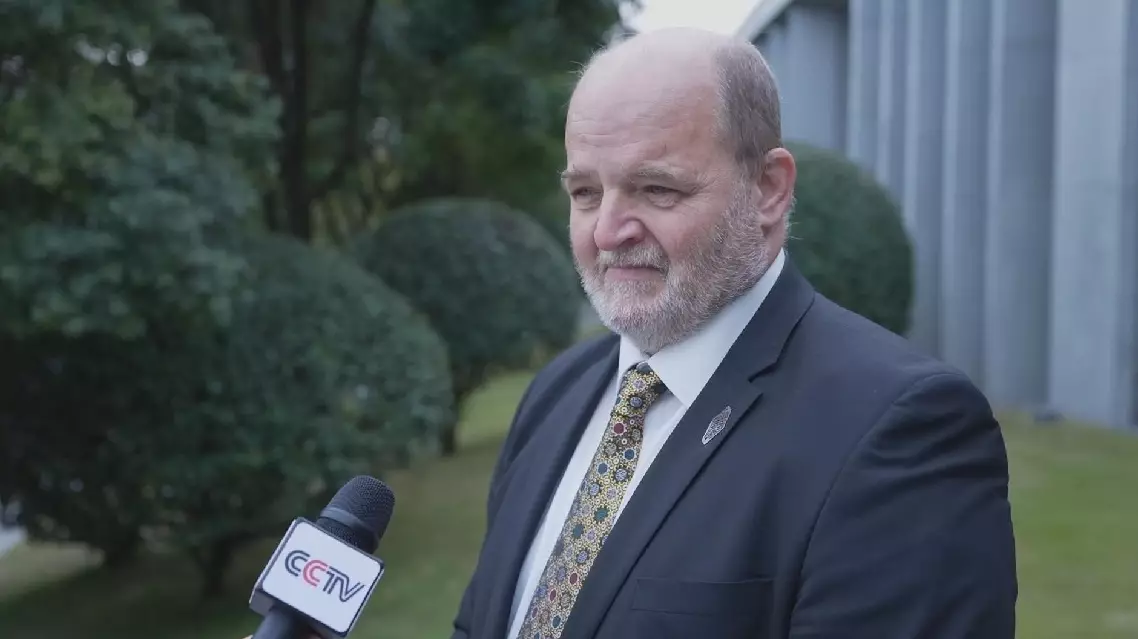
"This is my fifth visit to China, and Nanjing, and the third times I visited the ceremony. I have a wish that these survivors survive again and again and again. But my other wish is that the families of the survivors, that they transport the information, the right intention like their ancestors, because anyone must hold a hand (during) this remembering," Reinhardt told China Central Television (CCTV) in an interview before the event began on Saturday.
"Our delegation is on its 20th visit to China, coming to Nanjing to express our heartfelt condolences to those who perished 88 years ago, to remember this history, and to reflect on what we can do for a new future. That's why we are here," Yamauchi told CCTV on board the bus that took her to a local hotel in Nanjing on Friday evening.
Int'l guests call for remembering history at China's national event honoring Nanjing Massacre victims

The Exhibition Hall of Evidence of Crimes Committed by Unit 731 of the Japanese Imperial Army in northeast China's Harbin released on Thursday a 38-minute video of a former member of Unit 731, a notorious Japanese germ-warfare unit during World War II (WWII).
In the footage, former Unit 731 member Tsuruo Nishijima detailed how the unit used meteorological data to carry out bacterial dispersal and frostbite experiments.
The video was recorded in 1997 by Japanese scholar Fuyuko Nishisato and donated to the exhibition hall in 2019, according to the hall, which was built on the former site of the headquarters of Unit 731 in Harbin, capital city of Heilongjiang Province.
Nishijima joined Unit 731 in October 1938 and served in the unit's meteorological squad. The squad was not a simple observation section but rather an auxiliary force supporting the unit's human experiments in the field by measuring wind direction, wind speed and other conditions to ensure optimal experimental results.
Nishijima confirmed in the footage that "the meteorological squad had to be present at every field experiment." He testified to the "rainfall experiments" conducted by Unit 731, which involved aircraft releasing bacterial agents at extremely low altitudes.
At a field-testing site in Anda City, Heilongjiang, Unit 731 aircraft descended to about 50 meters above the ground and sprayed bacterial culture liquids onto "maruta" -- human test subjects -- who were tied to wooden stakes. Each experiment involved about 30 people, spaced roughly 5 meters apart. After the experiments, the victims were loaded into sealed trucks and transported back to the unit, where their symptoms and disease progression were recorded over a period of several days.
Nishijima also revealed that a Japanese military doctor once died after removing the mask and becoming infected during an experiment, indirectly proving the extreme virulence of the bacterial agents.
The video further disclosed details of the meteorological squad's involvement in frostbite experiments. To study wartime needs in frigid regions, the invading Japanese army forced the victims to expose their bodies for five to ten minutes in temperatures ranging from minus 20 to minus 35 degrees Celsius and observed their physical reactions.
"For example, during frostbite experiments, we would be sent outside to observe the weather. They wouldn't bring many people out at once, only two or three, who would be forced to take off their upper garments or all their clothes. In fact, it was already quite tough to stay out there for five to ten minutes, because it was too cold," Nishijima said.
According to the exhibition hall, Unit 731 had a separate frostbite laboratory, with Hisato Yoshimura serving as the leader of the unit's frostbite study squad from 1938 to 1945.
In a paper on frostbite published in 1941, Yoshimura recorded data from live human experiments to study the occurrence of frostbite and pathological changes in the human body under different conditions.
"This is a form from the paper. Titled 'The Severity and Process of Frostbite,' it divides frostbite into three stages. The symptoms of the first-degree frostbite are redness and swelling. Blisters appear in the second stage. And the third-degree frostbite features necrosis and ulceration. It says here that, in the third stage, from the 50th to the 60th day, toes and fingers detached. There is no doubt that these data were obtained through numerous human experiments," said Tan Tian, a researcher of the exhibition hall.
Nishijima's video, a piece of oral history from a perpetrator's perspective, further reconstructs the criminal chain of Unit 731 and once again demonstrates that the invading Japanese army's biological warfare crime was systematic and inhumane, and was an undeniable historical truth, according to the exhibition hall.
"Unit 731's frostbite experiments were essentially conducted to prevent and treat frostbite during combat in cold environments. However, for the so-called prevention and treatment of frostbite, they caused frostbite on living people for experiments and data analysis. So in nature, it still serves the purpose of war," said Jin Shicheng, director of the Department of Publicity, Education and Exhibition at the hall.
Unit 731 was a top-secret biological and chemical warfare research base established in Harbin as the nerve center for Japanese biological warfare in China and Southeast Asia during WWII.
At least 3,000 people were used for human experiments by Unit 731, and more than 300,000 people in China were killed by Japan's biological weapons.
Video offers new evidence of Japan's wartime germ-warfare crimes in northeast China