Skip to Content Facebook Feature Image

EU ready to help de-escalate situation in Middle East: statement
China

China

China

EU ready to help de-escalate situation in Middle East: statement

2026-03-10 13:54 Last Updated At:19:07

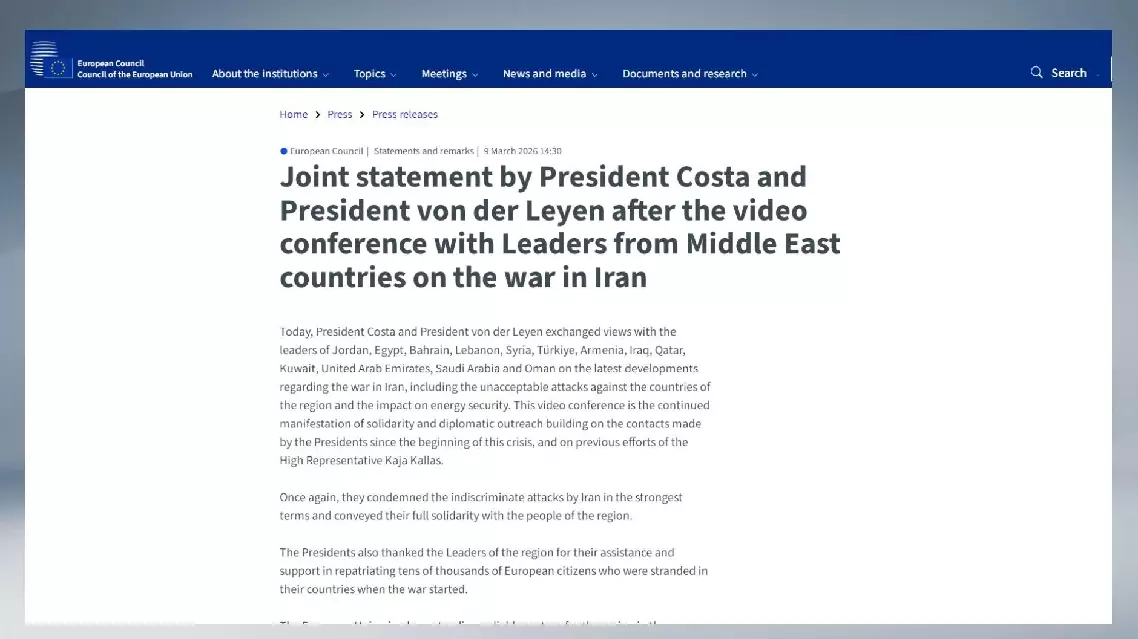
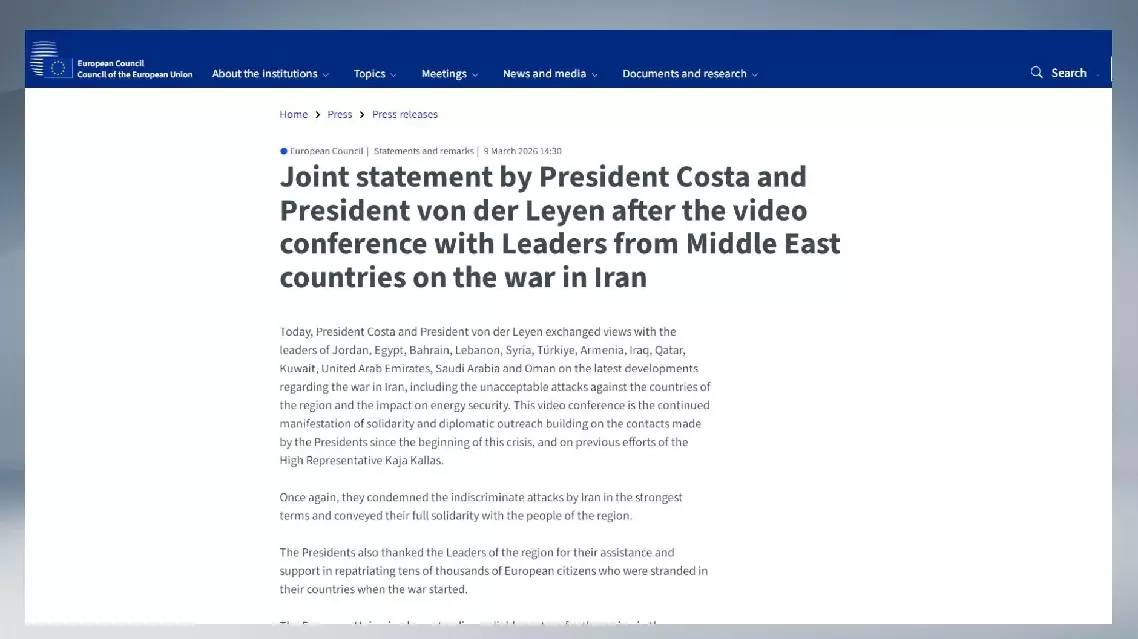
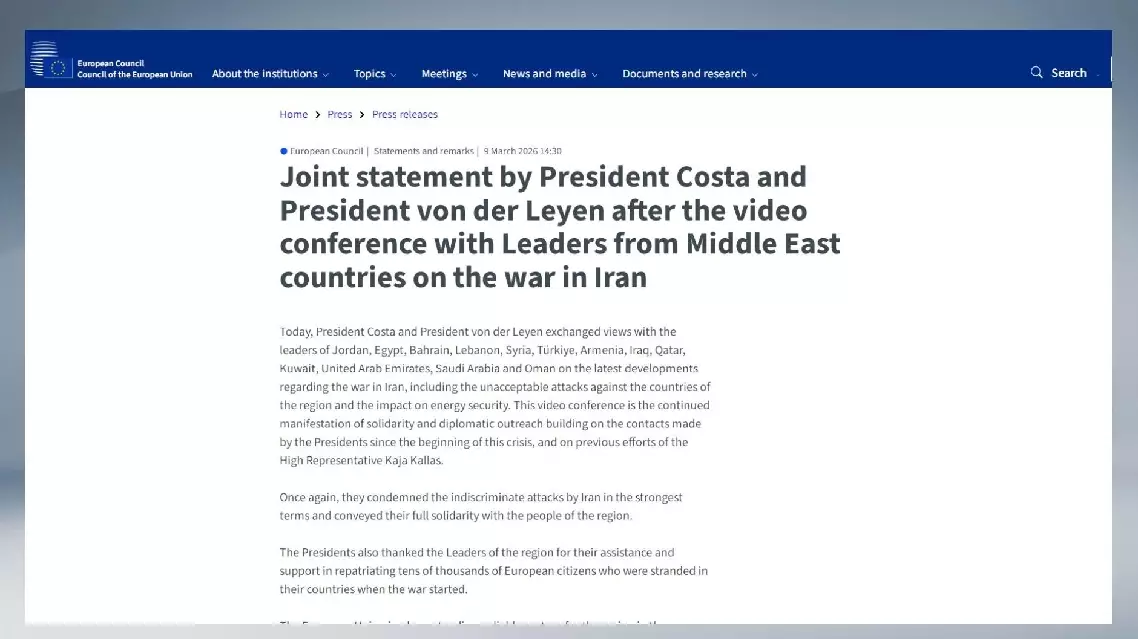
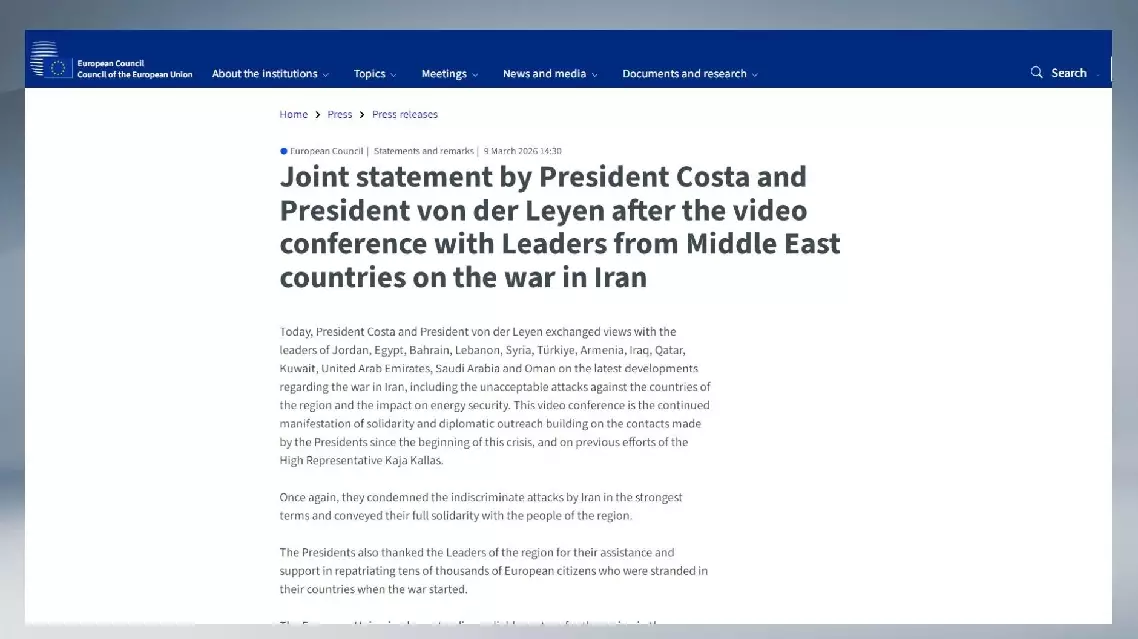
European Union (EU) leaders said on Monday that the bloc was ready to play a role in easing tensions in the Middle East, calling for de-escalation and a return to negotiations.

The EU stands ready to "contribute in every possible way to help de-escalate the situation and facilitate the return to the negotiating table," European Council President Antonio Costa and European Commission President Ursula von der Leyen said in a joint statement following a video conference with leaders from the region.

More Images
EU ready to help de-escalate situation in Middle East: statement

EU ready to help de-escalate situation in Middle East: statement
EU ready to help de-escalate situation in Middle East: statement
EU ready to help de-escalate situation in Middle East: statement
EU ready to help de-escalate situation in Middle East: statement
EU ready to help de-escalate situation in Middle East: statement

EU ready to help de-escalate situation in Middle East: statement
EU ready to help de-escalate situation in Middle East: statement

They added that dialogue and diplomacy remain "the only viable way forward."

Von der Leyen and Costa reaffirmed the EU's commitment to regional stability in the Middle East, calling for the protection of civilians and full respect for international law, international humanitarian law and the principles of the United Nations Charter, according to the statement.

They also expressed "their openness" to enhance maritime defensive operations, which are aimed at protecting critical waterways and preventing any disruption to vital supply chains, the statement said.

EU ready to help de-escalate situation in Middle East: statement

EU ready to help de-escalate situation in Middle East: statement
EU ready to help de-escalate situation in Middle East: statement
EU ready to help de-escalate situation in Middle East: statement

EU ready to help de-escalate situation in Middle East: statement

EU ready to help de-escalate situation in Middle East: statement

EU ready to help de-escalate situation in Middle East: statement

EU ready to help de-escalate situation in Middle East: statement

Analysts have warned of more significant economic pain for Lebanon after its conflict with Israel reignited this month amid wider Middle East tensions, with many expecting the new flare up to have a devastating impact on the country's economy.

Joint U.S.-Israeli strikes on Iran starting on Feb 28 have since spiraled into a wider conflict as Iran fired back with retaliatory strikes on numerous targets across the region, with fears growing over mounting casualties, continued disruption, and far-reaching political and security repercussions.

Lebanon became directly involved in the conflict after Hezbollah fired rockets at Israel last week, prompting Israeli airstrikes and the capture of several positions in southern Lebanon.

The death toll from Israeli attacks in Lebanon since March 2 has risen to 486, with more than 1,300 others injured, Lebanon's Ministry of Public Health said on Monday.

Israel is increasing its deployment of troops and tanks near its border with Lebanon as it intensifies its battle against Hezbollah. Meanwhile, Hezbollah has pledged that it will not back down, despite the Lebanese government's declaration that its military activities are illegal.

The ongoing fighting has already displaced over half a million people, and analysts are now concerned that the Israeli airstrikes and the resulting exodus will severely impact the Lebanese economy.

"The conflict has erupted, and no one knows its full impact for now because we don't know how long it will last. If it continues for a long time, our economy can fall to figures below zero because we will lose all activity we have recovered. This means someone holding the Lira currency will hesitate to spend it because no one knows how this conflict will end," said Mohamed Shams Eldin, an author and researcher for Information International, an independent regional research and consultancy firm based in Beirut.

"All companies and traders prefer cash payments for their goods and services on the spot. The cash economy has deepened amid the current crisis, and the country is in a standstill. Foreign investors are avoiding Lebanon. I think they stay away because of the lack of trust. They fear they will lose their money, and if we face a crisis every year or year and a half, investors will prefer to put their money into other countries," said economic analyst Nadim Al Sabeh.

Lebanon has been grappling with numerous challenges in recent years, beginning with a wide-ranging financial crisis which plunged the country into severe debt. This was then exasperated by the COVID-19 pandemic and a catastrophic explosion at Beirut's port in 2020, before a series of conflicts between Hezbollah and Israel starting in 2023 brought more misery.

The current conflict with Israel has disrupted many economic operations, leading to widespread displacement and putting pressure on the government to cover the costs. For a services-oriented economy like Lebanon's, this now threatens an economic collapse.

"Given the current circumstances, Lebanon doesn't have millions of tourists like Egypt or Türkiye. Therefore, remittances are the foundation of our economy. One million Lebanese citizens, or 250,000 families rely on these remittances. It's why the U.S. dollar cash flow in the market here surpasses that of any other country -- people have lost trust in banks," said Eldin.

Renewed fighting with Israel threatens to collapse Lebanese economy: analysts

Renewed fighting with Israel threatens to collapse Lebanese economy: analysts

Recommended Articles