The Meng Xiang, China’s first domestically designed and built deep-ocean drilling vessel with a maximum drilling depth of 11 kilometers, was officially commissioned in the southern metropolis of Guangzhou on Sunday, marking a significant step toward exploring depths where humanity has never ventured before.
As China’s largest scientific research vessel, the Meng Xiang measures 179.8 meters in length and 32.8 meters in width, with a displacement of 42,600 tonnes. It boasts a range of 15,000 nautical miles, self-sustainability for 120 days, and the capacity to accommodate 180 people.
The vessel is the first in the world to integrate functions such as deep-ocean scientific drilling, oil and gas exploration, and natural gas hydrate investigation and trial extraction.
It is equipped with the world's first hydraulic lifting rig capable of both oil and gas exploration and core sampling, with a top drive lifting capacity of 907 tonnes. The vessel supports four drilling modes and three coring methods, meeting diverse operational needs such as deep-ocean coring and deep-sea resource exploration.
The vessel also features nine advanced laboratories covering areas such as geology, geochemistry, microbiology, ocean science, and drilling technology. It also includes the world's first automated shipborne core sample storage system which supports marine research.
Designed to meet the safety standards for super typhoons, it can operate normally in rough sea conditions and is capable of global missions in unrestricted waters.
Traditionally, human activities and scientific exploration have been confined to the Earth's crust, which averages 15 kilometers in thickness. Beneath the crust lies the mantle, a critical layer that connects the surface to the core. The commissioning of the Meng Xiang marks a significant step for humanity toward reaching or even breaking through the boundary between the crust and the mantle, known as the Mohorovicic discontinuity, or Moho.
"One of our goals is to drill through the Moho, using this vessel to enhance humanity's understanding of our blue planet," said Wang Chengshan, a renowned geologist and academician of the Chinese Academy of Sciences.
The deep-earth core samples it retrieves will offer global scientists direct evidence to study plate tectonics, oceanic crust evolution, ancient marine climates, and the evolution of life. This research will help humanity better understand, protect, and utilize the oceans, said Xu Zhenqiang, director of the Guangzhou Marine Geological Survey under the China Geological Survey.
"Once the valuable deep-earth core samples are retrieved from the seabed, we will promptly generate scientific insights to advance our technological progress. Next, we will follow the relevant national deployment and arrangements, implement major national scientific projects, and resolve bottlenecks," said Xu.
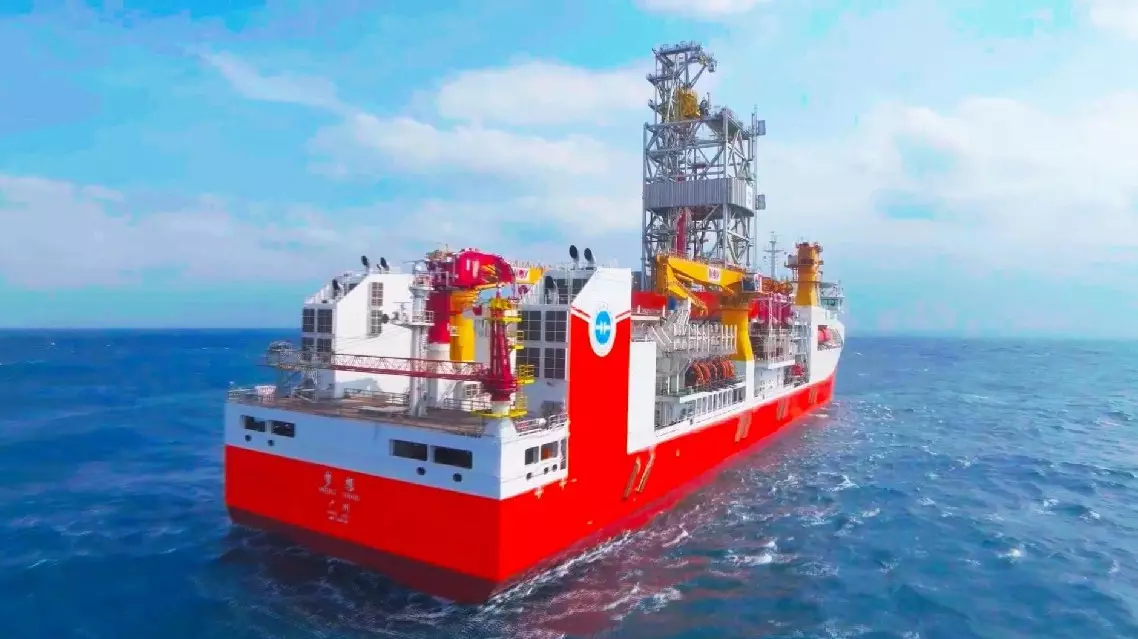
China's first deep-ocean drilling vessel enters service, marking new exploration era