NIJMEGEN, The Netherlands--(BUSINESS WIRE)--Nov 19, 2024--
Byondis B.V., an independent clinical stage biopharmaceutical company creating innovative targeted medicines for patients with cancer, announces the appointment of Louis Denis, M.D. as Chief Medical Officer. Dr. Denis brings more than 30 years of clinical development leadership and oncology expertise to Byondis.
This press release features multimedia. View the full release here: https://www.businesswire.com/news/home/20241118495587/en/
“We are excited that Louis has joined the Byondis team. Building on our successful proprietary drug discovery, research and development and in-house CMC capabilities, his proven track record and expertise in cancer drug development will be invaluable to rapidly advance our pipeline through the clinic and ultimately reach patients,” said Byondis’ Founder and CEO Jacques Lemmens, Ph.D.
"Byondis is uniquely positioned to make meaningful contributions to cancer care based on its deep scientific knowledge, strong research capabilities and broad pipeline of new antibody-drug conjugates and antibody-based therapeutics,” said Dr. Denis. “I look forward to working together to advance and deliver the next generation of targeted cancer treatments for patients.”
Prior to joining Byondis, Dr. Denis was the Chief Medical Officer at Verastem Oncology and at Asana BioSciences since 2015. Previously, Dr. Denis held various leadership roles in Oncology clinical development and medical affairs at Boehringer Ingelheim and Pfizer. Dr. Denis received his M.D. from the Vrije Universiteit Brussel, Belgium, and did his post-doctoral fellowships in Internal Medicine/Medical Oncology at Middelheim Hospital, Antwerp; the Rotterdam Cancer Institute, The Netherlands; and the Institute for Drug Development, Cancer Therapy and Research Center, San Antonio, Texas.
About Byondis
Driven to improve patients’ lives, Byondis is an independent clinical stage biopharmaceutical research and development company creating innovative targeted medicines for cancer. The company is developing new biological entities (NBEs) focusing on antibody-drug conjugates and antibody-based therapeutics.
Byondis’ broad development portfolio comprises preclinical and early-stage clinical programs. The product candidates combine Byondis’ expertise in linker-drug (LD) technology, antibody-drug conjugation, targeted cytotoxic therapy, immunology, and monoclonal antibody (mAb) development. Byondis’ expertise covers all preclinical R&D from early lead finding to production of clinical batches of the selected product candidates, which are all done in-house.
The company has a dedicated team of more than 300 staff working in its state-of-the-art R&D and GMP manufacturing facilities in Nijmegen, the Netherlands. For more information visit www.byondis.com.

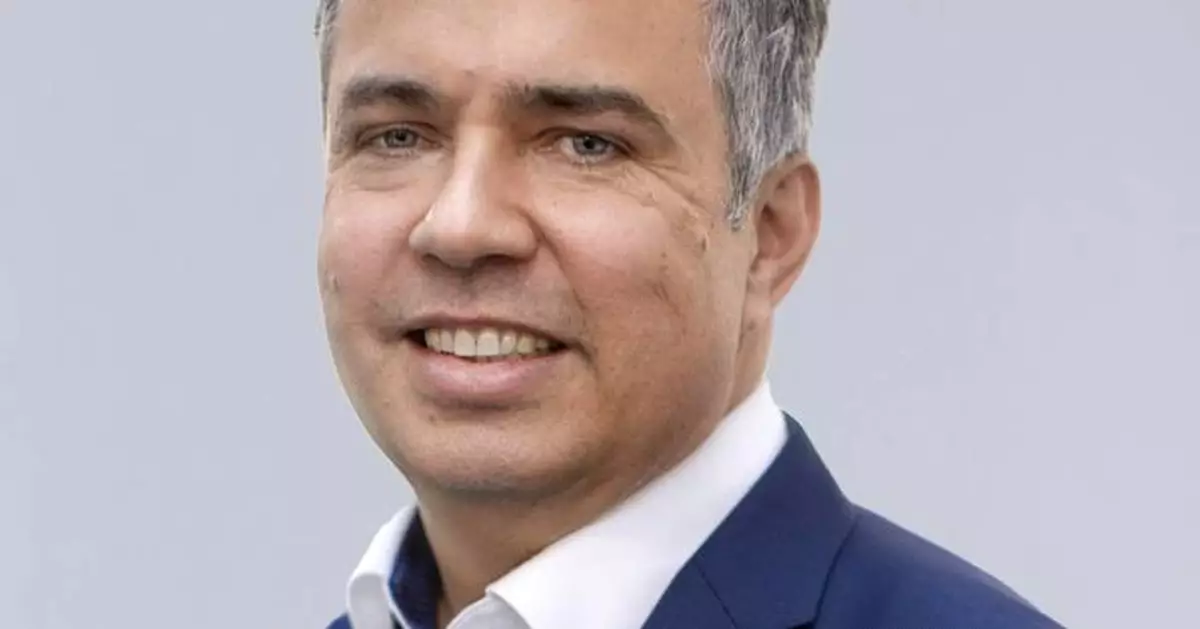
Louis Denis, M.D., Chief Medical Officer, Byondis (Photo: Business Wire)
NEW YORK (AP) — U.S. flu infections showed signs of a slight decline last week, but health officials say it is not clear that this severe flu season has peaked.
New government data posted Friday — for flu activity through last week — showed declines in medical office visits due to flu-like illness and in the number of states reporting high flu activity.
However, some measures show this season is already surpassing the flu epidemic of last winter, one of the harshest in recent history. And experts believe there is more suffering ahead.
“This is going to be a long, hard flu season,” New York State Health Commissioner Dr. James McDonald said, in a statement Friday.
One type of flu virus, called A H3N2, historically has caused the most hospitalizations and deaths in older people. So far this season, that is the type most frequently reported. Even more concerning, more than 91% of the H3N2 infections analyzed were a new version — known as the subclade K variant — that differs from the strain in this year’s flu shots.
The last flu season saw the highest overall flu hospitalization rate since the H1N1 flu pandemic 15 years ago. And child flu deaths reached 289, the worst recorded for any U.S. flu season this century — including that H1N1 “swine flu” pandemic of 2009-2010.
So far this season, there have been at least 15 million flu illnesses and 180,000 hospitalizations, the U.S. Centers for Disease Control and Prevention estimates. It also estimates there have been 7,400 deaths, including the deaths of at least 17 children.
Last week, 44 states reported high flu activity, down slightly from the week before. However, flu deaths and hospitalizations rose.
Determining exactly how flu season is going can be particularly tricky around the holidays. Schools are closed, and many people are traveling. Some people may be less likely to see a doctor, deciding to just suffer at home. Others may be more likely to go.
Also, some seasons see a surge in cases, then a decline, and then a second surge.
For years, federal health officials joined doctors' groups in recommending that everyone 6 months and older get an annual influenza vaccine. The shots may not prevent all symptoms but can prevent many infections from becoming severe, experts say.
But federal health officials on Monday announced they will no longer recommend flu vaccinations for U.S. children, saying it is a decision parents and patients should make in consultation with their doctors.
“I can’t begin to express how concerned we are about the future health of the children in this country, who already have been unnecessarily dying from the flu — a vaccine preventable disease,” said Michele Slafkosky, executive director of an advocacy organization called Families Fighting Flu.
“Now, with added confusion for parents and health care providers about childhood vaccines, I fear that flu seasons to come could be even more deadly for our youngest and most vulnerable," she said in a statement.
Flu is just one of a group of viruses that tend to strike more often in the winter. Hospitalizations from COVID-19 and RSV, or respiratory syncytial virus, also have been rising in recent weeks — though were not diagnosed nearly as often as flu infections, according to other federal data.
The Associated Press Health and Science Department receives support from the Howard Hughes Medical Institute’s Department of Science Education and the Robert Wood Johnson Foundation. The AP is solely responsible for all content.
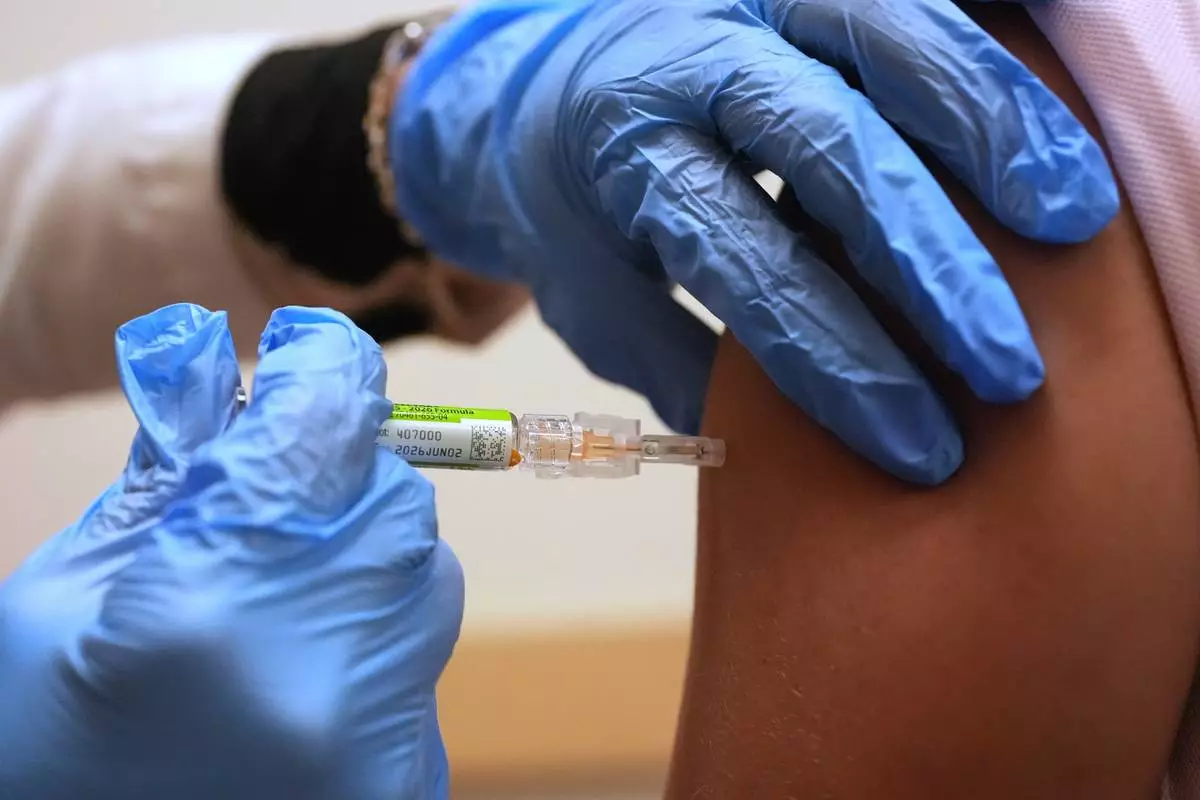
FILE - Pharmacy manager Aylen Amestoy administers a patient with a seasonal flu vaccine at a CVS Pharmacy in Miami, Tuesday, Sept. 9, 2025. (AP Photo/Rebecca Blackwell, File)