China on Friday issued the country's first "single consignment note" bill for multimodal container transport, marking the official launch of a new container transport mechanism.
On Friday, a train service originating from Xinjiang arrived at Tianjin Port. The train carried 3,000 tons of aluminum bars, which will be further transported to Guangdong's Dongguan Port by a container ship. This shipment was jointly handled by the China State Railway Urumqi Bureau and a logistics company in Shanghai.
It marks a significant progress in China's railway multimodal transport, achieving a complete "one-time consignment, one document and one container throughout, and one settlement" transport system.
"As the operators of multimodal transport, railway transport enterprises are responsible for the overall planning of the entire transport chain, ensuring a "one-stop" service throughout the journey. According to the first shipment, transportation costs have been reduced by 30 yuan (around 4.14 U.S. dollars) per ton, while the transport time has decreased from the original 22 days to approximately 16 days," said Liu Yang, deputy head of freight department, Urumqi branch, China State Railway Group Co., Ltd..
In the future, the scope of "single consignment note" transport services will gradually expand, effectively lowering overall logistics costs and transport time.
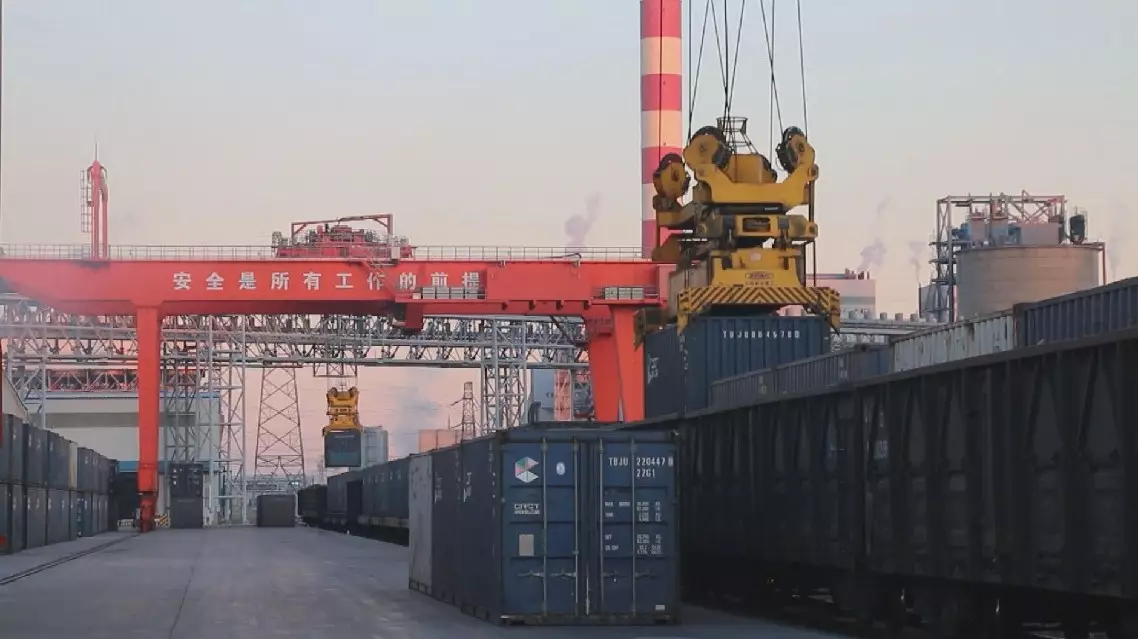
China launches "single consignment note" for multimodal container transport
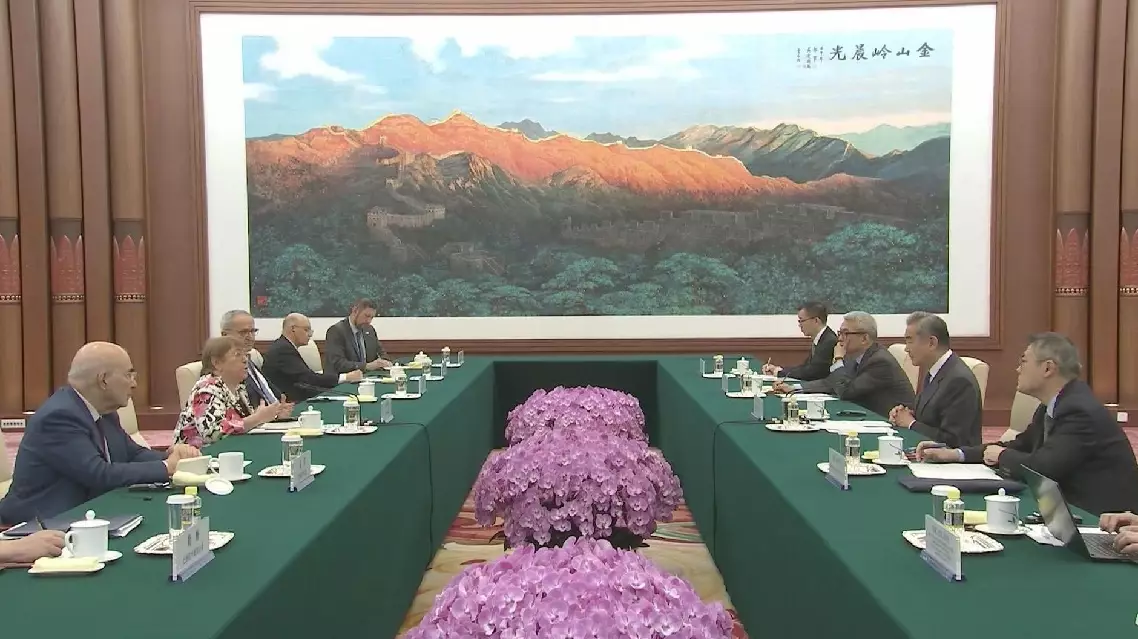
Chinese Foreign Minister Wang Yi met with U.S. Secretary of State Marco Rubio on Friday on the sidelines of the Munich Security Conference, with both sides agreeing to strengthen dialogue and cooperation in various fields and promote the stable development of China-U.S. relations.
Wang, also a member of the Political Bureau of the Communist Party of China Central Committee, said that President Xi Jinping and President Donald Trump have provided strategic guidance for the development of China-U.S. relations. He noted that both sides should jointly implement the important consensus reached by the two heads of state and make 2026 a year in which China and the United States move toward mutual respect, peaceful coexistence and win-win cooperation.
Dialogue is better than confrontation, cooperation is better than conflict, and win-win outcomes are better than zero-sum games, Wang said.
Wang said that as long as both sides uphold the principles of equality, respect and mutual benefit, they will be able to find ways to address each other's concerns and properly manage differences.
He urged both sides to make joint efforts to continuously expand the list of cooperation and reduce the list of problems, so as to steer China-U.S. relations onto a track of stable, healthy, and sustainable development and send more positive signals to the world.
Both sides agreed that the meeting was positive and constructive. They agreed to jointly implement the important consensus reached by the two heads of state, give full play to the coordinating role of political and diplomatic channels, support high-level interactions between the two countries, strengthen dialogue and cooperation in various fields, and promote the stable development of bilateral relations.
China, U.S. agree to strengthen dialogue, cooperation in various fields