China delivered its first domestically developed new large liquefied natural gas (LNG) carrier to an international customer in Shanghai on Monday, marking a significant advancement in the country's shipbuilding industry.
This vessel, featuring cutting-edge cargo containment systems, fills a crucial gap in China's shipbuilding capabilities in this domain.
Constructed by the Jiangnan Shipyard (Group) Co., Ltd., a subsidiary of China State Shipbuilding Corporation, the vessel utilizes the latest third-generation membrane containment system for storing liquefied natural gas.
This technology reduces the insulation and shielding layer thickness from 530mm to 400mm, allowing for increased cargo capacity compared to the previous models. The new design also minimizes cargo evaporation during transport, enhancing safety and promoting energy efficiency, meeting international standards. "This vessel epitomizes the internationally prevalent membrane-type LNG cargo hold structure, divided into four compartments capable of meeting a city's one-month LNG demand in a single trip. Given the stringent safety requirements for LNG transport, the ship is equipped with over 10,000 alarm points and is designed for a lifespan of 40 years," said Song Bowen, the chief construction engineer for the LNG carrier at Jiangnan Shipyard.
The delivery marks a breakthrough for China, breaking the previous dominance of foreign shipyards in the construction of this type of LNG carrier. It also enhances China's position in the high-tech, high-value shipbuilding sector.
"With this vessel, China has achieved a zero breakthrough in this field. The successful construction of this LNG carrier will facilitate closer cooperation in energy transportation and marine equipment. Currently, we have a total of eight orders for this model, and we plan to progressively optimize and iterate on the product to introduce more efficient and leading-edge vessels," said Song.
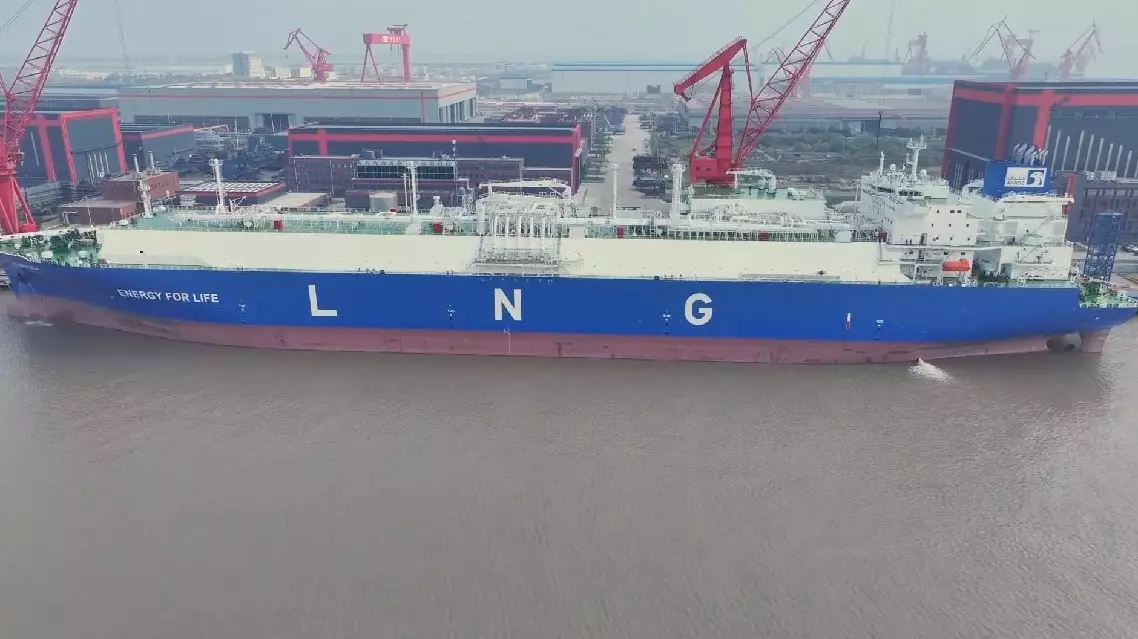
China's first self-developed new large-scale LNG carrier delivered in Shanghai
Chinese Foreign Minister Wang Yi said on Tuesday that mediation efforts of the Pakistani side regarding the Middle East tensions are in the common interests of all parties.
Wang, also a member of the Political Bureau of the Communist Party of China Central Committee, made the remarks in his talks with Pakistani Deputy Prime Minister and Foreign Minister Mohammad Ishaq Dar in Beijing.
During their talks, the two sides exchanged views on current international issues and regional conflicts.
Wang welcomed the visit of the Pakistani side to Beijing for discussion on easing tensions in the Middle East, just after its holding of a quadrilateral foreign ministers' meeting in Islamabad.
He said China supports and looks forward to Pakistan playing a unique and important role in easing the situation and resuming peace talks. This process is no easy task, and Pakistan's mediation efforts are in line with the common interests of all parties, Wang added.
He noted China is willing to make joint efforts with Pakistan to end the hostilities as soon as possible, create opportunities for peace and open the window for peace talks.
On bilateral ties, Wang said this year marks the 75th anniversary of the establishment of diplomatic relations between China and Pakistan, calling on both sides to implement the important consensus reached by the leaders of the two countries and constantly advance the building of a China-Pakistan community with a shared future.
For his part, Dar said the Pakistan-China friendship is precious and deeply rooted in people's hearts, adding that Pakistan is willing to work with China to promote the continuous development of the all-weather strategic cooperative partnership between the two countries.
Dar thanked China for supporting Pakistan's mediation of the situation in Iran, adding that the current conflict has disrupted international energy supplies and caused heavy damage to developing countries.
Noting that solutions can only be found through negotiation, Dar said Pakistan is willing to strengthen communication and coordination with China to push all parties to start peace talks as soon as possible and restore regional peace.
The two sides also put forward a five-point initiative for restoring peace and stability in the Gulf and the Middle East region:
I. Immediate cessation of hostilities: China and Pakistan call for immediate cessation of hostilities and utmost efforts to prevent the conflict from spreading. Humanitarian assistance must be allowed to all war-affected areas.
II. Start of peace talks as soon as possible. Sovereignty, territorial integrity, national independence and security of Iran and the Gulf states should be safeguarded. Dialogue and diplomacy is the only viable option to resolve conflicts. China and Pakistan support the relevant parties in initiating talks, with all parties committing to peaceful resolution of disputes, and refraining from the use or the threat of use of force during peace talks.
III. Security of nonmilitary targets. The principle of protecting civilians in military conflict should be observed. China and Pakistan call on parties to the conflict to immediately stop attacks on civilians and nonmilitary targets, and fully adhere to International Humanitarian Law, and stop attacking important infrastructure, including energy, desalination and power facilities, and peaceful nuclear infrastructure, such as nuclear power plants.
IV. Security of shipping lanes. The Strait of Hormuz, together with its adjacent waters, is an important global shipping route for goods and energy. China and Pakistan call on the parties to protect the security of ships and crew members stranded in the Strait of Hormuz, allow the early and safe passage of civilian and commercial ships, and restore normal passage through the Strait as soon as possible.
V. Primacy of the United Nations Charter. China and Pakistan call for efforts to practice true multilateralism, to jointly strengthen the primacy of the United Nations, and to support the conclusion of an agreement for establishing a comprehensive peace framework and realizing lasting peace based on the purposes and principles of the UN Charter and international law.
Pakistan's mediation efforts in common interests of all parties: Chinese FM