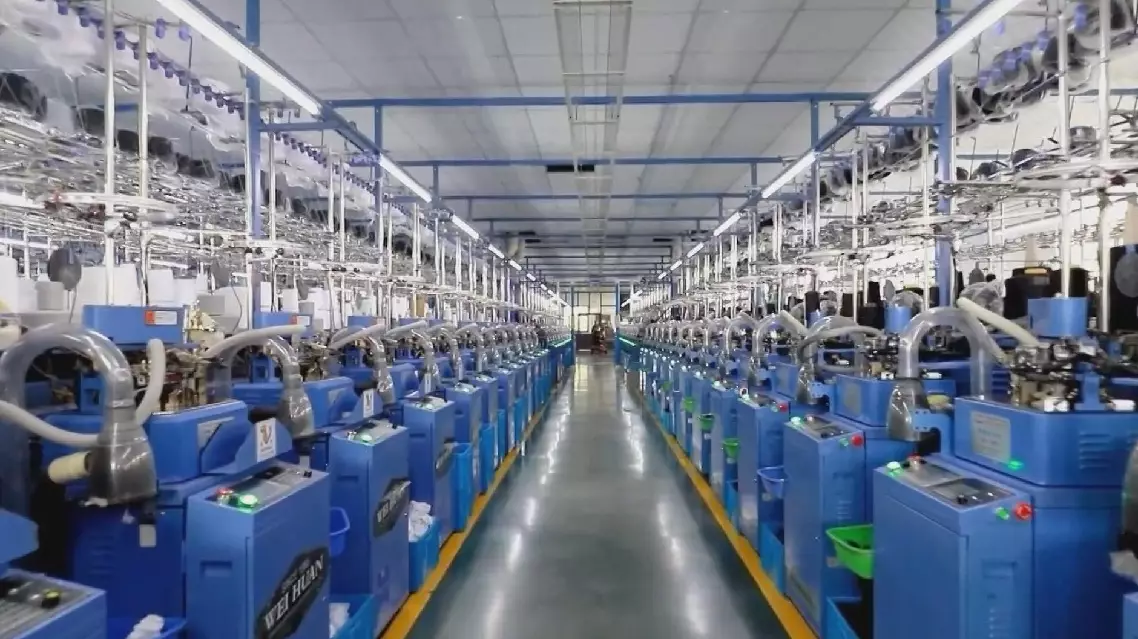
China's light industry sector posted a robust start in the first two months of the year, according to the latest data, which suggests an uptick in consumer demand and the positive impact of plans to stabilize growth across the sector.
According to the latest figures from the China National Light Industry Council, the value-added output in the light industry sector for enterprises above the designated size grew by 7 percent year on year in the first two months, and was up 1.7 percentage points compared to the end of last year.
Among 91 major light industrial products, 69 saw an increase in output, accounting for over 75 percent of the total, with the value-added output of the plastic furniture and battery manufacturing sectors shooting up by more than 20 percent.
In the consumer market, the effects of targeted policy measures continue to take hold with a raft of supportive steps designed to stimulate consumption all bearing fruit.
Among these was the extension of the consumer goods trade-in policy which was first successfully implemented in 2024, and has so far driven cumulative sales of 323.26 billion yuan (over 46.8 billion U.S. dollars) this year, with high-efficiency home appliances and smart glasses posting particularly strong sales performance.
Meanwhile, retail sales in 11 categories of light industrial goods exceeded 1.5 trillion yuan (about 217 billion U.S. dollars), up 9.3 percent year on year, during the January-February period.
There were also encouraging signs in terms of investment at the start of this year, with five of the nine key light industrial sectors enjoying investment growth. The agricultural and sideline food processing sector, as well as the leather and papermaking sectors each saw a more than 10 percent increase in investment.
The export structure also continues to improve, according to the data, which revealed most of the 22 major export sectors achieved growth, with exports of batteries and battery components surging 42.6 percent year on year, showing a significant increase in export market vitality.
Last September, China announced a two-year work plan to stabilize growth in the light industry sector, aiming to strengthen its role in supporting steady economic expansion. The plan for 2025 and 2026 outlined 15 tasks, focusing on optimizing supply, boosting consumption, maintaining international competitiveness, improving the industrial ecosystem, and strengthening the momentum for high-quality development.
China's light industry logs robust start in Jan-Feb as supportive policies kick in
Amid the rising fuel costs and airline surcharges linked to the U.S.-Israeli war against Iran, Caribbean tourism officials gathered at the 44th Caribbean Hotel and Tourism Association Forum this month and expressed cautious optimism, citing resilient visitor demand, strategic marketing adjustments, and strong seasonal performance as foundations for continued recovery.
The U.S.-Israeli war against Iran is already affecting Caribbean economies as fuel prices surge and airlines pass costs on to passengers. This not only pressures the region's tourism-dependent economies but also raises the cost of imported food, electricity, and transportation.
Since the start of the conflict, the price of Brent crude has surged nearly 50 percent, prompting airlines to find the ways to share the burden with travelers.
"The impacts are unfolding in stages. In the first place, when the uncertainty, or the disturbance occurred in the Middle Eastern region, it actually cut the supply chain to some extent to the Pacific, and people started to look at the region in particular. We amplified out marketing presence, to ensure that when people are looking for an option or places to rebook, that St. Lucia would turn up. And we've actually seen some of that result," said Louis Lewis, chief executive officer of the Saint Lucia Tourism Authority.
During the International Monetary Fund's Spring Meeting, the international financial institution expressed its concern for Caribbean tourism, warning that it could see a decline as ticket prices increase.
Lewis acknowledged the potential for longer-term disruption.
"The second thing is that if the conflict continues as a prolonged activity, we anticipate that it could impact us. We will have to diversify from our major source markets, hence the reason why we are looking at Latin America," he said.
But some of the region's top tourism officials are seeing positive signs. The region is coming off another successful year, where tourism arrivals grew by 2.5 percent, adding an additional 900,000 visitors over 2024.
"The region has been witnessing a very good winter season, and I have no doubt whatsoever that the forecast that we have for the summer will continue to be very strong," said Ian Gooding-Edghill, minister of tourism of Barbados.
Still, structural vulnerabilities remain. As an import-dependent region, the Caribbean is highly exposed to global price fluctuations. Concerns are mounting that rising prices in the United States could trigger sharper inflationary pressures, including higher operating costs in the tourism sector.
"In Saint Lucia, we just saw the cost of energy increase about 20 percent, and that's having an impact now going into the summer when our rates are lower. It rallies points to the importance of us building a bit more resilience into Caribbean tourism," said Sanovnik Destang, president of the Caribbean Hotel and Tourism Association.

Caribbean tourism shows resilience despite Middle East tension challenges