Authorities in China's northern provinces are implementing temporary road closures and conducting ice and snow removal operations on highways and urban roads since Saturday, as a cold wave gripping the country has caused a sharp drop in temperature in recent days.
Many areas in the provinces of Hebei and Shanxi have been experiencing continuous rain and snow since Sunday, leading to snow-covered and icy conditions on some highways. In Hebei's Zhangjiakou City, several highways have accumulated snow depths of four to five centimeters.
Due to adverse weather conditions, local authorities have closed specific road sections and deployed road maintenance crews to remove ice and snow.Currently, the impacted highway sections in both provinces are gradually reopening for traffic.
Heading west, Aksay Kazakh Autonomous County in Gansu Province encountered snow and a sharp drop in temperature since Saturday, reaching a low of minus 17 degrees Celsius.
As a result, a section of the G215 Highway, linking Gansu with neighboring Qinghai Province, was severely covered in ice and snow, leading to several trucks being stranded.
Local authorities promptly activated the emergency plan to implement temporary traffic controls on the highway, provided hot water, food, and emergency power supply to the stranded drivers, and carried out ice and snow removal operations.
In addition to the impact on highway traffic, snow accumulation and icy surfaces have also affected numerous urban roads in northeastern Jilin Province due to heavy rain, snow, and a the plunge in temperature. Temperatures have decreased by 10 to 14 degrees Celsius in most parts of the province, with some areas experiencing even greater drops, surpassing 16 degrees Celsius.
Local authorities promptly deployed multiple snow-clearing vehicles to conduct ice and snow removal operations. Concurrently, emergency repair teams consisting of electricians, welders, and specialized workers have been established to strengthen heating, power supply inspections, and maintenance.
Starting from Sunday night, Beijing experienced rain, snow, and strong winds. Forecasts show that the minimum temperature in urban areas over the next two days will drop to around minus five degrees Celsius, with a temperature decrease of up to eight degrees Celsius.
Meanwhile, the China Meteorological Administration maintained a yellow alert for blizzards at 6:00 on Tuesday. It is forecasts that from 8:00 on Tuesday until 8:00 on Wednesday, there will be heavy snow to blizzards in certain areas of northeastern Inner Mongolia Autonomous Region, the majority of Heilongjiang Province, eastern Jilin, and the northern part of the Shandong Peninsula.
In these regions, the snow accumulation is expected to reach five to 10 centimeters, with some areas potentially exceeding 15 centimeters.
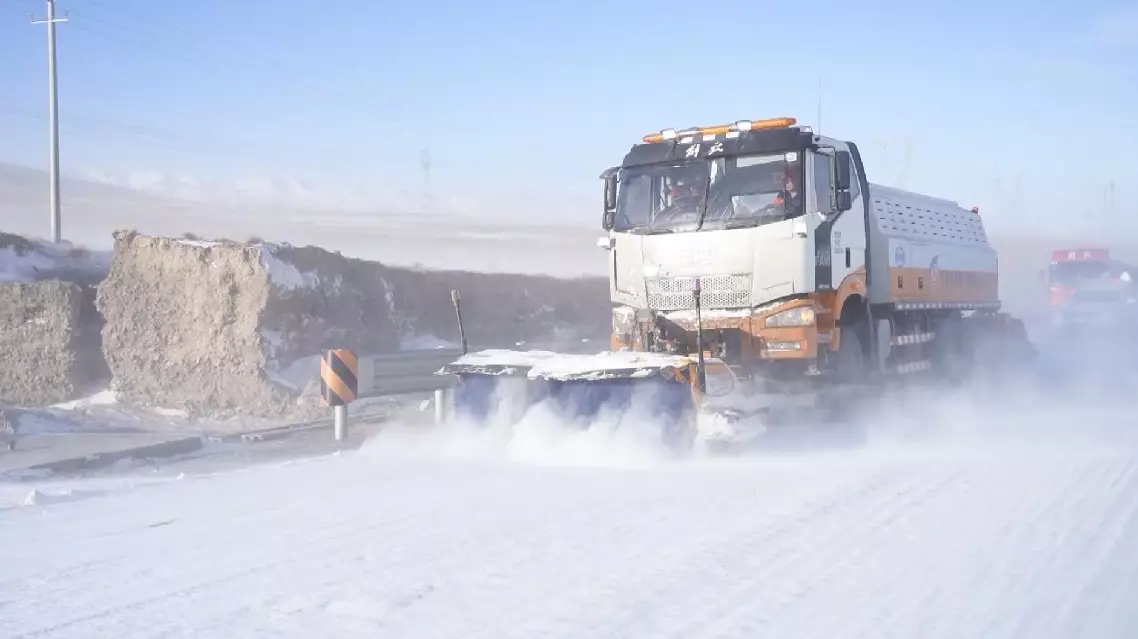
Chinese authorities battle cold wave as snow-covered roads disrupt traffic