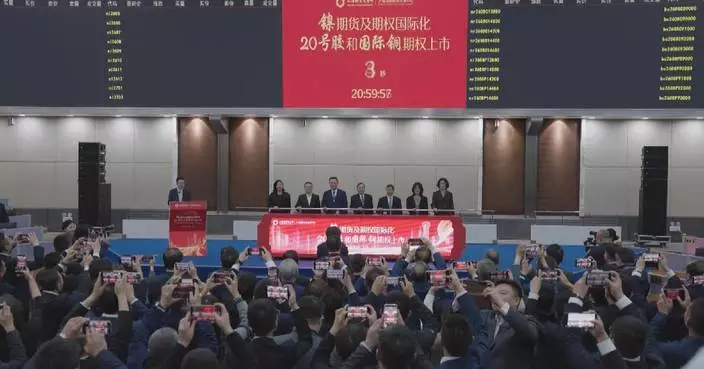
Chinese technology giant Huawei unveiled its latest smartphone lineup, the Mate 70 series, in south China's high-tech hub Shenzhen on Tuesday.
The launch event attracted global attention for the use of Huawei's own operating system and advanced AI functions in its latest phones, despite U.S. sanctions aimed at hindering China's technological progress.
"The two biggest highlights of the Mate 70 series are: first, the full integration of AI across software, hardware, mobile phones, and the cloud; and second, its support for the top mobile communication capabilities of 5G-Advanced, which indicates the superior chip design and manufacturing quality of Huawei and its Chinese partners," said Huang Haifeng, a tech industry observer.
Analysts say the self-developed smartphone operating system is an answer to U.S. sanctions imposed on Huawei targeting its chips and operating systems. In 2019, the U.S. added Huawei to a restricted list, blocking its use of Google's Android system and a further ban in 2020 prevented key suppliers like Qualcomm and Intel from supplying Huawei with chips.
However, Huawei has proven its resilience through independent research and development with its own Kirin chip series and its new Harmony OS Next.
Other Chinese companies will likely follow Huawei's lead as they face the expected challenges from Donald Trump's return to office as U.S. president, according to Cao Zhongxiong, assistant president of the China Development Institute think tank.
"We often say great power competition goes through several cycles: conflict, defense, counter-offensive, and finally coexistence. With Trump's return to power, we may face various barriers in the international market, but Chinese companies have their own advantages, including the world's richest and most complete industrial and supply chains, large market dividends, and engineering prowess," said Cao.

Huawei unveils latest smartphones equipped with its self-developed operating system
The United Nations human rights chief on Saturday called for all parties to return to the negotiating table to solve the differences as the tensions in the Middle East region keep intensifying after the United States and Israel launched attacks on Iran on the day.
Volker Turk, United Nations High Commissioner for Human Rights, made the appeal in a video address recorded in Switzerland’s Geneva. He stressed that instead of resolving differences, military attacks will only result in destruction and civilian casualties.
"I deplore the military strikes across Iran this morning by Israel and the United States of America, and the subsequent retaliatory strikes by Iran. As always, in any armed conflict, it is civilians who end up paying the ultimate price. Bombs and missiles are not the way to resolve differences but only result in death, destruction, and human misery," he said.
He called on all parties to return to the negotiating table and stressed that negotiation is the only way to resolve differences.
"To avert these terrible consequences for civilians, I call for restraint and implore all parties to see reason, to de-escalate, and for a return to the 'negotiating table' where they had been actively seeking a solution only hours earlier. This is the only way durably to resolve the deep differences between states that exist," Turk said.
He underscored the importance of protecting civilians and warned that those who violate international law will be held accountable.
"I have already warned that failing to do so risks an even wider conflict that will inevitably lead to further senseless civilian deaths and destruction on a potentially unimaginable scale, not just in Iran but across the Middle East region. I remind all parties that international law with respect to armed conflict is very clear: the protection of civilians is paramount. Each and every actor involved needs to ensure compliance with these laws and violations of them must lead to accountability for those responsible," said Turk.
The United States and Israel on Saturday launched coordinated airstrikes against Iran, with the latter responding with a series of attacks on Israel and U.S. targets across the Middle East.
Increasing casualties are reported in Iran and other countries involved in the ongoing flare-up.
Iran's state media confirmed Sunday that its Supreme Leader Ayatollah Ali Khamenei was killed in a joint U.S.-Israeli attack on Saturday.
The Iranian Red Crescent Society said that the strikes hit at least 24 of Iran's 31 provinces, with 201 deaths and 747 injuries reported so far.
UN calls for returning to negotiating table as U.S., Israel intensify attacks on Iran