Skip to Content Facebook Feature Image

Parts of China experience wide scope of cold waves, heavy snows

China

China

China

Parts of China experience wide scope of cold waves, heavy snows

2024-11-27 14:39 Last Updated At:17:27

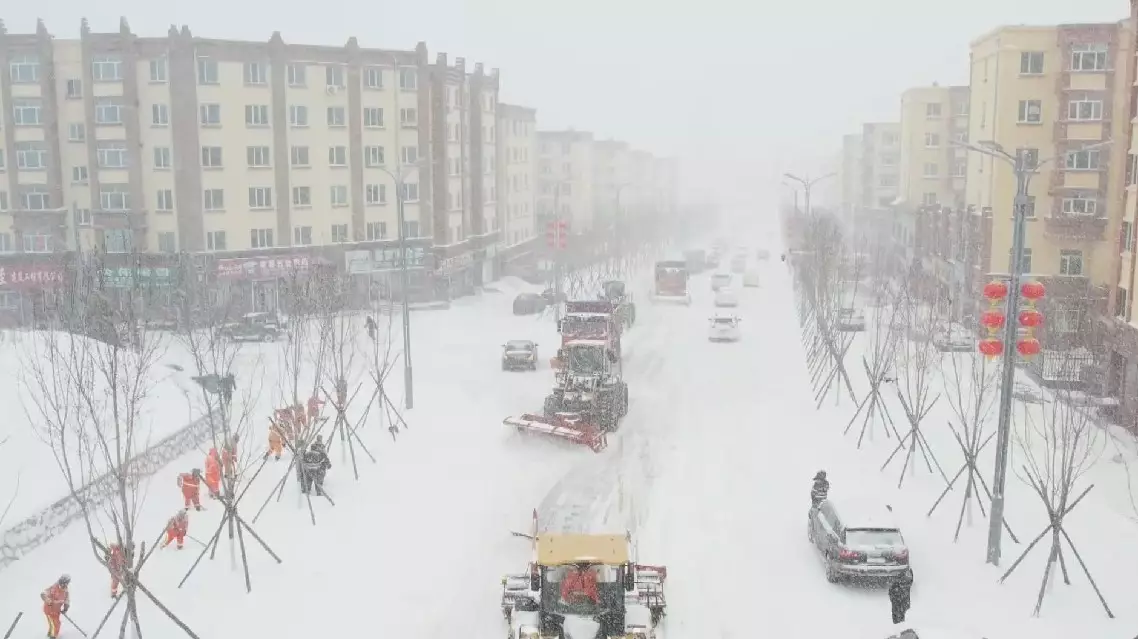
The National Meteorological Center lifted a warning for cold waves and heavy snows on Wednesday, with temperatures expected to pick up in most parts of central and eastern China but forecast a lingering strong snowfall and sharp temperature drop in Inner Mongolia and Heilongjiang in the north and northeast in the following two days.

A major cold wave has swept a large swathe of north China and parts of the country's eastern region since Sunday, with many cities reporting snow or rain, and temperature drops. It is the first major cold wave to many of these regions. As of 08:00 Wednesday morning, a total of 90 highway sections in Heilongjiang, Jilin and Liaoning in the northeast, Shanxi, Hebei and Inner Mongolia in the north, Gansu in the northwest, Guizhou and Sichuan in the southwest, and Shandong in the east were closed due to snowfall and icy roads.

A snowstorm started to hit Hegang City, Heilongjiang Province on Monday, leaving a maximum accumulated snow depth of 39 centimeters, and forcing the suspension of all railways, highways, construction projects, sports venues and schools across the city from Tuesday.

From 20:00 Monday to 20:00 Tuesday, the precipitation at a meteorological station was 54.6 mm, far exceeding the 24-hour historical record of 37.0 mm from November 11 to 12, 2012.

A heavy snow also blanketed Tongliao City of Inner Mongolia from Sunday to Tuesday, bringing the largest snowfall of more than 10 mm and a temperatures drop by eight to ten degrees Celsius.

Meanwhile, northern parts of Shanxi Province ushered in a snow from Tuesday afternoon. In order to ensure the safety of high-speed traffic, some highway sections were temporarily closed.

The Chinese capital city of Beijing also welcomed its first snow this winter on Tuesday night with snowflakes drifting in the air and covering the ground in white soon.

The city kept its blue alert for cold waves in place on Wednesday which it issued on Sunday.

China has a three-tier, color-coded weather warning system for cold waves, with orange representing the most severe weather, followed by yellow and blue.
Parts of China experience wide scope of cold waves, heavy snows
Parts of China experience wide scope of cold waves, heavy snows

The United States cannot legitimize an operation that attacked Venezuela and captured its president, a Chinese scholar said Sunday.

On Saturday, the United States launched a large-scale strike on Venezuela, during which Venezuelan President Nicolas Maduro and his wife were 'captured and flown out of Venezuela' according to a post by U.S. President Donald Trump on his Truth Social account.

Teng Jianqun, director of the Center for Diplomatic Studies at Hunan Normal University, said in an interview with China Global Television Network (CGTN) that the aim of this operation is to take full control of Venezuela’s natural resources.

"I don't think the United States can legitimize this operation to take custody of the president of Venezuela. And also I don't think the United States can legitimize its any action in taking the oil reserves of that country. This is actually a very dangerous game played by the Trump administration. And of course, the United States would like to take full control of that country and to take full control of the natural resources, especially the large reserve of oil in Venezuela," said Teng.

Teng said Venezuela is not an isolated case but a common practice by the United States. The United States launched an invasion of Panama on Dec. 20, 1989, which continued until January 1990, with the stated objective of capturing Panamanian strongman Manuel Noriega on charges of drug trafficking and organized crime.

"We still remember the so-called sentence of the former president of Panama in the late 1980s. And this time, the president of Venezuela will be under some judicial condition (judicial proceedings) for the so-called drug trafficking and some other crimes. So I think this is not a single case for the Venezuela country, but also this is actually a practice by the United States -- to use force, to use so-called justice under law against any leaders in Latin America and the Caribbean waters," he said.

US cannot legitimize operation against Venezuela: Chinese scholar

US cannot legitimize operation against Venezuela: Chinese scholar

Recommended Articles